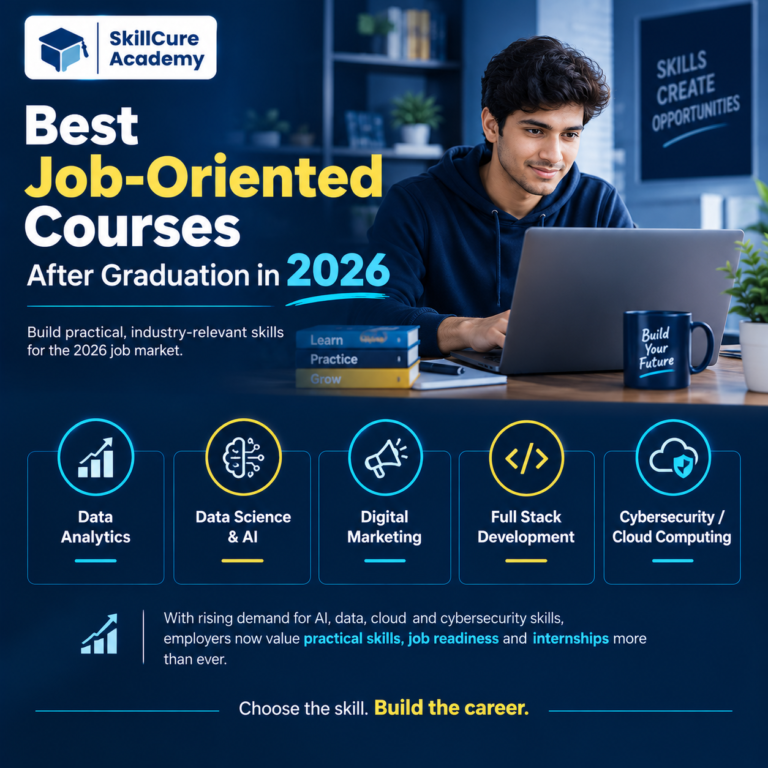

The job market is evolving faster than ever. Automation, artificial intelligence, and data-driven decision-making are no longer optional skills—they are becoming the foundation of most careers. For students and working professionals alike, choosing the right learning path is critical. This blog explores the Best career courses in 2026, explains why these courses matter, and highlights how learners can prepare themselves for long-term career growth.
Why 2026 is a turning point for careers
By 2026, companies are expected to prioritize skills over traditional degrees. Employers want professionals who can adapt, learn quickly, and solve real business problems. This shift has increased the value of career-focused courses that are practical, industry-aligned, and outcome-driven.
Instead of general education, learners are now looking for:
- Job-ready skills
- Hands-on experience
- Clear career pathways
This is why selecting from the Best career courses in 2026 can directly influence employability, salary growth, and job stability.
Major skill trends shaping careers in 2026
Understanding skill trends helps learners avoid outdated courses and focus on future-proof options.
Technology-driven skills
Technology continues to dominate hiring needs across industries. Even non-technical roles now require a basic understanding of digital tools and data.
Business and analytical thinking
Companies value professionals who can analyze information, understand customers, and support decision-making with data rather than assumptions.
Hybrid skill sets
The strongest candidates combine two or more skill areas, such as marketing with analytics or management with technology.
Best career-oriented courses to pursue in 2026
Below are some of the most valuable course options aligned with market demand and career growth.
Digital marketing and performance marketing
Digital marketing remains one of the fastest-growing career fields. Businesses need experts who can generate leads, increase brand visibility, and drive online sales.
Key learning areas include:
- Search engine optimization (SEO)
- Social media marketing
- Paid advertising (Google Ads & Meta Ads)
- Content strategy and analytics
This course suits creative thinkers as well as data-driven professionals.
Data analytics and business intelligence
Data analytics helps organizations make smarter decisions. Professionals trained in this field can work across finance, healthcare, marketing, and operations.
Important skills covered:
- Excel and advanced spreadsheets
- SQL for data querying
- Power BI or Tableau
- Data interpretation and reporting
Artificial intelligence and machine learning
AI is no longer limited to research labs. It is now part of customer support, marketing, finance, and operations. Courses in AI focus on practical use cases rather than theory alone.
Common topics include:
- Basics of machine learning
- Generative AI tools
- Prompt engineering
- AI applications in business
Web development and software fundamentals
Every digital product relies on developers. Web development courses continue to offer strong career opportunities, especially for learners who enjoy logic and problem-solving.
Core areas usually include:
- HTML, CSS, and JavaScript
- Front-end frameworks
- Basic back-end concepts
- Website deployment
Cybersecurity and ethical hacking
As digital systems grow, so do security risks. Cybersecurity professionals help protect data, systems, and user privacy.
Learners gain exposure to:
- Network security basics
- Threat detection
- Ethical hacking concepts
- Risk and compliance fundamentals
Comparison table of popular career courses in 2026
| Course Category | Primary Skills Learned | Career Opportunities | Ideal For |
| Digital Marketing | SEO, ads, analytics, content | Digital marketer, growth manager | Creative & analytical minds |
| Data Analytics | Excel, SQL, BI tools | Data analyst, business analyst | Logical problem-solvers |
| Artificial Intelligence | AI tools, ML basics | AI analyst, automation specialist | Tech-focused learners |
| Web Development | Front-end & basics of back-end | Web developer, UI developer | Coding enthusiasts |
| Cybersecurity | Security tools, risk management | Security analyst, SOC analyst | Detail-oriented professionals |
How learners should choose the right course
Choosing a course should never be based only on trends. A structured decision-making approach leads to better outcomes.
Learners should evaluate:
- Current skill level (beginner or experienced)
- Career goals for the next 3–5 years
- Industry demand and growth potential
- Course structure and practical exposure
Courses that include live projects, mentorship, and placement support usually deliver better results than purely theoretical programs.
Career readiness beyond certificates
While certifications help open doors, long-term success depends on continuous learning and adaptability. Employers increasingly value:
- Problem-solving ability
- Communication skills
- Willingness to learn new tools
The Best career courses in 2026 are those that focus not just on knowledge, but on real-world application and confidence building.
Why choose Skillcure Academy in the last section
For learners looking for structured, career-focused education, Skillcure Academy stands out as a reliable training institute. The academy focuses on practical learning, industry-relevant curriculum, and clear career outcomes.
Top Career Options in 2026: A Complete Guide for Future-Ready Professionals
The employment landscape is transforming rapidly due to automation, artificial intelligence, and digital expansion across industries. Traditional job roles are evolving, and new careers are emerging that demand modern, practical skills. For students and working professionals, understanding the Top career options in 2026 is essential for building a stable and growth-oriented career.
This blog explains the most promising career paths, the skills required for each, and how learners can prepare themselves for long-term success.
Why Career Planning Is Critical for 2026
Career planning is no longer limited to choosing a degree. By 2026, employers are expected to prioritize skills, adaptability, and real-world experience over formal qualifications alone.
Several factors are reshaping career decisions:
- Rapid technological advancements
- Increased use of AI and automation
- Digital-first business models
- Higher expectations for productivity and efficiency
Because of these changes, selecting from the Top career options in 2026 requires awareness of both present demand and future growth.