
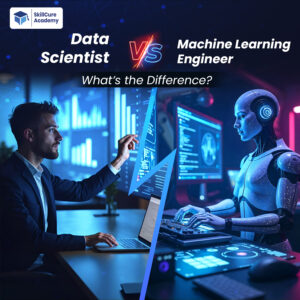

If you’ve been exploring careers in AI or tech, you’ve probably come across two roles that sound similar but are actually quite different: Data Scientist and Machine Learning Engineer. They often work together, use overlapping tools, and solve related problems—but their day-to-day responsibilities and goals diverge in important ways.
Let’s break it down in a clear, practical way.
The Big Picture!
At a high level:
| Role | Primary Focus | End Goal |
|---|---|---|
| Data Scientist | Extracting insights from data | Better decision-making |
| Machine Learning Engineer | Building scalable ML systems | Reliable production systems |
A simple way to understand this:
- A Data Scientist determines what the model should do.
- A Machine Learning Engineer ensures it works efficiently in production.
What Does a Data Scientist Do?
A Data Scientist analyzes structured and unstructured data to uncover patterns, trends, and actionable insights.
Key Responsibilities:
| Area | Tasks |
|---|---|
| Data Preparation | Cleaning, preprocessing, feature engineering |
| Analysis | Exploratory data analysis (EDA), statistical modeling |
| Modeling | Building machine learning models |
| Communication | Data visualization, storytelling |
| Experimentation | A/B testing, hypothesis validation |
Tools and Skills:
| Category | Examples |
|---|---|
| Programming | Python, R |
| Data Handling | SQL, Pandas, NumPy |
| ML Libraries | Scikit-learn |
| Visualization | Matplotlib, Tableau |
| Core Knowledge | Statistics, probability |
Objective.
The primary goal is to extract insights from data and support decision-making.
What Does a Machine Learning Engineer Do?
A Machine Learning Engineer focuses on deploying, scaling, and maintaining machine learning models in production environments.
Key Responsibilities?
| Area | Tasks |
|---|---|
| Deployment | Model serving, API development |
| Infrastructure | Building data pipelines |
| Optimization | Improving latency and performance |
| Monitoring | Tracking model performance, handling drift |
| Collaboration | Working with software and DevOps teams |
Tools and Skills?
| Category | Examples |
|---|---|
| Programming | Python |
| Frameworks | TensorFlow, PyTorch |
| DevOps | Docker, Kubernetes |
| Cloud | AWS, GCP, Azure |
| Core Knowledge | Software engineering, system design |
Objective.
The primary goal is to ensure models are scalable, reliable, and efficient in real-world applications.
Key Differences at a Glance?
| Aspect | Data Scientist | Machine Learning Engineer |
|---|---|---|
| Focus | Insights and analysis | Production systems |
| Work Style | Research-oriented | Engineering-oriented |
| Output | Reports, models, insights | APIs, pipelines, deployed models |
| Skill Emphasis | Statistics and analysis | Software engineering |
| Lifecycle Stage | Early (analysis and modeling) | Late (deployment and scaling) |
How They Work Together?
| Stage | Data Scientist | Machine Learning Engineer |
|---|---|---|
| Data Exploration | Leads | Supports if needed |
| Model Development | Leads | Collaborates |
| Validation | Leads | Assists with testing |
| Deployment | Supports | Leads |
| Monitoring | Shares responsibility | Leads |
In many organizations, these roles collaborate closely to move a model from experimentation to production.
Which Role Should You Choose?
| Preference | Suitable Role |
|---|---|
| Enjoy data analysis and statistics | Data Scientist |
| Prefer building systems and infrastructure | Machine Learning Engineer |
| Interested in research and insights | Data Scientist |
| Interested in scalability and performance | Machine Learning Engineer |
Final Thoughts.
Both roles are essential in the modern AI ecosystem. They complement each other and are often interdependent in real-world projects.
Choosing between them depends on whether you are more interested in understanding data or engineering systems that leverage that data.
For many professionals, the boundary between these roles evolves over time as they gain experience and specialize further.
Understanding both perspectives provides a strong foundation for a successful career in artificial intelligence and data-driven systems.
Frequently Asked Questions (FAQs).
1. Is a Data Scientist the same as a Machine Learning Engineer?
No, while both roles work with data and machine learning, a Data Scientist focuses on analyzing data and building models, whereas a Machine Learning Engineer focuses on deploying and maintaining those models in production environments.
2. Which role requires more coding?
Machine Learning Engineers typically require stronger software engineering and coding skills, as they build scalable systems and production pipelines. Data Scientists also code, but their focus is more on analysis and experimentation.
3. Can a Data Scientist become a Machine Learning Engineer?
Yes, many professionals transition from Data Science to Machine Learning Engineering by strengthening their software engineering, system design, and deployment skills.
4. Which role is better for beginners?
Data Science is often considered more beginner-friendly because it emphasizes data analysis and statistics. However, the best choice depends on whether you prefer analytical work or engineering tasks.
5. Do companies always separate these roles?
Not always. In smaller companies or startups, one person may handle both responsibilities. In larger organizations, these roles are usually more specialized and clearly defined.