
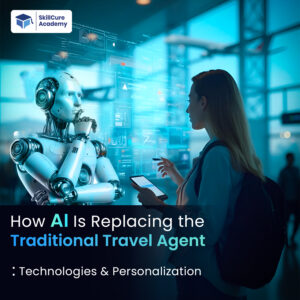

The travel industry is undergoing a profound transformation. Where once travelers relied heavily on traditional travel agents for bookings, recommendations, and itinerary planning, artificial intelligence (AI) is now stepping in to automate and enhance these services. With smarter tools, faster responses, and hyper-personalized experiences, AI is redefining how people plan and experience travel.
The Shift from Human Agents to AI?
Traditional travel agents offered expertise, human touch, and curated recommendations. However, they often came with limitations such as fixed working hours, slower response times, and higher service costs. AI-driven platforms are addressing these gaps by providing instant assistance, 24/7 availability, and scalable personalization.
Key AI Technologies Transforming Travel?
| Technology | Description | Impact on Travel |
|---|---|---|
| Machine Learning | Learns from user behavior and preferences | Improves recommendations over time |
| Natural Language Processing (NLP) | Understands and responds to human language | Enables chatbots and voice assistants |
| Predictive Analytics | Forecasts trends and pricing | Helps travelers book at optimal times |
| Computer Vision | Processes images and visual data | Enhances search via images and recognition |
Personalization: The Game Changer?
AI excels in delivering personalized travel experiences. By analyzing user data such as search history, preferences, and past bookings, AI systems can tailor recommendations uniquely for each traveler.
Example of Personalization:
| User Type | AI Recommendation |
|---|---|
| Budget Traveler | Suggests affordable destinations, hostels, and deals |
| Luxury Traveler | Recommends premium hotels, exclusive experiences |
| Adventure Seeker | Highlights trekking, diving, and offbeat locations |
| Family Traveler | Suggests family-friendly hotels and activities |
Benefits of AI Over Traditional Travel Agents?
- 24/7 Availability: No waiting for office hours.
- Faster Bookings: Instant confirmations.
- Cost Efficiency: Reduced service fees.
- Real-Time Updates: Alerts on delays, weather, and pricing.
- Scalable Support: Handles millions of users simultaneously.
Limitations and Challenges?
Despite its advantages, AI is not without flaws:
- Lack of Human Touch: Emotional understanding is limited.
- Data Privacy Concerns: Heavy reliance on user data.
- Over-Automation: May overlook unique, nuanced preferences.
- Dependence on Technology: Requires internet and digital literacy.
The Future of Travel Planning?
Rather than completely replacing traditional agents, AI is likely to augment them. Hybrid models—where human expertise is supported by AI tools—will offer the best of both worlds. Travel agents may evolve into experience designers, focusing more on complex, high-value itineraries.
Conclusion.
AI is not just replacing traditional travel agents—it is reshaping the entire travel ecosystem. With advanced technologies and deep personalization, travelers now have more control, convenience, and customization than ever before. The future of travel lies in the seamless integration of human creativity and machine intelligence.
FAQs.
1. Is AI completely replacing travel agents?
No, AI is transforming the role of travel agents rather than fully replacing them. Human expertise is still valuable for complex travel needs.
2. How does AI personalize travel recommendations?
AI uses data such as past bookings, preferences, and browsing history to tailor suggestions for each user.
3. Are AI travel platforms safe to use?
Most platforms are secure, but users should be mindful of data privacy and choose trusted services.
4. Can AI handle complex travel itineraries?
AI can manage many complex itineraries, but human agents are still preferred for highly customized or multi-destination plans.
5. What are the biggest advantages of AI in travel?
Speed, convenience, cost savings, and personalized recommendations are the key benefits.