
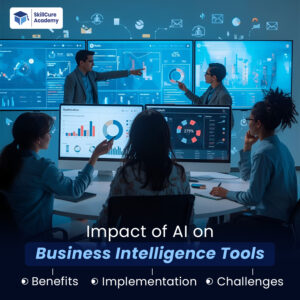

In today’s data-driven world, businesses generate massive amounts of information every single day. Traditional Business Intelligence (BI) tools helped organizations make sense of this data—but with the rise of Artificial Intelligence (AI), BI is evolving from descriptive reporting into predictive and even prescriptive decision-making.
This blog explores how AI is transforming BI tools, the benefits it brings, how to implement it effectively, and the challenges organizations must navigate.
1. The Evolution of Business Intelligence with AI
Traditional BI tools focus on answering “what happened?” and “why did it happen?” through dashboards, reports, and visualizations. AI takes this further by answering:
- What will happen next? (Predictive analytics)
- What should we do about it? (Prescriptive insights)
Comparison: Traditional BI vs AI-Powered BI
| Feature | Traditional BI | AI-Powered BI |
|---|---|---|
| Data Processing | Manual & scheduled | Real-time & automated |
| Insights | Descriptive | Predictive & Prescriptive |
| User Interaction | Dashboard-based | Natural language queries |
| Decision Support | Reactive | Proactive |
2. Key Benefits of AI in BI Tools
a) Faster and Smarter Decision-Making
AI can process large datasets in seconds, uncovering patterns and trends that would take humans days or weeks to identify.
b) Predictive Analytics
AI models can forecast trends such as customer behavior, sales performance, and demand.
c) Automated Insights
AI-driven tools automatically highlight anomalies and suggest actions.
d) Natural Language Queries (NLQ)
Users can interact using simple queries like “Show last quarter’s sales growth.”
e) Improved Data Accuracy
AI detects inconsistencies and improves data quality.
f) Personalization
Dashboards are customized based on user roles and behavior.
Benefits Overview Table
| Benefit | Description | Business Impact |
|---|---|---|
| Speed | Real-time data processing | Faster decisions |
| Accuracy | Error detection & cleaning | Reliable insights |
| Automation | Reduced manual effort | Cost efficiency |
| Forecasting | Predictive capabilities | Better planning |
3. Implementing AI in Business Intelligence
Step-by-Step Implementation
| Step | Action | Outcome |
|---|---|---|
| 1 | Define objectives | Clear business goals |
| 2 | Prepare data | Clean & structured datasets |
| 3 | Select tools | Right BI platform |
| 4 | Integrate AI models | Advanced analytics |
| 5 | Train teams | Better adoption |
| 6 | Monitor performance | Continuous improvement |
4. Challenges of AI in BI
| Challenge | Description | Impact |
|---|---|---|
| Data Quality | Incomplete or inaccurate data | Misleading insights |
| Cost | High setup and maintenance | Budget constraints |
| Skill Gap | Lack of AI expertise | Slow adoption |
| Transparency | Black-box models | Trust issues |
| Integration | Complex system merging | Delays |
| Security | Data privacy concerns | Compliance risks |
5. Future of AI in Business Intelligence
The future of BI lies in augmented analytics, where AI acts as a co-pilot for decision-makers.
Emerging Trends
- Automated data storytelling
- Conversational BI
- Real-time predictive dashboards
- Generative AI insights
Conclusion
AI is not just enhancing Business Intelligence tools—it is redefining them. By enabling faster insights, predictive capabilities, and automation, AI empowers organizations to make smarter decisions.
Businesses that adopt AI-driven BI today will gain a significant competitive advantage in the future.
FAQs.
1. What is AI in Business Intelligence?
AI in BI refers to the use of machine learning and automation to analyze data, generate insights, and support decision-making.
2. How does AI improve BI tools?
AI enhances BI by providing predictive insights, automating analysis, and enabling natural language queries.
3. Is AI in BI expensive to implement?
Initial costs can be high, but long-term benefits such as efficiency and better decisions often outweigh the investment.
4. What are the biggest challenges of AI in BI?
Key challenges include data quality, high costs, lack of skilled professionals, and integration complexity.