

Artificial Intelligence has become one of the fastest-growing technologies in the world. From chatbots and recommendation systems to self-driving cars and healthcare diagnostics, AI is transforming every industry. Recently, another term has become equally popular—Generative AI.
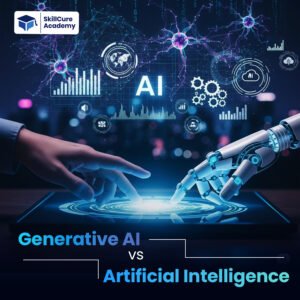
Many people believe that Generative AI and Artificial Intelligence are the same, but they are not. Generative AI is actually a subset of Artificial Intelligence, designed specifically to create new content such as text, images, videos, music, and code.
In this blog, we’ll explain Generative AI vs Artificial Intelligence, their differences, applications, benefits, limitations, career opportunities, and which one you should learn in 2026.
What is Artificial Intelligence?
Artificial Intelligence (AI) is a branch of computer science that enables machines to simulate human intelligence. AI systems can learn from data, recognize patterns, solve problems, make decisions, and automate tasks without constant human intervention.
The primary objective of AI is to make machines capable of performing tasks that usually require human intelligence.
Examples include:
- Voice assistants like Siri and Alexa
- Recommendation systems on Netflix and YouTube
- Fraud detection in banking
- Face recognition
- Autonomous vehicles
- Medical diagnosis systems
Artificial Intelligence focuses mainly on analyzing data, predicting outcomes, automating decisions, and improving efficiency.
What is Generative AI?
Generative AI is a specialized branch of Artificial Intelligence that creates new content instead of simply analyzing existing data.
Rather than only making predictions, Generative AI learns patterns from large datasets and generates completely new outputs.
Examples include:
- Writing articles
- Creating images
- Generating videos
- Writing programming code
- Producing music
- Designing presentations
Popular Generative AI tools include:
- ChatGPT
- Google Gemini
- Claude AI
- Midjourney
- DALL·E
- GitHub Copilot
Generative AI has become one of the most in-demand technologies because it significantly improves productivity across multiple industries.
Generative AI vs Artificial Intelligence:
| Feature | Artificial Intelligence | Generative AI |
|---|---|---|
| Purpose | Analyze data and make decisions | Create new content |
| Main Function | Prediction, automation, classification | Content generation |
| Output | Decisions and recommendations | Text, images, videos, code |
| Learning Style | Pattern recognition | Pattern learning and content creation |
| Human Creativity | Limited | High |
| Business Use | Analytics and automation | Content creation and innovation |
| Examples | Fraud detection, recommendation engines | ChatGPT, Midjourney, DALL·E |
How Artificial Intelligence Works?
Artificial Intelligence generally follows these steps:
- Collect data
- Clean and preprocess data
- Train machine learning models
- Identify patterns
- Make predictions
- Improve through continuous learning
AI models are designed to optimize accuracy while making intelligent decisions.
How Generative AI Works?
Generative AI follows a different approach:
- Learns massive datasets
- Understands language, images, and patterns
- Predicts the next sequence
- Generates completely new content
- Improves output through user feedback
Most modern Generative AI systems use Large Language Models (LLMs) and Transformer architecture.
Applications of Artificial Intelligence?
Artificial Intelligence is widely used across industries.
Healthcare:
- Disease prediction
- Medical imaging
- Drug discovery
Banking:
- Fraud detection
- Credit scoring
- Risk analysis
Manufacturing:
- Predictive maintenance
- Robotics
- Quality inspection
Retail:
- Personalized recommendations
- Inventory management
- Customer analytics
Transportation:
- Route optimization
- Self-driving vehicles
- Traffic prediction
Applications of Generative AI?
Generative AI is transforming creative and business workflows.
Content Writing:
- Blogs
- Emails
- Product descriptions
- Marketing copy
Graphic Designing:
- Logos
- Social media posts
- Illustrations
- Advertisements
Programming:
- Code generation
- Debugging
- Documentation
Video Creation:
- AI avatars
- Video scripts
- Voice generation
- Animation
Education:
- Personalized learning
- Notes generation
- Question papers
- Course material
Advantages of Artificial Intelligence?
Some major benefits include:
- Improves efficiency
- Reduces manual work
- Better decision making
- High accuracy
- Faster processing
- Business automation
- Cost reduction
Advantages of Generative AI?
Generative AI offers several unique advantages.
- Creates original content
- Saves time
- Boosts creativity
- Enhances productivity
- Generates code quickly
- Assists in research
- Improves customer engagement
Limitations of Artificial Intelligence?
Despite its benefits, AI has limitations.
- Requires quality data
- Expensive implementation
- Bias in datasets
- Privacy concerns
- High computational costs
Limitations of Generative AI?
Generative AI also has challenges.
- May generate incorrect information
- Hallucinations
- Copyright concerns
- Ethical issues
- Requires human verification
- Data privacy risks
Career Opportunities?
Both Artificial Intelligence and Generative AI offer excellent career opportunities.
Artificial Intelligence Careers:
- AI Engineer
- Machine Learning Engineer
- Data Scientist
- Robotics Engineer
- Computer Vision Engineer
- NLP Engineer
Generative AI Careers:
- Prompt Engineer
- Generative AI Engineer
- AI Content Specialist
- AI Automation Consultant
- LLM Engineer
- AI Product Manager
- AI Research Engineer
Salary Comparison India?
| Job Role | Average Salary |
|---|---|
| AI Engineer | ₹8–20 LPA |
| Machine Learning Engineer | ₹9–22 LPA |
| Data Scientist | ₹8–25 LPA |
| Prompt Engineer | ₹8–30 LPA |
| Generative AI Engineer | ₹12–35 LPA |
| LLM Engineer | ₹15–45 LPA |
Salary depends on experience, skills, company, and location.
Which One Should You Learn in 2026?
The answer depends on your career goals.
Choose Artificial Intelligence if you want to:
- Build intelligent systems
- Work in Machine Learning
- Become a Data Scientist
- Develop AI algorithms
Choose Generative AI if you want to:
- Build AI applications
- Create AI-powered products
- Automate content creation
- Develop chatbots
- Work with Large Language Models
For the best career opportunities in 2026, learning both Artificial Intelligence and Generative AI together is highly recommended. AI provides the foundation, while Generative AI equips you with the latest tools and technologies that companies are actively adopting.
Final Thoughts.
When comparing Generative AI vs Artificial Intelligence, it’s important to remember that Generative AI is not a replacement for Artificial Intelligence—it is one of its most advanced branches.
Artificial Intelligence focuses on analyzing information, making predictions, and automating decision-making. Generative AI takes this a step further by creating original content such as text, images, code, audio, and videos.
As businesses continue adopting AI-driven solutions, professionals with expertise in both AI fundamentals and Generative AI technologies will have a significant advantage in the job market. Whether you’re a student, developer, data analyst, or business professional, learning these technologies can open the door to exciting career opportunities in 2026 and beyond.
Frequently Asked Questions (FAQs).
1. What is the main difference between Generative AI and Artificial Intelligence?
Artificial Intelligence focuses on analyzing data and making decisions, while Generative AI creates new content such as text, images, videos, music, and code.
2. Is Generative AI a part of Artificial Intelligence?
Yes. Generative AI is a subset of Artificial Intelligence that specializes in generating original content using advanced AI models.
3. Which has better career opportunities in 2026: AI or Generative AI?
Both fields have strong demand, but Generative AI roles are growing rapidly. Learning AI fundamentals along with Generative AI tools provides the best career prospects.
4. What skills are required to learn Generative AI?
Key skills include Python, Machine Learning, Deep Learning, Natural Language Processing (NLP), Prompt Engineering, Large Language Models (LLMs), and AI frameworks such as TensorFlow or PyTorch.
5. Can beginners learn Generative AI without prior AI experience?
Yes. Beginners can start with AI basics, Python programming, and machine learning concepts before progressing to Generative AI tools and applications.