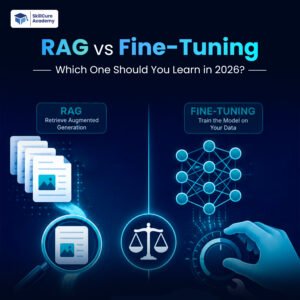

Artificial Intelligence is changing rapidly, and two important concepts in modern AI development are RAG (Retrieval-Augmented Generation) and Fine-Tuning. Both are used to improve the performance of AI models, but they solve different problems.
If you are learning AI, Data Science, Machine Learning, or Generative AI in 2026, understanding the difference between RAG and Fine-Tuning can help you choose the right skill for your career.
So, should you learn RAG or Fine-Tuning in 2026? The answer depends on what you want to build, your career goals, and the type of AI applications you want to work with.
What Is RAG?
RAG, or Retrieval-Augmented Generation, is a technique that allows an AI model to retrieve relevant information from external data sources before generating an answer.
Instead of depending only on the information contained in the model’s training data, a RAG system searches a knowledge base, database, documents, or other sources and provides relevant information to the AI model.
How RAG Works
A typical RAG workflow includes:
- User asks a question.
- The system converts the question into a searchable representation.
- Relevant information is retrieved from a knowledge base or vector database.
- The retrieved information is provided to the AI model.
- The model generates an answer using that context.
For example, a company could build a chatbot that answers questions using its internal HR policies, training documents, and company guidelines.
What Is Fine-Tuning?
Fine-Tuning is the process of further training a pre-trained AI model on a specific dataset so that it performs better for a particular task, style, or domain.
Instead of giving the model external information at every query, fine-tuning changes the model’s learned parameters based on the training examples.
Fine-tuning can be useful when you want an AI model to consistently follow a particular format, behavior, writing style, or task pattern.
Examples of Fine-Tuning
Fine-tuning can be used for:
- Customer-support response styles.
- Classification tasks.
- Specialized language or terminology.
- Structured output generation.
- Consistent brand communication.
- Domain-specific task performance.
RAG vs Fine-Tuning: Key Difference
The biggest difference is how the AI system gets specialized.
| Feature | RAG | Fine-Tuning |
|---|---|---|
| Main purpose | Give the model access to external knowledge. | Adapt the model’s behavior or capabilities. |
| Changes model weights | No. | Yes. |
| Uses external documents | Yes. | Usually through training data. |
| Updating information | Relatively easy. | Requires another training process. |
| Best for current information | Excellent. | Not ideal by itself. |
| Implementation | Retrieval system + AI model. | Training or fine-tuning pipeline. |
| Cost | Often lower to get started. | Can require more compute and expertise. |
| Hallucination control | Can improve grounding when retrieval is good. | Does not automatically provide current factual grounding. |
| Knowledge updates | Add or update the knowledge base. | Retrain or fine-tune again. |
When Should You Choose RAG?
RAG is generally a strong choice when your AI application needs to work with frequently changing or private information.
For example, imagine a company wants to build an AI assistant that answers questions about:
- Company policies.
- Product documentation.
- Internal reports.
- Financial documents.
- Training materials.
- Frequently updated FAQs.
Instead of retraining the AI model whenever a document changes, the company can update the knowledge base used by the RAG system.
This makes RAG particularly useful for enterprise AI applications.
When Should You Choose Fine-Tuning?
Fine-tuning becomes more useful when the primary problem is not access to information but how the model behaves or performs a particular task.
For example, a company may want a model to:
- Generate responses in a specific format.
- Perform a specialized classification task.
- Follow a particular response style.
- Handle domain-specific language more consistently.
- Produce structured outputs based on examples.
In these situations, fine-tuning may be more appropriate than simply retrieving documents.
RAG vs Fine-Tuning: Which Is Easier to Learn?
For beginners, RAG is generally easier to start with because you can build useful applications without training a large language model from scratch.
A beginner RAG project might involve:
Documents → Embeddings → Vector Database → Retrieval → LLM → Response
You can learn concepts such as:
- Embeddings.
- Vector databases.
- Semantic search.
- Chunking.
- Retrieval.
- Prompt engineering.
- LLM APIs.
- Evaluation.
These concepts are also valuable for building practical Generative AI applications.
Fine-tuning requires a deeper understanding of areas such as:
- Machine learning.
- Model architecture.
- Training datasets.
- Training parameters.
- Evaluation.
- GPUs and compute.
- Model optimization.
Therefore, learners who are new to Generative AI may find RAG a more approachable starting point.
Which One Is More Useful for Jobs in 2026?
Both skills are valuable, but their applications can be different.
RAG is especially relevant to roles involving Generative AI applications, AI assistants, enterprise search, knowledge systems, and AI-powered business applications.
Fine-tuning is valuable for professionals working more deeply with machine learning, LLM development, model adaptation, and specialized AI systems.
| Career Goal | Recommended Skill |
|---|---|
| Generative AI Developer | RAG + Fine-Tuning. |
| AI Application Developer | RAG. |
| LLM Engineer | RAG + Fine-Tuning. |
| Machine Learning Engineer | Fine-Tuning + RAG. |
| Data Scientist | Both. |
| AI Automation Developer | RAG. |
| Beginner in Generative AI | Start with RAG. |
Can RAG and Fine-Tuning Be Used Together?
Yes. RAG and fine-tuning are not competing technologies in every situation. They can work together.
For example, an enterprise AI system could use a fine-tuned model to produce responses in a particular style while RAG provides the latest company information.
A simplified architecture could look like:
User Query → Retrieval → Relevant Context → Fine-Tuned Model → Response
This approach can combine the strengths of both techniques.
Advantages of RAG
RAG offers several practical benefits:
- Works well with private company information.
- Makes it easier to update knowledge.
- Can connect AI applications to external information.
- Useful for document-based question answering.
- Can improve factual grounding when retrieval is accurate.
- Does not require changing the underlying model weights.
- Suitable for many enterprise AI applications.
Advantages of Fine-Tuning
Fine-tuning also has important advantages:
- Can improve performance on specialized tasks.
- Helps create consistent response patterns.
- Can teach models specific output formats.
- Useful for domain-specific applications.
- Can reduce the need for lengthy prompts in some use cases.
- Allows developers to adapt an existing model for a particular purpose.
Limitations of RAG
RAG is powerful, but it is not perfect.
The quality of the final response depends heavily on the quality of retrieval. If the system retrieves irrelevant or incomplete information, the model may still produce an incorrect answer.
Other challenges include:
- Document chunking.
- Retrieval accuracy.
- Vector database management.
- Context limitations.
- Retrieval latency.
- Evaluation of search quality.
Therefore, learning RAG means learning more than simply connecting a chatbot to a document.
Limitations of Fine-Tuning
Fine-tuning also has challenges.
It requires suitable training data and careful evaluation. Poor-quality training data can result in poor model behavior.
Other challenges include:
- Training costs.
- Dataset preparation.
- Model evaluation.
- Infrastructure requirements.
- Risk of overfitting.
- Updating the model when requirements change.
Most importantly, fine-tuning should not automatically be treated as a replacement for a knowledge retrieval system. If the information changes frequently, RAG may still be needed.
RAG or Fine-Tuning: What Should You Learn First?
If you are starting your Generative AI journey in 2026, a practical learning sequence would be:
Step 1: Learn Python
Python is widely used across AI, machine learning, data science, and Generative AI applications.
Step 2: Understand LLM Fundamentals
Learn how large language models work at a conceptual level, including tokens, prompts, context windows, embeddings, and inference.
Step 3: Learn Prompt Engineering
Understand how instructions and context can influence model responses.
Step 4: Learn RAG
Move into:
- Embeddings.
- Vector databases.
- Document processing.
- Chunking.
- Retrieval.
- Semantic search.
- RAG pipelines.
- RAG evaluation.
Step 5: Learn Fine-Tuning
After understanding the basics, learn how models can be adapted using specialized datasets and training techniques.
Step 6: Build Projects
Projects are essential for turning theoretical knowledge into practical skills.
You could build:
- PDF question-answering assistant.
- Company knowledge chatbot.
- Resume analysis assistant.
- Customer-support AI.
- Research assistant.
- Internal documentation chatbot.
- Domain-specific AI assistant.
Which One Should You Learn in 2026?
For most beginners, start with RAG and then learn Fine-Tuning.
RAG gives you practical exposure to several important Generative AI concepts and allows you to build useful applications around existing AI models.
After gaining confidence with RAG, learning fine-tuning can help you understand how AI models can be adapted for specialized tasks.
The most valuable approach, however, is not to think of RAG and Fine-Tuning as an either-or choice.
RAG helps an AI system access the right information, while fine-tuning helps adapt how the model performs a task.
Understanding when to use each approach—and when to combine them—is an important skill for AI professionals in 2026.
Frequently Asked Questions
1. Is RAG better than Fine-Tuning?
Neither is universally better. RAG is generally better when an AI application needs access to changing or private information, while fine-tuning is useful for adapting a model to specific tasks, behaviors, or output patterns.
2. Should beginners learn RAG first?
Yes. RAG is a practical starting point for beginners because it introduces important Generative AI concepts without requiring extensive model training knowledge.
3. Is Fine-Tuning still important in 2026?
Yes. Fine-tuning remains useful for specialized AI tasks, consistent model behavior, and adapting models to particular datasets or requirements.
4. Can RAG and Fine-Tuning be used together?
Yes. A system can use a fine-tuned model together with RAG so that the model can follow specialized behavior while retrieving current information from an external knowledge base.
5. What should I learn for a Generative AI career in 2026?
Start with Python, machine learning fundamentals, LLM concepts, prompt engineering, RAG, embeddings, vector databases, and AI application development. Then add fine-tuning and model evaluation for deeper expertise.