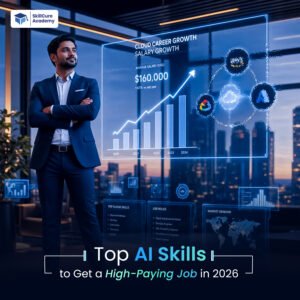

Artificial Intelligence is changing the way businesses work, make decisions, and build products. From data analytics and software development to marketing, finance, and customer service, companies are increasingly looking for professionals who can work effectively with AI.
In 2026, learning AI is no longer limited to becoming a machine learning engineer. Professionals from different backgrounds can benefit by developing practical AI skills and combining them with their existing expertise.
If you are planning to build a career in AI or want to upgrade your skills for better job opportunities, here are some of the most valuable AI skills to learn in 2026.
Why AI Skills Are Important for Jobs in 2026?
Companies are not only hiring professionals who understand AI concepts. They are looking for people who can use AI to solve real business problems.
For example, a data analyst who knows how to use AI for SQL generation, data cleaning, reporting, and analysis can potentially work more efficiently than someone who relies entirely on manual processes.
Similarly, developers, marketers, business analysts, and finance professionals can use AI tools to automate repetitive tasks and improve productivity.
| Career Area | How AI Is Being Used |
|---|---|
| Data Analytics | Automated analysis, forecasting, insights, dashboards. |
| Software Development | Code generation, debugging, testing, documentation. |
| Marketing | Content creation, customer analysis, personalization. |
| Finance | Forecasting, fraud detection, financial analysis. |
| Business Analysis | Requirement analysis, documentation, reporting. |
| Customer Service | AI assistants, chatbots, automated support. |
1. Generative AI
Generative AI is one of the most important skills for professionals in 2026.
Generative AI systems can create text, images, code, presentations, summaries, and other forms of content. Professionals who understand how to use these systems effectively can automate several tasks and improve their productivity.
You should understand:
- How large language models work at a basic level.
- How to use AI assistants for professional tasks.
- AI limitations and hallucinations.
- Prompt design and optimization.
- AI-based content and data workflows.
- Responsible and secure use of AI.
Popular AI assistants can be used for research, writing, coding, analysis, brainstorming, and automation.
2. Prompt Engineering
Prompt engineering involves creating effective instructions for AI models to produce useful and reliable outputs.
A good prompt can provide context, define the required output, establish constraints, and guide the AI toward a specific objective.
For example, instead of simply asking an AI tool to analyze sales data, a professional can provide the business objective, explain the columns, define the required KPIs, and specify the expected output format.
Important prompt engineering skills include:
- Context setting.
- Role-based prompting.
- Few-shot prompting.
- Structured output generation.
- Prompt testing.
- Error identification.
- AI response evaluation.
Prompt engineering is particularly useful when combined with another professional skill such as analytics, programming, marketing, or business analysis.
3. AI Agents and Agentic AI
AI agents are becoming an important part of modern AI applications.
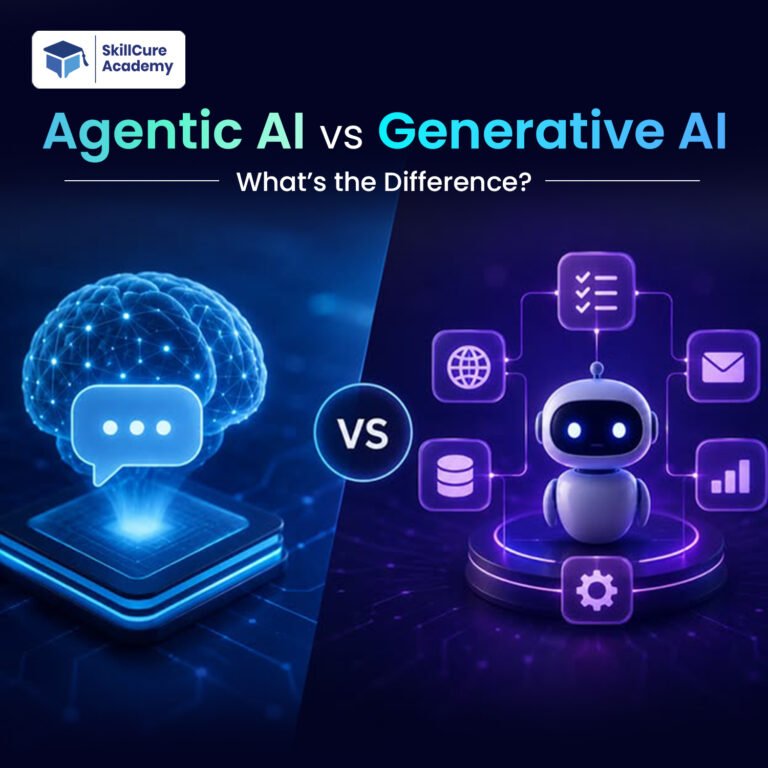
Unlike a basic chatbot that responds to individual prompts, an AI agent can be designed to perform multiple steps toward a goal. Depending on the system, an agent may reason about a task, use tools, retrieve information, execute actions, and evaluate results.
Professionals interested in advanced AI should understand:
- AI agent fundamentals.
- Tool calling.
- Workflow automation.
- Retrieval systems.
- Multi-step reasoning workflows.
- Agent evaluation.
- Human-in-the-loop systems.
Knowledge of agentic AI can be particularly valuable for developers, automation specialists, data professionals, and AI engineers.
4. Python for AI
Python continues to be one of the most useful programming languages for AI and data-related careers.
You do not necessarily need to become an advanced software engineer to start working with AI. However, understanding Python fundamentals can help you work with data, APIs, machine learning models, and automation tools.
Important Python skills include:
- Variables and data types.
- Functions.
- Loops and conditional statements.
- Object-oriented programming basics.
- File handling.
- APIs.
- Data processing.
- Automation.
- AI and machine learning libraries.
For AI-focused careers, Python becomes even more valuable when combined with data analysis and machine learning knowledge.
5. Machine Learning
Machine learning remains a core technical skill for many high-paying AI careers.
Machine learning allows systems to learn patterns from data and make predictions or classifications.
Professionals should understand concepts such as:
- Supervised learning.
- Unsupervised learning.
- Regression.
- Classification.
- Clustering.
- Feature engineering.
- Model evaluation.
- Overfitting and underfitting.
- Model deployment basics.
Common Python libraries such as Scikit-learn can help beginners start building practical machine learning projects.
6. SQL and AI-Powered Data Analysis
SQL remains an essential skill for data-related jobs, even as AI becomes more powerful.
AI can help professionals write SQL queries, explain database structures, identify patterns, and assist with data analysis. However, professionals still need to understand databases and SQL fundamentals to verify AI-generated queries and interpret the results correctly.
Important skills include:
- SELECT statements.
- Filtering and sorting.
- Joins.
- Subqueries.
- Common Table Expressions.
- Window functions.
- Aggregations.
- Data cleaning.
- Query optimization basics.
Combining SQL with AI can be particularly useful for data analysts and business intelligence professionals.
7. Retrieval-Augmented Generation (RAG)
Retrieval-Augmented Generation, commonly called RAG, is an important concept for professionals working with AI applications.
RAG allows AI systems to retrieve relevant information from external knowledge sources before generating an answer.
This can help organizations build AI applications that work with their own documents, databases, knowledge bases, and business information.
A basic understanding of RAG should include:
- Embeddings.
- Vector databases.
- Document retrieval.
- Chunking.
- Semantic search.
- Context retrieval.
- LLM integration.
- RAG evaluation.
RAG skills can be especially useful for AI developers and professionals building enterprise AI applications.
8. Data Analytics with AI
AI is changing the way analysts work with data.
Instead of manually performing every step, analysts can use AI to assist with data cleaning, exploratory analysis, SQL queries, Python code, visualization ideas, and report generation.
However, analytical thinking remains extremely important.
A strong AI-powered data analyst should understand:
- Excel.
- SQL.
- Power BI or other visualization tools.
- Python.
- Statistics.
- Business analysis.
- AI-assisted analytics.
- Data storytelling.
The combination of data analytics + AI can create strong career opportunities because businesses still need professionals who can convert data into meaningful business decisions.
9. AI Automation
AI automation focuses on using AI and software tools to reduce repetitive manual work.
Businesses can automate workflows such as:
- Lead processing.
- Email classification.
- Report generation.
- Document processing.
- Customer support.
- Data entry.
- Content workflows.
- Internal knowledge search.
Professionals who understand automation can combine AI models with APIs, databases, workflow platforms, and business applications.
This makes AI automation a useful skill for both technical and non-technical professionals.
10. AI + Cloud Computing
Modern AI applications often require cloud infrastructure for data storage, model deployment, APIs, and scalable computing.
Therefore, basic cloud knowledge can make an AI professional more valuable.
You can start by learning:
- Cloud computing fundamentals.
- Cloud storage.
- Virtual machines.
- APIs.
- Databases.
- AI/ML cloud services.
- Model deployment.
- Security basics.
Knowledge of platforms such as AWS, Microsoft Azure, or Google Cloud can complement AI and machine learning skills.
11. AI Ethics and Responsible AI
As AI becomes more widely used, organizations also need professionals who understand responsible AI practices.
AI systems can produce incorrect, biased, or misleading outputs. Professionals should understand how to evaluate AI systems and identify potential risks.
Important concepts include:
- Data privacy.
- Bias.
- Transparency.
- Security.
- AI governance.
- Model evaluation.
- Human oversight.
- Responsible deployment.
Understanding responsible AI can become increasingly important as businesses integrate AI into critical workflows.
Which AI Skills Should You Learn Together?
You do not need to learn every AI skill at once. A better approach is to create a skill combination based on your career goal.
| Career Goal | Recommended Skill Combination |
|---|---|
| AI Engineer | Python + ML + Deep Learning + LLMs + Cloud. |
| Data Analyst | Excel + SQL + Power BI + Python + AI. |
| Data Scientist | Python + Statistics + ML + SQL + GenAI. |
| AI Developer | Python + APIs + LLMs + RAG + AI Agents. |
| Business Analyst | Excel + SQL + Business Analysis + GenAI + Automation. |
| Digital Marketer | Marketing + GenAI + Analytics + Automation. |
| AI Automation Specialist | GenAI + APIs + AI Agents + Workflow Automation. |
How to Start Learning AI in 2026
If you are a beginner, trying to learn everything simultaneously can become confusing. Instead, follow a structured approach.
Step 1: Learn the Fundamentals
Start with basic programming, data concepts, and AI fundamentals.
Step 2: Choose a Career Direction
Decide whether you want to move toward data analytics, data science, AI development, automation, business analysis, or another AI-related field.
Step 3: Learn Practical Tools
Focus on tools that are actually used to complete professional tasks rather than learning AI only theoretically.
Step 4: Build Projects
Projects demonstrate whether you can apply your knowledge to real-world problems.
Examples include:
- AI-powered sales analysis.
- Customer churn prediction.
- Automated business reports.
- RAG-based document assistant.
- AI-powered data dashboard.
- Automated lead qualification system.
Step 5: Develop Business Understanding
Technical skills become more valuable when you understand the business problem behind them.
Employers want professionals who can answer questions such as:
What problem are we solving?
How can AI improve the process?
What business impact will the solution create?
AI Skills vs Traditional Skills
AI does not mean that traditional professional skills are no longer important.
In many careers, the strongest combination is domain knowledge + AI skills.
For example:
- Data Analytics + AI.
- Finance + AI.
- Marketing + AI.
- HR + AI.
- Software Development + AI.
- Business Analysis + AI.
Professionals who can combine AI with their existing expertise can potentially create more value than someone who knows AI tools but does not understand the underlying business problem.
Build an AI-Ready Career in 2026
The AI job market is evolving quickly, so learning one AI tool is not enough. Tools will change, but fundamental skills such as programming, data analysis, problem-solving, statistics, business understanding, and AI concepts can remain useful.
The most effective strategy is to develop a combination of AI knowledge, practical tools, domain expertise, and project experience.
Whether you are a student, working professional, data analyst, developer, marketer, or business professional, learning how to work effectively with AI can help you stay competitive in the changing job market.
Frequently Asked Questions
1. Which AI skill is best for getting a high-paying job in 2026?
There is no single best AI skill for everyone. Generative AI, machine learning, Python, AI agents, RAG, AI automation, and AI-powered data analytics are valuable areas. The best choice depends on your career background and target role.
2. Can non-technical students learn AI?
Yes. Non-technical students can start with Generative AI, prompt engineering, AI tools, automation, and AI-powered analytics. Programming and machine learning can be added later depending on their career goals.
3. Is Python necessary for an AI career?
Python is highly useful for technical AI careers such as machine learning, data science, AI development, and automation. However, not every AI-related job requires advanced Python.
4. Should I learn AI or data analytics first?
If your goal is to become a data analyst, it is useful to first build fundamentals in Excel, SQL, Power BI, statistics, and data analysis, and then add AI skills. This creates a stronger combination of analytical and AI capabilities.
5. How can I get a job after learning AI skills?
Build practical projects, create a strong portfolio, practice technical and HR interviews, and learn to explain how your AI skills solve real business problems. Practical experience can help demonstrate your capabilities to potential employers.