
What Is the Data Science Roadmap for Beginners in 2026?
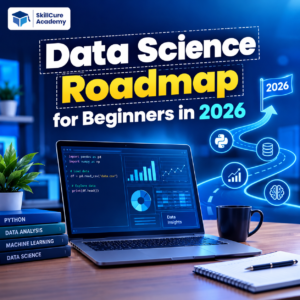
The data science roadmap for beginners in 2026 has seven stages: (1) build math and statistics basics, (2) learn Python and SQL, (3) master data analysis and visualization, (4) learn machine learning, (5) study deep learning and generative AI, (6) build deployable projects, and (7) prepare for interviews. Most beginners can become job-ready in 8 to 12 months with structured, mentor-led learning, which is why many learners in Delhi NCR look for the best data science course institute in Noida that offers live projects and placement support.
Table of Contents
- Why Data Science Is Still a Top Career in 2026
- The 2026 Data Science Roadmap at a Glance
- Step-by-Step Roadmap (Stages 1 to 7)
- Tools and Technologies to Learn in 2026
- Projects Every Beginner Should Build
- Data Science Careers, Roles and Salary Expectations
- Why Noida Is a Strong Place to Learn Data Science
- How to Choose the Best Data Science Course Institute in Noida
- Common Mistakes Beginners Should Avoid
- Final Thoughts
- Frequently Asked Questions (10 FAQs)
Why Data Science Is Still a Top Career in 2026
Data science sits at the centre of how modern businesses make decisions. Banks use it to detect fraud, e-commerce platforms use it to recommend products, hospitals use it to predict risk, and almost every startup now uses AI-driven analytics.
What has changed in 2026 is the expectation from entry-level candidates. Employers no longer want only theory. They look for people who can:
- Work with real, messy data using Python and SQL
- Build and explain machine learning models
- Use generative AI and large language model (LLM) tools responsibly
- Communicate insights clearly to non-technical teams
- Show a portfolio of end-to-end projects
The good news: you do not need a PhD or a computer science degree to start. A structured roadmap, consistent practice and the right mentorship are enough.
The 2026 Data Science Roadmap at a Glance
| Stage | Focus Area | Key Topics | Approx. Duration |
|---|---|---|---|
| 1 | Foundations | Statistics, probability, linear algebra basics | 3 to 4 weeks |
| 2 | Programming and Databases | Python, NumPy, Pandas, SQL | 5 to 6 weeks |
| 3 | Data Analysis and Visualization | EDA, data cleaning, Matplotlib, Seaborn, Power BI or Tableau | 4 to 5 weeks |
| 4 | Machine Learning | Regression, classification, clustering, model evaluation | 8 to 10 weeks |
| 5 | Deep Learning and Generative AI | Neural networks, NLP, LLMs, prompt engineering, RAG | 6 to 8 weeks |
| 6 | Projects and Deployment | Capstone projects, Git, APIs, cloud basics, MLOps intro | 6 to 8 weeks |
| 7 | Career Preparation | Resume, GitHub, portfolio, mock interviews | 3 to 4 weeks |
Durations are indicative and vary with the time you can dedicate each week.
Step-by-Step Data Science Roadmap for Beginners
Stage 1: Build Your Math and Statistics Foundation
You do not need advanced mathematics, but you do need the fundamentals that machine learning relies on.
- Statistics: mean, median, variance, standard deviation, distributions, hypothesis testing, confidence intervals
- Probability: conditional probability, Bayes’ theorem, common distributions
- Linear algebra: vectors, matrices, dot products
- Calculus (basic): derivatives and gradients, to understand how models learn
Tip: Focus on intuition and application, not on memorising formulas.
Stage 2: Learn Python and SQL
Python remains the most widely used language in data science, and SQL remains the most requested skill in analyst and data scientist job descriptions.
| Skill | What to Learn | Why It Matters |
|---|---|---|
| Python basics | Variables, loops, functions, OOP basics | Core programming ability |
| NumPy | Arrays, vectorised operations | Fast numerical computing |
| Pandas | DataFrames, merging, grouping, cleaning | Daily data wrangling |
| SQL | SELECT, JOINs, GROUP BY, window functions, subqueries | Extracting data from databases |
| Git and GitHub | Commits, branches, pull requests | Version control and portfolio |
Stage 3: Data Analysis and Visualization
Before building models, you must understand your data. This stage is called Exploratory Data Analysis (EDA).
- Handle missing values, duplicates and outliers
- Create charts using Matplotlib, Seaborn and Plotly
- Build dashboards in Power BI or Tableau
- Practise storytelling: turn numbers into business recommendations
Stage 4: Machine Learning
This is the heart of the roadmap. Learn both the concepts and the practical use of scikit-learn.
| Category | Algorithms to Learn | Example Use Case |
|---|---|---|
| Supervised: Regression | Linear, Ridge, Lasso, Random Forest Regressor | House price prediction |
| Supervised: Classification | Logistic Regression, Decision Trees, Random Forest, XGBoost | Customer churn prediction |
| Unsupervised | K-Means, Hierarchical Clustering, PCA | Customer segmentation |
| Model evaluation | Accuracy, precision, recall, F1, ROC-AUC, cross-validation | Choosing the right model |
| Feature engineering | Encoding, scaling, feature selection | Improving model performance |
Stage 5: Deep Learning and Generative AI
In 2026, even beginner-level roles increasingly expect basic familiarity with AI.
- Deep learning: neural networks, CNNs, RNNs and Transformers using TensorFlow or PyTorch
- Natural Language Processing (NLP): text cleaning, embeddings, sentiment analysis
- Generative AI: working with LLMs, prompt engineering, fine-tuning basics
- RAG (Retrieval-Augmented Generation): building simple question-answering apps over your own documents
- Responsible AI: bias, privacy and ethical use of data
Stage 6: Build Projects and Learn Deployment
A model that lives only in a notebook has limited business value. Learn to ship.
- Create a REST API using Flask or FastAPI
- Build a simple front end with Streamlit
- Understand Docker and basic cloud services (AWS, Azure or GCP)
- Get an introduction to MLOps: experiment tracking, model monitoring
Stage 7: Prepare for Your Job Search
- Build a one-page resume focused on projects and measurable results
- Publish 4 to 5 projects on GitHub with clear README files
- Practise SQL, Python, statistics and case-study interview questions
- Attend mock interviews and apply to roles in analytics, data science and AI
Tools and Technologies to Learn in 2026
| Category | Beginner Priority Tools | Nice to Have |
|---|---|---|
| Programming | Python, SQL | R, Scala |
| Data libraries | NumPy, Pandas, Matplotlib, Seaborn | Polars, Plotly |
| Machine learning | scikit-learn, XGBoost | LightGBM, CatBoost |
| Deep learning and GenAI | TensorFlow or PyTorch, Hugging Face | LangChain, vector databases |
| Visualization and BI | Power BI or Tableau | Looker Studio |
| Big data and cloud | Basics of cloud storage and compute | Spark, Databricks, Snowflake |
| Deployment | Streamlit, FastAPI, Docker | MLflow, Kubernetes |
| Collaboration | Git, GitHub, Jupyter, VS Code | Google Colab Pro |
Projects Every Beginner Should Build
Recruiters hire on evidence. These projects help you demonstrate skills across the full roadmap.
| Level | Project Idea | Skills Demonstrated |
|---|---|---|
| Beginner | Sales dashboard using SQL and Power BI | SQL, visualization, business insight |
| Beginner | Titanic or house price prediction | EDA, regression or classification |
| Intermediate | Customer churn prediction | Feature engineering, model comparison |
| Intermediate | Movie or product recommendation system | Similarity, collaborative filtering |
| Advanced | Sentiment analysis on customer reviews | NLP, Transformers |
| Advanced | Document Q&A chatbot using RAG | LLMs, embeddings, deployment |
| Capstone | End-to-end project with deployed web app | Full data science lifecycle |
Data Science Careers, Roles and Salary Expectations in India
Salaries vary by city, company, skills and experience. The figures below are indicative ranges for early-career professionals in India and should be verified against current job listings.
| Role | What You Do | Core Skills | Indicative Entry-Level Pay (per year) |
|---|---|---|---|
| Data Analyst | Analyse data, build reports and dashboards | SQL, Excel, Power BI, Python | Approx. 3 to 6 LPA |
| Business Analyst | Translate data into business decisions | SQL, BI tools, communication | Approx. 3.5 to 7 LPA |
| Junior Data Scientist | Build predictive models | Python, ML, statistics | Approx. 5 to 10 LPA |
| Machine Learning Engineer | Deploy and scale ML systems | Python, MLOps, cloud | Approx. 6 to 12 LPA |
| AI or GenAI Engineer | Build LLM-powered applications | LLMs, RAG, APIs | Approx. 6 to 14 LPA |
Why Noida Is a Strong Place to Learn Data Science
Noida is one of the fastest-growing technology and IT hubs in the Delhi NCR region. Learners here benefit from:
- Proximity to industry: IT services firms, product companies, fintech, edtech and e-commerce businesses operate across Noida, Greater Noida and the wider NCR.
- Strong connectivity: The Noida Metro, Noida-Greater Noida Expressway and links to Delhi and Gurugram make commuting to classes practical.
- Networking and hiring opportunities: Hiring drives, meetups and internships are widely available across Sector 62, Sector 125, Sector 132 and nearby tech corridors.
- Flexible learning options: Classroom, hybrid and live online batches suit students, graduates and working professionals alike.
- How to Choose the Best Data Science Course Institute in Noida
Searching for the best data science course institute in Noida can be overwhelming because many institutes make similar promises. Use the checklist below to compare options objectively.
| Criteria | What to Look For | Red Flag |
|---|---|---|
| Curriculum | Python, SQL, statistics, ML, deep learning, GenAI, deployment | Only tool demos with no depth |
| Updated syllabus | Covers LLMs, RAG and MLOps relevant to 2026 | Syllabus unchanged for years |
| Trainers | Industry practitioners with real project experience | No information about trainers |
| Projects | 8 or more hands-on projects plus a capstone | Only theory or toy datasets |
| Placement support | Resume building, mock interviews, interview referrals | Guaranteed job claims with no proof |
| Batch size | Small batches with doubt-clearing sessions | Overcrowded classes |
| Learning modes | Classroom, hybrid and recorded backups | One rigid format |
| Certification | Recognised certificate plus portfolio proof | Certificate as the only outcome |
| Reviews and alumni | Verifiable Google reviews and alumni outcomes | Only testimonials on their own site |
| Fees and transparency | Clear fee structure, EMI options, demo class | Hidden charges or high-pressure sales |
Practical tip: Attend a free demo class, ask to speak with former students, and request the complete syllabus and project list before you pay.
Typical Features of a Good Data Science Programme
| Feature | Ideal Standard |
|---|---|
| Course duration | 6 to 9 months for a complete beginner-to-advanced programme |
| Weekly commitment | 8 to 12 hours of classes and practice |
| Tools covered | Python, SQL, Power BI, scikit-learn, TensorFlow or PyTorch, Git |
| Capstone | Industry-style project with deployment |
| Career services | Portfolio review, interview prep and hiring-partner connections |
Common Mistakes Beginners Should Avoid
- Skipping the basics. Jumping to deep learning without statistics leads to shallow understanding.
- Tutorial hell. Watching videos without building projects does not create skills.
- Ignoring SQL. Many data roles depend on it daily.
- Only using clean datasets. Real data is messy; practise on it.
- No portfolio. Certificates alone rarely win interviews.
- Chasing every new tool. Master the core stack first, then expand.
- Choosing a course based only on price. Prioritise curriculum quality, mentors and outcomes.
- Final Thoughts
Data science in 2026 rewards people who combine strong fundamentals with practical, project-based experience and an understanding of AI. Follow the seven-stage roadmap, build a portfolio steadily, and learn from mentors who work with real business problems.
If you are based in Delhi NCR, choosing the best data science course institute in Noida can accelerate your journey through structured teaching, live projects, peer learning and career support. Compare institutes using the checklist above, attend demo sessions, and pick the programme that matches your goals and schedule.
Ready to start? Book a free counselling session or demo class to get a personalised learning plan.
Frequently Asked Questions (FAQs)
1. What is the best data science roadmap for beginners in 2026?
Start with statistics and probability, then learn Python and SQL, followed by data analysis, machine learning, deep learning and generative AI. Finish with deployment, projects and interview preparation. Following these stages in order builds skills progressively and keeps learning manageable.
2. How long does it take to learn data science from scratch?
Most beginners need around 8 to 12 months of consistent effort to become job-ready. Learners who can study 10 or more hours per week in a structured programme often progress faster than self-learners.
3. Can a non-technical student or fresher learn data science?
Yes. Many successful data professionals come from commerce, arts, mechanical, and other non-IT backgrounds. Beginner-friendly courses start from Python basics and statistics, so prior coding experience is not mandatory.
4. Which is the best data science course institute in Noida?
The best institute depends on your goals, budget and learning style. Compare institutes on curriculum depth, trainer experience, hands-on projects, placement support, batch size and verified student reviews. Attending a demo class is the most reliable way to judge teaching quality.
5. What skills are required to get a data science job in 2026?
Employers typically look for Python, SQL, statistics, machine learning, data visualization, and communication skills. Familiarity with generative AI, cloud basics and deployment tools gives candidates a clear advantage.
6. Is Python or R better for data science beginners?
Python is the better choice for most beginners because of its simple syntax, large community and wide use in machine learning, AI and production systems. R is useful in statistics-heavy and research environments.
7. Do I need a strong maths background to learn data science?
You need only the basics: statistics, probability, introductory linear algebra and simple calculus. A good course teaches these concepts alongside practical examples, so you learn the maths as you apply it.
8. What is the typical fee for a data science course in Noida?
Fees vary widely based on duration, mode of learning, trainer expertise and placement services. Always ask for a complete fee breakdown, EMI options and what is included, such as projects, certification and career support.
9. Will a data science course guarantee a job?
No ethical institute can guarantee a job. A good course improves your employability through skills, projects, mock interviews and hiring connections, but your effort, portfolio and interview performance determine the final outcome.
10. Is data science still a good career choice in 2026 with AI growing so fast?
Yes. AI increases demand for people who can prepare data, build and evaluate models, and apply AI responsibly to business problems. Professionals who combine data science fundamentals with generative AI skills are especially well placed.