
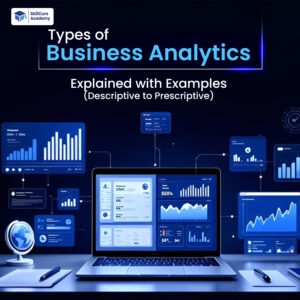

In today’s data-driven world, business analytics is no longer limited to large corporations or data scientists. It plays a role in everyday decision-making—from managing personal finances to choosing the fastest route home. Understanding the different types of business analytics helps individuals and organizations make informed, strategic decisions.
Business analytics is broadly classified into four types:
- Descriptive Analytics.
- Diagnostic Analytics.
- Predictive Analytics.
- Prescriptive Analytics.
Each type answers a different question and builds upon the previous one.
Overview Table:
| Type of Analytics | Key Question Answered | Purpose | Complexity Level |
|---|---|---|---|
| Descriptive | What happened? | Summarizes past data | Low |
| Diagnostic | Why did it happen? | Identifies causes | Medium |
| Predictive | What will happen? | Forecasts future outcomes | High |
| Prescriptive | What should we do? | Recommends actions | Very High |
1. Descriptive Analytics – What happened?
Descriptive analytics focuses on analyzing historical data to understand past performance. It is the foundation of all analytics processes.
Everyday Example:
Checking your monthly bank statement to see:
- Total spending.
- Categories of expenses.
- Transaction history.
Business Example:
A company reviews:
- Monthly sales reports.
- Revenue figures.
- Customer acquisition numbers.
Key Features:
- Uses historical data.
- Provides summaries and reports.
- Helps in identifying trends.
2. Diagnostic Analytics – Why did it happen?
Diagnostic analytics goes a step further by identifying the root causes behind trends or anomalies.
Everyday Example:
If your expenses increased, you analyze:
- Increased online shopping.
- Travel or special events.
Business Example:
A company investigates declining sales by analyzing:
- Customer feedback.
- Website traffic.
- Pricing changes.
Key Features:
- Drill-down analysis.
- Correlation and pattern identification.
- Root cause analysis.
3. Predictive Analytics – What is likely to happen?
Predictive analytics uses statistical models and machine learning techniques to forecast future outcomes.
Everyday Example:
- Weather forecasts.
- Fitness apps predicting progress.
Business Example:
- Demand forecasting.
- Customer behavior prediction.
Key Features:
- Uses historical and real-time data.
- Identifies patterns and trends.
- Helps in forecasting future events.
4. Prescriptive Analytics – What should we do?
Prescriptive analytics provides actionable recommendations based on predictions and data insights.
Everyday Example:
- Navigation apps suggesting fastest routes.
- Shopping apps recommending products.
Business Example:
- Dynamic pricing strategies.
- Resource allocation.
- Marketing optimization.
Key Features:
- Suggests actions.
- Uses AI and optimization techniques.
- Supports decision-making.
Comparative Summary Table:
| Aspect | Descriptive | Diagnostic | Predictive | Prescriptive |
|---|---|---|---|---|
| Focus | Past | Past + Causes | Future | Action |
| Data Type | Historical | Historical | Historical + Current | All Data |
| Output | Reports | Insights | Forecasts | Recommendations |
| Example Tool | Dashboards | Data Mining | Machine Learning Models | AI Systems |
Real-Life Integrated Example?
Consider ordering food online:
- Descriptive: You view your past orders.
- Diagnostic: You notice higher weekend spending.
- Predictive: The app predicts your next order timing.
- Prescriptive: The app offers discounts to influence your decision.
Conclusion
Business analytics is a powerful tool that transforms raw data into meaningful insights. By understanding its four types, individuals and organizations can make better, data-driven decisions.
From simply understanding the past to actively shaping the future, business analytics plays a critical role in modern life.
Frequently Asked Questions (FAQs)
1. What is the main purpose of business analytics?
Business analytics helps organizations and individuals make informed decisions by analyzing data and extracting meaningful insights.
2. Which type of analytics is the most advanced?
Prescriptive analytics is the most advanced as it not only predicts outcomes but also recommends actions.
3. Can small businesses use business analytics?
Yes, even small businesses can use basic analytics tools like spreadsheets and dashboards to gain insights.
4. What tools are commonly used in business analytics?
Common tools include Excel, Power BI, Tableau, and various machine learning platforms.
5. How are predictive and prescriptive analytics different?
Predictive analytics forecasts future outcomes, while prescriptive analytics suggests the best actions to achieve desired results.