


In today’s data-driven landscape, organizations must make decisions faster than ever before. Traditional analytics methods, which rely on processing historical data, are no longer sufficient for many modern use cases. This has led to the rise of real-time analytics, a powerful approach that enables instant insights and rapid decision-making.
What is Real-Time Analytics?
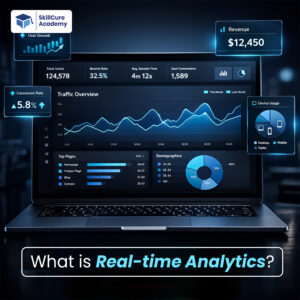
Real-time analytics refers to the process of collecting, processing, and analyzing data as soon as it is generated, enabling organizations to act on insights immediately.
Unlike batch processing, where data is analyzed after a delay, real-time analytics ensures minimal latency between data generation and actionable insights.
How Real-Time Analytics Works?
A typical real-time analytics pipeline consists of the following stages:
| Stage | Description |
|---|---|
| Data Generation | Data is created from sources such as applications, sensors, or transactions |
| Data Ingestion | Streaming systems collect and transfer data continuously |
| Data Processing | Real-time engines process and analyze incoming data |
| Data Visualization | Dashboards display insights instantly |
| Action/Response | Automated or manual actions are triggered based on insights |
Key Technologies Used?
| Technology Type | Purpose | Examples |
|---|---|---|
| Streaming Platforms | Handle real-time data streams | Kafka, Kinesis |
| Processing Engines | Analyze streaming data | Flink, Spark Streaming |
| Data Warehouses | Store and query large datasets | BigQuery, Snowflake |
| Visualization Tools | Display real-time dashboards | Tableau, Power BI |
Real-World Applications?
| Industry | Use Case | Benefit |
|---|---|---|
| E-commerce | Personalized recommendations | Increased sales |
| Finance | Fraud detection | Reduced financial risk |
| Healthcare | Patient monitoring | Improved patient outcomes |
| Transportation | Traffic and route optimization | Reduced travel time |
| Social Media | Trend analysis | Better user engagement |
Benefits of Real-Time Analytics?
- Faster Decision-Making: Immediate insights enable quick actions.
- Enhanced Customer Experience: Personalized and responsive interactions.
- Improved Operational Efficiency: Continuous monitoring of systems.
- Proactive Risk Management: Early detection of anomalies or threats.
- Competitive Advantage: Ability to react faster than competitors.
Challenges of Real-Time Analytics?
| Challenge | Description |
|---|---|
| High Infrastructure Cost | Requires advanced systems and cloud resources |
| Data Complexity | Managing continuous data streams is complex |
| Scalability Issues | Systems must handle large volumes of data |
| Data Consistency | Ensuring accuracy across real-time systems is difficult |
Real-Time vs Batch Analytics?
| Feature | Real-Time Analytics | Batch Analytics |
|---|---|---|
| Processing Speed | Instant (ms to seconds) | Delayed (minutes to hours) |
| Data Handling | Continuous streams | Scheduled batches |
| Use Case | Live monitoring | Historical reporting |
| Complexity | High | Moderate |
Best Practices for Implementation?
- Choose the right technology stack based on scale and requirements.
- Ensure low-latency data pipelines.
- Focus on data quality and validation.
- Implement strong monitoring and alert systems.
- Design for scalability from the beginning.
Frequently Asked Questions (FAQs).
1. What is the difference between real-time and near real-time analytics?
Real-time analytics processes data instantly with minimal latency, while near real-time analytics involves slight delays (seconds to minutes).
2. Is real-time analytics expensive to implement?
Yes, it can be costly due to infrastructure, tools, and maintenance, but cloud-based solutions can reduce upfront investment.
3. Which industries benefit most from real-time analytics?
Industries like finance, healthcare, e-commerce, and transportation benefit significantly due to the need for immediate insights.
4. Can small businesses use real-time analytics?
Yes, many cloud platforms offer scalable and cost-effective solutions suitable for small and medium-sized businesses.
5. What skills are required to work with real-time analytics?
Key skills include data engineering, stream processing, cloud computing, and knowledge of analytics tools.
Conclusion.
Real-time analytics is transforming how organizations operate by enabling instant insights and faster decision-making. While it comes with challenges, the benefits far outweigh the costs when implemented correctly.
As data continues to grow in volume and importance, mastering real-time analytics will be essential for businesses aiming to stay competitive in the modern digital era.