

A Data Analyst Course is a practical starting point for students, freshers, and working professionals who want to build a career in data analytics. As businesses increasingly use data to make decisions, professionals who can analyze information, identify patterns, and prepare reports are valuable across different industries.
Whether you have recently graduated or want to switch careers, learning data analytics can help you develop technical and analytical skills relevant to modern business environments.
But what should you learn in a data analyst course? Which tools are important? How long does training take, and what career opportunities can you explore after completing it?
In this guide, we will cover the essential details you should know before choosing a data analyst course in 2026.
What Is a Data Analyst Course?
A data analyst course teaches learners how to collect, clean, analyze, and interpret data to solve business problems.
The training generally covers analytical tools, database queries, data visualization, reporting, and practical projects. Depending on the curriculum, students may learn Microsoft Excel, SQL, Power BI, Python, and statistical concepts.
For example, a retail company might use data analytics to identify its best-selling products, understand customer purchasing patterns, and improve inventory planning.
A trained data analyst helps transform raw information into meaningful insights that support better decisions.
Why Should You Learn Data Analytics in 2026?
Data analytics is used across industries, including IT, banking, healthcare, e-commerce, retail, finance, and digital marketing.
Organizations use data to understand customer behavior, measure business performance, identify trends, and improve operational efficiency.
Here are some reasons to consider learning data analytics:
- Multiple career paths: Explore roles in reporting, business intelligence, and data analysis.
- Practical technical skills: Learn tools used to organize, analyze, and visualize information.
- Industry flexibility: Apply analytical skills across different business sectors.
- Career development: Build skills that can complement your existing education or professional experience.
- Project-based learning: Develop projects that demonstrate your ability to solve analytical problems.
Career opportunities depend on your skills, experience, educational qualifications, and the requirements of individual employers.
Data Analyst Course Syllabus: What Should You Learn?
Before enrolling in a data analyst course, check whether its syllabus covers the essential tools and concepts required for practical analytical work.
A structured course should help you progress from basic data handling to more advanced analysis and reporting.
| Tool or Subject | Important Topics | How It Is Used |
|---|---|---|
| Advanced Excel | Formulas, PivotTables, lookup functions, data cleaning | Data organization and reporting |
| SQL | SELECT, JOINs, GROUP BY, subqueries | Retrieving and analyzing database information |
| Power BI | Power Query, data modeling, DAX, dashboards | Interactive business reporting |
| Python | Fundamentals, Pandas, NumPy, visualization | Data manipulation and exploratory analysis |
| Statistics | Mean, median, distributions, correlation | Understanding patterns in data |
| Data Visualization | Charts, KPIs, dashboards | Communicating insights clearly |
The exact syllabus varies between institutes. Beginners should prioritize understanding the fundamentals before moving on to more advanced topics.
1. Advanced Excel
Excel is an important starting point for many aspiring data analysts.
It helps users organize information, perform calculations, identify errors, and prepare reports.
Key topics include:
- IF and nested IF functions
- VLOOKUP and XLOOKUP
- SUMIF and COUNTIF
- PivotTables and PivotCharts
- Conditional formatting
- Data cleaning and validation
These skills are useful for reporting, business analysis, and everyday data management tasks.
2. SQL for Data Analysis
SQL is used to retrieve and analyze information stored in relational databases.
A data analyst may use SQL to identify monthly sales, compare product performance, or summarize customer transactions.
Important concepts include SELECT statements, filtering, aggregate functions, JOINs, GROUP BY, HAVING, and subqueries.
Practicing SQL with business datasets helps learners understand how to answer practical questions using data.
3. Power BI for Data Visualization
Power BI helps analysts transform data into interactive dashboards and reports.
Instead of presenting large spreadsheets, analysts can use visualizations to communicate important business metrics.
Topics to learn include:
- Connecting data sources
- Data transformation using Power Query
- Building relationships between tables
- Creating measures using DAX
- Designing interactive dashboards
- Publishing and sharing reports
Power BI projects can demonstrate your ability to turn data into clear, actionable business insights.
4. Python for Data Analytics
Python is useful for data cleaning, exploratory analysis, automation, and visualization.
Beginners can start with basic programming concepts before learning libraries commonly used for data analysis.
Important topics include Python fundamentals, Pandas, NumPy, data manipulation, handling missing values, and data visualization.
You do not need to master every Python feature to begin working on introductory analytics projects.
How Long Does a Data Analyst Course Take?
The duration of a data analyst course depends on its syllabus, class schedule, learning format, and the amount of practice included.
The following table provides illustrative estimates rather than fixed industry standards.
| Learning Format | Illustrative Duration | Suitable For |
|---|---|---|
| Intensive training | 2–3 months | Learners who can study regularly |
| Structured professional course | 3–6 months | Students seeking guided learning and projects |
| Self-paced learning | Varies | Learners studying alongside work or college |
When comparing courses, ask whether the advertised duration includes practical assignments, projects, revision, and interview preparation.
The number of months alone does not determine how job-ready a learner will become.
Data Analyst Course Fees in India
The cost of a data analyst course varies according to the institute, course duration, training format, syllabus, project work, and additional services.
Online courses, classroom programs, and comprehensive instructor-led training may have different pricing structures.
Before paying the fee, compare what each program includes.
| Factor | Questions to Ask |
|---|---|
| Course syllabus | Are Excel, SQL, Power BI, and Python covered? |
| Practical training | Will you work with datasets and assignments? |
| Projects | How many projects will you complete? |
| Trainer support | Can you ask questions and receive feedback? |
| Interview preparation | Are mock interviews and resume guidance included? |
| Career assistance | What support is provided, and what are its limitations? |
For accurate pricing, request the latest fee structure directly from the institute.
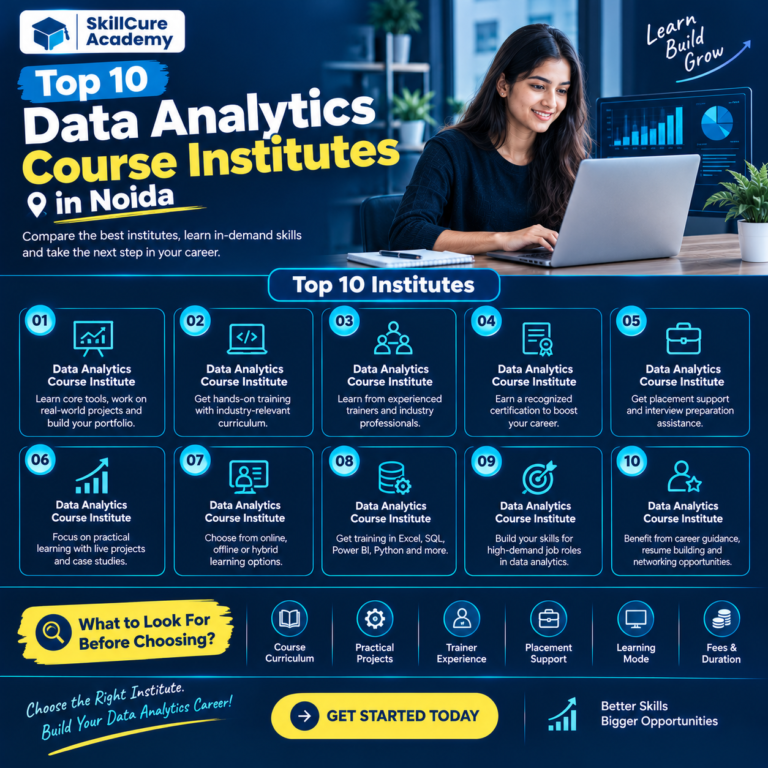
How to Choose the Best Data Analytics Course Institute in Noida
If you are searching for the best data analytics course institute in Noida, compare institutes based on the quality of training rather than relying on advertisements alone.
A good learning environment should help you understand analytical concepts, practice with relevant tools, and apply your knowledge to business problems.
Consider the following factors before enrolling.
Practical training: Choose a program that provides hands-on exercises rather than focusing exclusively on theory.
Industry-relevant syllabus: Check whether the curriculum includes the tools and concepts relevant to your career goals.
Real-world projects: Ask whether you will complete projects involving sales, customer behavior, finance, or other business scenarios.
Trainer guidance: Understand how trainers explain difficult concepts and help students resolve technical problems.
Interview preparation: Check whether the institute provides technical question practice, mock interviews, or resume guidance.
Flexible learning options: Compare online and offline classes according to your schedule and preferences.
Taking time to evaluate these factors can help you select a course that matches your learning requirements.
Skillcure Academy: Data Analytics Training in Noida
Skillcure Academy offers online and offline learning options for students and professionals interested in developing data analytics skills.
For learners comparing a Data Analyst Course in Noida, the important considerations include the curriculum, practical exercises, project opportunities, and support available during training.
A structured learning plan can help beginners progress from understanding spreadsheets and databases to developing dashboards and analyzing datasets.
Before enrolling, prospective students should confirm the current syllabus, batch timings, course fees, training duration, and available career support directly with the institute.
Choosing a course that combines conceptual learning with practical application can help you develop a stronger foundation in data analytics.
Projects to Build During a Data Analyst Course
Projects help you demonstrate how you apply analytical tools to practical problems.
Instead of listing software skills alone on your resume, you can explain the problem you investigated, the steps you followed, and the insights you discovered.
Here are some project ideas for beginners.
| Project | Tools | Objective |
|---|---|---|
| Sales Dashboard | Excel, Power BI | Analyze revenue and product performance |
| Customer Analysis | SQL, Python | Identify purchasing patterns |
| Employee Attrition Analysis | Python, Power BI | Explore factors associated with employee turnover |
| E-commerce Analysis | SQL, Excel | Evaluate orders, sales, and customer trends |
| Financial Dashboard | Excel, Power BI | Track financial metrics and performance |
When presenting a project, explain your data-cleaning process, analytical approach, key findings, and recommendations.
A clear project portfolio can help recruiters understand your practical abilities.
Career Opportunities After a Data Analyst Course
After acquiring the relevant skills and practical experience, you can explore several roles depending on your qualifications and abilities.
| Job Role | Main Responsibility |
|---|---|
| Data Analyst | Analyze data and communicate findings |
| Junior Data Analyst | Assist with data preparation and analysis |
| MIS Executive | Prepare reports and maintain business information |
| Reporting Analyst | Generate regular business performance reports |
| Power BI Developer | Develop dashboards and data models |
| Business Analyst | Analyze business needs and support decision-making |
Your first role may focus on Excel reporting, data validation, or basic SQL analysis. With additional experience, you may progress toward more specialized analytical responsibilities.
Completing a course does not guarantee employment. Practical skills, project quality, communication, and interview performance also matter.
Frequently Asked Questions About Data Analyst Courses
1. Which course is best for becoming a data analyst?
A course that covers Excel, SQL, Power BI, Python, statistics, and practical projects can provide a useful foundation. Compare the syllabus and training approach before enrolling.
2. Can a fresher learn data analytics?
Yes. Freshers can start with the fundamentals and gradually develop their skills through guided practice, assignments, and projects.
3. Is coding required for a data analyst course?
Not all data analysis tasks require extensive programming. However, learning SQL and basic Python can expand the types of analytical work you can perform.
4. Can non-IT students pursue data analytics?
Yes. Students from commerce, management, science, and other educational backgrounds can learn data analytics. Eligibility requirements vary by employer and course provider.
5. How can I choose the best data analytics course institute in Noida?
Compare the syllabus, practical training, trainers, projects, learning format, fees, and career support. Ask for clear details before enrolling.