

Data Analytics and Business Analytics are two popular career options for students, freshers, and working professionals who want to build a career in the data-driven business world. Both fields help organisations make better decisions, improve performance, and solve business problems. However, they differ in their primary objectives, tools, responsibilities, and career paths.
If you are planning to enter the analytics industry, you may be wondering whether you should choose Data Analytics or Business Analytics. Understanding the difference between these fields can help you select the right career based on your interests, educational background, and professional goals.
In this blog, we will compare Data Analytics vs Business Analytics based on their meaning, skills, tools, job roles, salary, and career opportunities in India.
1. What Is Data Analytics?
Data Analytics is the process of collecting, cleaning, transforming, and analysing data to identify patterns, trends, and useful insights. Data analysts use statistical methods and analytical tools to understand what has happened, why it happened, and what the data reveals about business performance.
For example, an e-commerce company may use Data Analytics to identify its best-selling products, analyse customer purchasing patterns, track monthly revenue, and understand why sales have declined.
Common responsibilities of a Data Analyst include:
- Collecting and cleaning raw data.
- Analysing datasets using SQL, Excel, or Python.
- Creating reports and dashboards using Power BI or Tableau.
- Identifying trends, patterns, and performance issues.
- Presenting data-driven insights to stakeholders.
Data Analytics is suitable for people who enjoy working with numbers, exploring datasets, solving analytical problems, and using technical tools to discover insights.
2. What Is Business Analytics?
Business Analytics focuses on using data, business knowledge, and analytical techniques to solve business problems and improve decision-making.
Business Analysts and Business Analytics professionals work to understand business requirements, identify opportunities, evaluate performance, and recommend improvements. Depending on the role, they may also work with dashboards, reports, financial metrics, and business process documentation.
For example, a retail company may want to open a new store. A Business Analytics professional might evaluate customer demand, market conditions, operating costs, and expected revenue to help management decide whether the new location is commercially viable.
Common responsibilities include:
- Understanding business objectives and requirements.
- Analysing business performance and key metrics.
- Identifying operational problems and opportunities.
- Preparing reports and presenting recommendations.
- Communicating with stakeholders and different departments.
- Supporting business planning and decision-making.
Business Analytics is suitable for people who enjoy problem-solving, business strategy, communication, and understanding how organisations operate.
3. Data Analytics vs Business Analytics: Key Differences
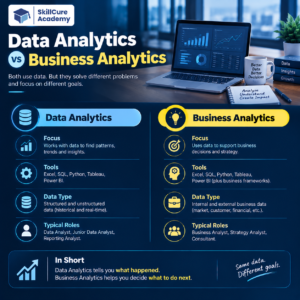
Although both fields use data to improve decisions, their primary focus is different. Data Analytics generally emphasises analysing data, while Business Analytics emphasises applying insights to business problems.
| Comparison Factor | Data Analytics | Business Analytics |
|---|---|---|
| Main focus | Analysing data to discover insights | Using analysis to solve business problems |
| Primary objective | Understand patterns, trends, and performance | Improve business decisions and outcomes |
| Key activities | Data cleaning, querying, analysis, visualisation | Requirement analysis, performance evaluation, recommendations |
| Technical focus | Often more technical and data-oriented | Often more business-oriented, depending on the role |
| Common tools | Excel, SQL, Python, Power BI, Tableau | Excel, SQL, Power BI, Tableau, business analysis tools |
| Important skills | Data analysis, statistics, data visualisation | Business understanding, communication, analytical thinking |
| Typical output | Reports, dashboards, analytical findings | Business recommendations, requirements, decision support |
| Common job titles | Data Analyst, BI Analyst, Reporting Analyst | Business Analyst, Business Analytics Analyst, Business Intelligence Analyst |
| Suitable interests | Working with datasets and technical tools | Solving business problems and improving processes |
Important: These fields overlap considerably. Some Data Analysts make strategic recommendations, while some Business Analysts work extensively with SQL, dashboards, and datasets. Job descriptions are more reliable than job titles alone.
4. Data Analytics vs Business Analytics: Skills Required
Both career paths require analytical thinking, attention to detail, and the ability to interpret information. However, the emphasis on specific skills can vary.
Skills Required for Data Analytics
To become a Data Analyst, you should focus on developing technical and analytical skills.
- Excel: Data cleaning, formulas, PivotTables, and reporting.
- SQL: Retrieving, filtering, joining, and aggregating data.
- Python: Data manipulation and analysis using libraries such as Pandas.
- Power BI or Tableau: Creating interactive dashboards and reports.
- Statistics: Understanding averages, distributions, trends, and relationships.
- Data storytelling: Explaining analytical findings clearly.
You should also practise working with real-world datasets to understand how to transform raw data into meaningful insights.
Skills Required for Business Analytics
Business Analytics requires a combination of analytical, communication, and business-related skills.
- Business understanding: Knowing how organisations generate revenue and manage costs.
- Requirement gathering: Understanding what stakeholders need.
- Excel and reporting: Analysing business metrics and preparing reports.
- Data visualisation: Presenting information through dashboards and charts.
- Problem-solving: Identifying the causes of business challenges.
- Communication: Explaining findings and recommendations to stakeholders.
- Process analysis: Understanding workflows and identifying improvements.
SQL, Power BI, and other technical skills can also be important, especially for Business Analytics roles that involve substantial data analysis.
5. Tools Used in Data Analytics vs Business Analytics
The tools used in both fields overlap, but their importance depends on the job responsibilities.
| Tool | Use in Data Analytics | Use in Business Analytics |
|---|---|---|
| Microsoft Excel | Cleaning, analysing, and summarising data | Business reports, budgets, and performance analysis |
| SQL | Extracting and querying data from databases | Retrieving business data and analysing metrics |
| Python | Data cleaning, automation, and statistical analysis | Advanced analysis and forecasting in technical roles |
| Power BI | Building analytical dashboards | Monitoring KPIs and business performance |
| Tableau | Visualising patterns and trends | Presenting business insights through dashboards |
| Jira | Tracking analytical tasks in some teams | Managing requirements and project workflows |
| Microsoft Visio | Occasionally documenting processes | Mapping business processes and workflows |
You do not need to learn every tool at once. Start with Excel and SQL, then learn a visualisation tool such as Power BI. If your preferred career requires it, expand your skills with Python, statistics, or business process tools.
6. Data Analytics vs Business Analytics Salary in India
Salary is an important consideration when choosing between these careers. Compensation depends on experience, industry, location, company size, technical skills, and the responsibilities of the role.
The following figures are broad illustrative estimates for India, not guaranteed salaries or verified current market averages.
| Experience Level | Data Analytics Roles | Business Analytics Roles |
|---|---|---|
| Fresher (0–1 year) | ₹2.5–4.5 LPA | ₹2.5–5 LPA |
| Early career (1–3 years) | ₹4–7 LPA | ₹4–8 LPA |
| Mid-level (3–5 years) | ₹6–12 LPA | ₹7–14 LPA |
| Experienced (5+ years) | ₹10–20+ LPA | ₹10–22+ LPA |
Actual offers can fall outside these ranges. Technical specialisation, consulting experience, domain knowledge, and strong communication skills can influence compensation in either field.
Neither career guarantees a higher salary. Compare specific job descriptions, required experience, and responsibilities instead of choosing based on job title alone.
7. Career Opportunities After Data Analytics
Data Analytics can lead to a range of roles across industries such as banking, healthcare, retail, e-commerce, technology, education, and telecommunications.
Common career options include:
| Job Role | Main Responsibility |
|---|---|
| Data Analyst | Analyses datasets and identifies useful insights |
| Business Intelligence Analyst | Builds reports and dashboards to monitor performance |
| Reporting Analyst | Prepares recurring reports and tracks business metrics |
| Marketing Analyst | Evaluates campaigns, customer behaviour, and marketing performance |
| Financial Data Analyst | Analyses financial data and performance indicators |
| Product Analyst | Studies product usage and customer behaviour |
With experience, professionals can move into senior analytical roles, analytics consulting, data engineering, or analytics management, depending on their skills and interests.
8. Career Opportunities After Business Analytics
Business Analytics professionals can work in organisations where data is used to improve processes, evaluate business performance, and support strategic decisions.
Common opportunities include:
| Job Role | Main Responsibility |
|---|---|
| Business Analyst | Understands business needs and recommends solutions |
| Business Analytics Analyst | Analyses business metrics and supports decisions |
| Business Intelligence Analyst | Uses reports and dashboards to monitor performance |
| Operations Analyst | Identifies inefficiencies and improves operations |
| Management Analyst | Evaluates organisational challenges and recommends improvements |
| Business Consultant | Helps organisations solve business and operational problems |
Some Business Analyst positions focus primarily on requirements, processes, and software implementation rather than advanced data analysis. Always check the specific responsibilities before applying.
9. Data Analytics vs Business Analytics: Which Is Better for Freshers?
Both are viable career options for freshers. The better choice depends on whether you prefer technical data work or business-focused problem-solving.
Choose Data Analytics if you:
- Enjoy working with Excel, SQL, Python, and datasets.
- Want to create dashboards and analyse trends.
- Like solving problems using numbers and evidence.
- Are interested in technical analytical roles.
Choose Business Analytics if you:
- Enjoy understanding business problems.
- Prefer working with stakeholders and teams.
- Like interpreting KPIs and recommending improvements.
- Are interested in business operations, consulting, or strategy.
Students from B.Com, BBA, economics, mathematics, engineering, and other backgrounds may enter either field. The required qualifications vary by employer, so focus on relevant skills, practical projects, and job requirements.
10. Which Career Should You Choose in 2026?
There is no single winner in the Data Analytics vs Business Analytics comparison. Both can provide career opportunities when supported by practical skills and relevant experience.
If you want a more technical, hands-on role involving data extraction, cleaning, visualisation, and analysis, Data Analytics may be a good starting point.
If you prefer understanding business requirements, evaluating performance, communicating with stakeholders, and recommending improvements, Business Analytics may suit you better.
A practical learning path for either career is to start with Excel, learn SQL, develop Power BI skills, and complete projects based on real business problems. Add Python for more technical analysis or strengthen business process and requirement-gathering skills for business-focused roles.
Frequently Asked Questions (FAQs)
1. What is the main difference between Data Analytics and Business Analytics?
Data Analytics focuses on examining data to identify patterns, trends, and insights. Business Analytics focuses on applying data and business knowledge to solve organisational problems and support decisions. The two fields often overlap.
2. Which is better, Data Analytics or Business Analytics?
Neither is universally better. Data Analytics may suit people who enjoy technical tools and working directly with datasets. Business Analytics may suit people who prefer business problem-solving, communication, and process improvement.
3. Which pays more in India: Data Analytics or Business Analytics?
Salaries vary by employer, industry, experience, and responsibilities. Business Analytics roles in consulting or strategy may offer strong compensation, while technical Data Analytics roles can also pay well. There is no guaranteed salary advantage for either field.
4. Can a B.Com or BBA student become a Data Analyst?
Yes. Graduates from B.Com, BBA, and other non-engineering backgrounds can pursue Data Analyst roles. They should learn Excel, SQL, Power BI, basic statistics, and relevant analytical techniques, and build a portfolio of practical projects.
5. Do I need Python for Business Analytics?
Python is not required for every Business Analytics position. Excel, SQL, dashboards, business knowledge, and communication may be sufficient for some roles. Python is useful when the position involves automation, advanced analysis, or forecasting.
Choosing between Data Analytics and Business Analytics becomes easier when you understand the daily work involved in each career. Focus on your interests, build practical skills, and select projects that match your target job. Both fields can be valuable career paths in India’s growing data-driven business environment.