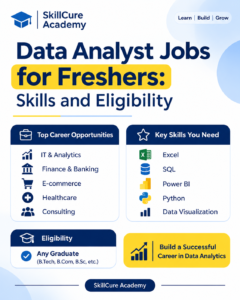

Are you a fresher looking for a job in the IT or analytics industry? Do you want to become a Data Analyst but don’t know which skills, qualifications, or tools are required?
Data Analytics is becoming an important part of modern businesses. Companies use data to understand customer behaviour, improve performance, identify business opportunities and make better decisions. Because of this, skilled data professionals are needed across different industries.
The good news is that you do not always need a computer science degree or previous work experience to start your career as a Data Analyst. Freshers from commerce, science, management, engineering and other educational backgrounds can also enter this field by developing the right technical and analytical skills.
In this blog, we will explain the eligibility criteria, essential skills, job opportunities, required tools and career preparation tips for freshers who want to become Data Analysts in India.
1. What Does a Data Analyst Do?
A Data Analyst collects, cleans, organises and analyses data to find useful information. Their main responsibility is to convert raw data into meaningful insights that help businesses make better decisions.
For example, an e-commerce company may want to understand why its sales are decreasing. A Data Analyst studies sales records, customer behaviour, product performance and other business information to identify possible reasons.
Some common responsibilities of a Data Analyst include:
- Collecting data from different sources.
- Cleaning and organising raw datasets.
- Analysing data using Excel, SQL and Python.
- Creating reports and interactive dashboards.
- Identifying trends and business patterns.
- Presenting insights to management teams.
- Supporting business decisions through data.
2. Eligibility Criteria for Data Analyst Jobs for Freshers
One of the most common questions among students is whether they are eligible for a Data Analyst job without having a technical degree.
The answer is yes. Many entry-level employers consider candidates from different educational backgrounds, depending on the job requirements.
Here are some common eligibility requirements:
| Eligibility Criteria | Requirements |
|---|---|
| Educational Qualification | Graduation in any relevant stream |
| Preferred Degrees | BCA, B.Tech, B.Sc, B.Com, BBA, BA and others |
| Experience | Freshers and candidates with 0–1 year experience |
| Technical Skills | Excel, SQL, Power BI and Python |
| Analytical Skills | Logical thinking and problem-solving |
| Communication | Ability to explain findings clearly |
| Projects | Practical knowledge through real-world projects |
Can a Non-Technical Student Become a Data Analyst?
Absolutely! Students from B.Com, BBA, BA and other non-technical backgrounds can also build a career in Data Analytics.
You need to understand how data works, learn industry-relevant tools and practise analysing real datasets.
Your educational background can also help you understand specific industries. For example, commerce graduates may find financial data analysis interesting, while management graduates may enjoy business and sales analytics.
3. Top Skills Required for Data Analyst Jobs
If you want to apply for Data Analyst jobs as a fresher, learning the right technical skills is important.
Companies generally look for candidates who can work with data, generate reports and communicate meaningful insights.
Let’s understand the most important skills.
1. Advanced Microsoft Excel
Excel is one of the most commonly used tools in Data Analytics. It helps analysts organise, clean, calculate and analyse information.
Important Excel skills include:
- VLOOKUP and XLOOKUP
- Pivot Tables
- IF and SUMIF functions
- Conditional Formatting
- Data Cleaning
- Charts and Graphs
- Data Validation
Freshers should practise working with large datasets and creating business reports using Excel.
2. SQL (Structured Query Language)
SQL is used to communicate with databases and retrieve the required information.
A Data Analyst often works with databases containing thousands or millions of records. SQL helps extract, filter and organise this information.
Important SQL concepts include:
- SELECT and DISTINCT
- WHERE and ORDER BY
- GROUP BY and HAVING
- Joins
- Subqueries
- Aggregate Functions
- Window Functions
SQL is an important skill for technical assessments and Data Analyst interviews.
3. Power BI
Power BI is a business intelligence and data visualisation tool developed by Microsoft.
It helps analysts convert complex datasets into interactive dashboards and reports.
Important Power BI skills include:
- Data Import
- Power Query
- Data Cleaning
- Data Modelling
- DAX Functions
- Interactive Dashboards
- Data Visualisation
For example, you can create a sales dashboard to understand monthly revenue, top-performing products and regional sales performance.
4. Python for Data Analytics
Python is a popular programming language used for data analysis, automation and data processing.
Freshers should understand basic Python programming and important libraries used in analytics.
Some important topics include:
- Variables and Data Types
- Conditional Statements
- Loops
- Functions
- Lists and Dictionaries
- NumPy
- Pandas
- Matplotlib
Python helps analysts handle datasets, perform calculations and identify patterns more efficiently.
5. Basic Statistics
Statistics helps Data Analysts understand numerical information and identify meaningful patterns.
You should understand concepts such as:
- Mean, Median and Mode
- Probability
- Standard Deviation
- Variance
- Correlation
- Data Distribution
These concepts help analysts interpret data and avoid incorrect conclusions.
4. Which Tools Should a Fresher Learn to Become a Data Analyst?
Here is a quick overview of the most important tools:
| Tool | Primary Use | Importance |
|---|---|---|
| Advanced Excel | Data Cleaning and Reporting | Essential |
| SQL | Database Management and Data Extraction | Essential |
| Power BI | Dashboard Development | Essential |
| Python | Data Analysis and Automation | Highly Useful |
| Tableau | Data Visualisation | Additional Skill |
| Statistics | Data Interpretation | Essential |
You do not need to master every available analytics tool before applying for your first job.
Start with Excel and SQL, develop practical knowledge of Power BI, and then strengthen your Python and statistical skills.
5. Types of Data Analyst Jobs Available for Freshers
After learning the required skills, you can explore different entry-level opportunities in the analytics industry.
Some common job roles include:
| Job Role | Responsibilities |
|---|---|
| Junior Data Analyst | Analysing datasets and preparing reports |
| Data Analyst Intern | Supporting data analysis projects |
| MIS Executive | Maintaining reports and business information |
| Reporting Analyst | Preparing regular business reports |
| Business Analyst Trainee | Understanding business requirements and analysing information |
| Power BI Developer Trainee | Creating dashboards and visual reports |
| Data Analytics Associate | Supporting analytics and reporting activities |
You should also search for jobs using terms such as Data Analyst Trainee, Junior Analyst, Analytics Associate and MIS Executive.
These alternative job titles can help you discover more entry-level opportunities.
6. How to Get Your First Data Analyst Job as a Fresher?
Learning tools is important, but practical knowledge makes a difference when you start applying for jobs.
Here are some steps that can help you prepare.
Step 1: Learn Industry-Relevant Tools
Start learning Advanced Excel, SQL, Power BI and Python. Focus on understanding how these tools are used in actual business situations.
Step 2: Work on Real-Time Projects
Projects help demonstrate your practical knowledge to recruiters.
Some beginner-friendly Data Analytics project ideas include:
- Netflix Data Analysis
- E-Commerce Sales Dashboard
- HR Employee Attrition Analysis
- Swiggy Sales Analysis
- Customer Behaviour Analysis
- Financial Performance Dashboard
Try to explain the problem, analysis process and insights generated through each project.
Step 3: Create a Professional Resume
Your resume should highlight your technical skills, educational qualifications, certifications and practical projects.
If you are a fresher, give sufficient importance to your projects because they demonstrate your ability to apply your knowledge.
Step 4: Prepare for Technical Interviews
Practise commonly asked questions related to Excel, SQL, Power BI, Python and statistics.
Also, prepare to explain your projects and the business insights you discovered.
Step 5: Apply for Entry-Level Opportunities
Start applying through job portals, company career pages, internships and professional networking platforms.
Some useful platforms include LinkedIn, Naukri, Indeed and Internshala.
Do not restrict your search to jobs mentioning only the word fresher. Explore suitable 0–2 years experience opportunities as well.
7. Common Mistakes Freshers Should Avoid
Many students learn Data Analytics but struggle to get shortlisted because they focus only on theoretical knowledge.
Avoid these common mistakes:
- Learning tools without practising them.
- Ignoring SQL and Advanced Excel.
- Building projects by simply copying tutorials.
- Having a resume without practical projects.
- Ignoring communication and presentation skills.
- Applying without preparing for technical interviews.
- Learning too many tools without mastering the basics.
Remember, companies want candidates who can solve problems using data, not just candidates who have completed multiple courses.
8. Start Your Data Analytics Career with Skillcure Academy
Are you looking for a practical Data Analytics course in Noida to prepare for entry-level job opportunities?
Skillcure Academy provides practical training in Data Analytics and Data Science with a focus on industry-relevant tools and real-world projects.
Our Data Analytics training covers important skills such as:
- Advanced Excel
- SQL
- Power BI
- Python
- Data Visualisation
- Practical Projects
- Mock Interview Sessions
- Presentation Sessions
At Skillcure Academy, students get opportunities to demonstrate their knowledge through live mock interviews and project presentations on the Skillcure Academy YouTube channel.
These activities help students improve their technical understanding, communication skills and confidence.
Whether you are a fresher, graduate or working professional looking to switch careers, developing practical Data Analytics skills can help you prepare for opportunities in the analytics industry.
Start your Data Analytics journey with Skillcure Academy today!
Website: https://skillcureacademy.com/
Location: Noida Sector 15
Contact: 8595385355
Conclusion
Getting your first Data Analyst job as a fresher is possible if you have the right combination of technical knowledge, analytical thinking and practical experience.
Start by learning Advanced Excel, SQL, Power BI, Python and basic statistics. Work on real-world projects, build a professional resume and prepare for technical interviews.
You do not need to know everything before starting your career. Focus on building strong fundamentals, improving your practical skills and applying consistently.
The demand for data-driven decision-making creates opportunities across different industries. With the right preparation, you can take your first step towards becoming a Data Analyst.
Frequently Asked Questions (FAQs)
1. Can a fresher get a Data Analyst job without experience?
Yes. Freshers can apply for entry-level Data Analyst jobs, internships and trainee positions. Practical projects, technical knowledge and a good understanding of Excel, SQL and Power BI can help demonstrate your abilities.
2. What qualifications are required for a Data Analyst job?
Most employers prefer candidates with a bachelor’s degree in fields such as Computer Science, Mathematics, Statistics, Commerce, Economics, Engineering or Management. However, eligibility requirements vary by company and job role.
3. Which skills are most important for a fresher Data Analyst?
The most important skills include Advanced Excel, SQL, Power BI, Python, basic statistics, data visualisation and problem-solving. Communication skills are also important.
4. Can a B.Com or BBA student become a Data Analyst?
Yes. B.Com and BBA graduates can become Data Analysts by learning industry-relevant tools such as Excel, SQL, Power BI and Python. Their knowledge of finance, accounting and business can also be useful in analytics roles.
5. Is Python compulsory for a Data Analyst job?
Python is not compulsory for every entry-level Data Analyst position. However, it is a valuable skill that helps with data cleaning, analysis and automation. Learning Python along with SQL and Power BI can improve your technical capabilities.