

Ranking a website on Google in 2026 is one of the most important goals for businesses, bloggers, startups and digital marketers. When people search for a product, service or solution, they usually visit websites that appear on the first page of Google. This makes search engine optimization (SEO) essential for increasing website traffic, generating leads and building online visibility.
However, ranking on Google is no longer just about adding keywords to website content. Google considers multiple factors, including content quality, website experience, technical performance, search intent, website authority and trustworthiness.
Whether you are a beginner learning SEO or a business owner trying to grow your website, understanding modern SEO strategies can help you improve your search engine rankings.
In this guide, we will explore how to rank a website on Google in 2026 using practical and effective SEO techniques.
1. Understand How Google Ranking Works
Before implementing SEO strategies, it is important to understand how Google Search works.
Google generally follows three major processes:
| Process | Meaning |
|---|---|
| Crawling | Google discovers website pages through links and other methods. |
| Indexing | Google analyzes and stores information about discovered pages. |
| Ranking | Google selects and organizes relevant pages for a user’s search query. |
Your website must be accessible to Google, eligible for indexing and relevant to users’ search queries to appear in search results.
Remember that getting indexed does not guarantee first-page rankings.
2. Perform Proper Keyword Research
Keyword research is the foundation of every successful SEO strategy.
Keywords are the words and phrases people enter into Google when searching for information, products or services.
For example, someone looking for digital marketing training in Noida might search for:
- Digital marketing course in Noida
- Best digital marketing institute in Noida
- Digital marketing training for beginners
- Digital marketing course fees in Noida
- Digital marketing course with placement
Your website should target keywords that match your audience’s requirements.
Types of SEO Keywords
| Keyword Type | Example |
|---|---|
| Short-tail keywords | Digital Marketing |
| Long-tail keywords | Best digital marketing course in Noida |
| Informational keywords | What is SEO? |
| Commercial keywords | Best SEO tools |
| Transactional keywords | Join digital marketing course |
| Local keywords | SEO institute near me |
Popular Keyword Research Tools
Some useful keyword research tools include:
- Google Keyword Planner
- Google Search Console
- Ahrefs
- SEMrush
- Ubersuggest
- Google Trends
Pro Tip: Target a combination of primary, secondary and long-tail keywords. Avoid keyword stuffing because excessive keyword repetition can make content unnatural and negatively affect the user experience.
3. Create High-Quality, SEO-Friendly Content
Content plays an important role in website ranking.
Google aims to provide users with helpful, relevant and reliable information. Therefore, publishing content only to insert keywords is not an effective long-term SEO strategy.
Your content should solve the user’s problem and provide useful information.
Important Content Optimization Techniques
- Write informative and original content.
- Use your primary keyword naturally.
- Divide content into proper H1, H2 and H3 headings.
- Keep paragraphs short and easy to understand.
- Include relevant examples and practical information.
- Add FAQs based on actual user questions.
- Link to relevant pages within your website.
- Update outdated information whenever necessary.
For example, if your target keyword is “How to Rank a Website on Google in 2026”, your article should explain keyword research, technical SEO, backlinks, content optimization and website performance.
The goal should be to provide a better answer than competing websites, not simply publish a longer article.
4. Focus on On-Page SEO Optimization
On-page SEO refers to optimizing individual website pages to help search engines understand their content and relevance.
It also improves the experience of visitors navigating your website.
Important On-Page SEO Elements
| SEO Element | Best Practice |
|---|---|
| SEO Title | Include your primary keyword naturally. |
| Meta Description | Write an attractive and relevant description. |
| URL Slug | Keep URLs short and descriptive. |
| H1 Heading | Use one clear main heading. |
| H2 and H3 | Organize information into meaningful sections. |
| Image Alt Text | Describe images accurately. |
| Internal Links | Connect relevant pages of your website. |
| External Links | Reference trustworthy and relevant sources. |
Example of On-Page SEO
Suppose your target keyword is “Best Data Analytics Course in Noida”.
You can optimize your page using:
- SEO Title: Best Data Analytics Course in Noida – Complete Guide
- H1: Best Data Analytics Course in Noida
- URL: /data-analytics-course-in-noida/
- Meta Description: Explore data analytics courses in Noida, learn essential tools like Excel, SQL and Power BI, and discover practical training opportunities.
Remember to write titles and descriptions that accurately represent the page rather than forcing keywords into every sentence.
5. Improve Technical SEO
Technical SEO helps search engines crawl, understand and access your website efficiently.
Even high-quality content may struggle to perform if your website has serious technical issues.
Important Technical SEO Factors
1. Website Speed
A slow website can create a frustrating experience for visitors. Optimize images, reduce unnecessary scripts and use reliable hosting.
2. Mobile-Friendly Design
Most people browse websites through smartphones. Your website should display properly across mobile phones, tablets and desktops.
3. HTTPS Security
Install an SSL certificate and ensure your website uses HTTPS to provide a secure browsing experience.
4. XML Sitemap
An XML sitemap helps search engines discover important website URLs.
5. Robots.txt
Use the robots.txt file to guide search engine crawlers about which website sections they can access.
6. Fix Broken Links
Identify and fix broken internal links and incorrect redirects to improve website navigation.
7. Canonical Tags
Use canonical tags where appropriate to identify the preferred version of similar or duplicate pages.
6. Optimize Website Speed and Core Web Vitals
Website performance is an important part of providing a good page experience.
Google uses Core Web Vitals to evaluate important aspects of user experience.
The three major Core Web Vitals are:
| Metric | What It Measures | Good Score |
|---|---|---|
| LCP | Loading performance | 2.5 seconds or less |
| INP | Interaction responsiveness | 200 milliseconds or less |
| CLS | Visual stability | 0.1 or less |
How to Improve Website Performance
- Compress large images.
- Use modern image formats such as WebP.
- Enable browser caching.
- Reduce unnecessary plugins.
- Minimize unused CSS and JavaScript.
- Use a reliable hosting provider.
- Consider using a Content Delivery Network (CDN).
You can check your website performance using Google PageSpeed Insights.
A good Core Web Vitals score supports a better user experience, but it does not guarantee higher rankings.
7. Build High-Quality Backlinks
Backlinks are links from other websites that point towards your website.
They can help search engines discover your content and understand your website’s reputation and relevance.
However, not every backlink is valuable. Links from relevant, trustworthy websites are generally more useful than large numbers of unrelated or low-quality links.
Effective Link-Building Strategies
- Guest posting on relevant websites.
- Publishing original research and useful resources.
- Creating informative infographics.
- Getting mentioned by industry websites.
- Collaborating with relevant businesses.
- Publishing content that other websites naturally want to reference.
Avoid buying spammy backlinks, participating in link schemes or creating artificial links just to manipulate rankings.
Remember: Quality and relevance matter more than backlink quantity.
8. Focus on Local SEO for Better Visibility
If you run a business that serves customers in a particular location, local SEO can help you attract nearby customers.
For example, an institute offering digital marketing or data analytics courses in Noida should optimize its online presence for relevant local searches.
Important Local SEO Strategies
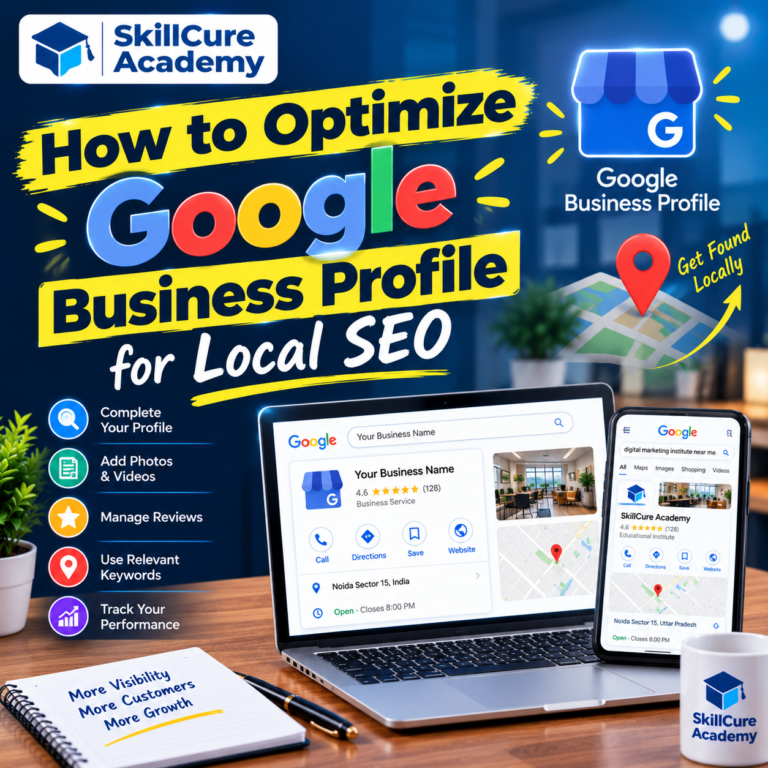
- Create and optimize your Google Business Profile.
- Add accurate business name, address and phone number.
- Select relevant business categories.
- Upload genuine business and classroom photographs.
- Collect authentic customer reviews.
- Respond professionally to reviews.
- Maintain consistent business information across directories.
- Create location-specific website pages where they provide genuine value.
For example, businesses can target relevant searches such as:
- Digital Marketing Institute in Noida
- Data Analytics Course in Noida
- Best Training Institute in Noida
Local SEO helps businesses improve their visibility in relevant local search results and Google Maps.
9. Use Internal Linking to Improve Website Structure
Internal linking means connecting one page of your website to another relevant page.
It helps visitors discover related information and allows search engines to understand the relationship between different pages.
For example, a blog about SEO interview questions can link to:
- SEO Course for Beginners
- How to Rank a Website on Google
- Digital Marketing Course in Noida
- Best SEO Tools for Beginners
Benefits of Internal Linking
- Improves website navigation.
- Helps search engines discover pages.
- Establishes relationships between related topics.
- Distributes link equity across relevant pages.
- Encourages visitors to explore more content.
Use descriptive anchor text instead of generic phrases such as “Click Here”.
10. Optimize Your Website for AI Search and Answer Engines
Search behaviour is evolving in 2026.
Apart from traditional Google search results, users are increasingly discovering information through AI-powered search experiences and answer engines.
This makes it important to create content that is easy to understand, accurate and well-structured.
AEO and AI Search Optimization Strategies
AEO stands for Answer Engine Optimization. It focuses on making content useful and understandable for systems that provide direct answers to users’ questions.
Consider these practices:
- Answer important questions directly.
- Use descriptive headings.
- Add relevant FAQs.
- Include factual information and examples.
- Demonstrate subject expertise.
- Mention credible sources wherever necessary.
- Keep important business information accurate.
- Organize related topics into meaningful content clusters.
For example, instead of writing only about “SEO”, create detailed content covering:
- What is SEO?
- How does SEO work?
- What are the types of SEO?
- How long does SEO take?
- Which SEO tools should beginners learn?
There is no guaranteed method to appear in AI-generated answers. Focus on publishing genuinely useful information that can be understood and trusted.
11. Track Website Performance Using Google Search Console and Analytics
SEO is not a one-time activity. You need to regularly monitor your website’s performance and identify opportunities for improvement.
Two important tools are Google Search Console and Google Analytics 4.
| Tool | Purpose |
|---|---|
| Google Search Console | Monitor search performance, indexing and technical issues. |
| Google Analytics 4 | Understand website visitors and their behaviour. |
| Google PageSpeed Insights | Analyze website performance. |
| Google Keyword Planner | Research keyword opportunities. |
| Ahrefs | Analyze backlinks and competitors. |
| SEMrush | Research keywords and monitor SEO performance. |
Important SEO Metrics to Monitor
- Organic website traffic
- Keyword rankings
- Search impressions
- Organic clicks
- Click-through rate (CTR)
- Indexed pages
- Backlink growth
- User engagement
- Conversions and enquiries
By monitoring these metrics, you can understand which pages are performing well and which require further optimization.
12. Common SEO Mistakes to Avoid in 2026
Many websites struggle to rank because of incorrect SEO practices.
Here are some common mistakes you should avoid:
| SEO Mistake | Why You Should Avoid It |
|---|---|
| Keyword Stuffing | Makes content unnatural and difficult to read. |
| Duplicate Content | Provides little additional value to users. |
| Buying Spammy Backlinks | Can violate Google’s spam policies. |
| Ignoring Mobile Optimization | Creates a poor mobile experience. |
| Slow Website Speed | Can negatively affect user experience. |
| Missing Meta Information | Reduces clarity and control over search presentation. |
| Publishing Low-Quality AI Content | Content without originality or value may perform poorly. |
| Ignoring Search Console | Makes SEO problems harder to identify. |
| Broken Internal Links | Affects navigation and page discovery. |
Avoid shortcuts and focus on building a website that genuinely helps its audience.
13. How Long Does It Take to Rank a Website on Google?
One of the most common questions among website owners is how long SEO takes to show results.
There is no fixed timeline because rankings depend on competition, website history, content quality, technical health, backlinks and search intent.
Here is an illustrative SEO progress timeline:
| Time Period | Possible SEO Activities |
|---|---|
| Month 1 | Website audit, keyword research and technical improvements. |
| Month 2 | Content optimization and internal linking. |
| Month 3 | Publishing quality content and building relevant backlinks. |
| Month 4–6 | Monitoring rankings, improving existing pages and expanding content. |
| Month 6–12 | Continuing optimization and strengthening website authority. |
These are planning stages, not guaranteed ranking milestones. Some pages may gain visibility earlier, while competitive keywords can take considerably longer.
Consistency, quality and continuous improvement are essential for long-term SEO success.
Why Should You Learn SEO in 2026?
Search engine optimization is an important digital marketing skill for businesses and professionals.
As companies continue investing in online visibility, the demand for people who understand SEO, content marketing, analytics and digital growth strategies remains relevant.
Learning SEO can help you explore career opportunities such as:
- SEO Executive
- SEO Analyst
- Digital Marketing Executive
- SEO Specialist
- Content Strategist
- Technical SEO Specialist
- Digital Marketing Manager
To become an SEO professional, you should understand keyword research, on-page SEO, off-page SEO, technical SEO, Google Analytics, Google Search Console and content optimization.
Practical knowledge and experience working on real websites can help you develop industry-ready skills.
Frequently Asked Questions (FAQs)
1. How can I rank my website on Google in 2026?
You can improve your website rankings by performing keyword research, creating helpful content, optimizing website pages, improving technical SEO, building relevant backlinks and monitoring performance through Google Search Console.
2. Is SEO still worth learning in 2026?
Yes. SEO remains an important digital marketing skill because businesses need organic visibility, website traffic and online leads. Learning SEO alongside analytics and AI-powered marketing tools can help professionals develop relevant industry skills.
3. How many keywords should I use in an SEO blog?
There is no fixed keyword limit for an SEO blog. Focus on one primary keyword and naturally include relevant secondary keywords and related search terms wherever they fit the content.
4. Do backlinks help websites rank higher on Google?
Relevant and trustworthy backlinks can help search engines discover content and understand a website’s authority. However, backlinks are only one part of SEO, and their quality and relevance matter more than quantity.
5. Which tools are best for improving Google rankings?
Some useful SEO tools include Google Search Console, Google Analytics 4, Google Keyword Planner, Google PageSpeed Insights, Ahrefs and SEMrush. These tools help with keyword research, performance tracking, technical analysis and backlink monitoring.