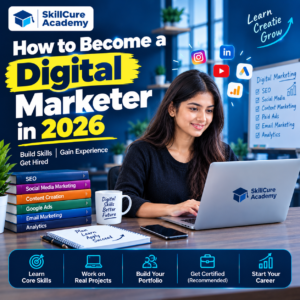

Digital marketing has become an important part of how businesses promote their products and services online. From social media marketing and Google Ads to SEO and content creation, companies need skilled professionals who can help them reach the right audience and generate leads.
If you are a student, fresher, graduate, or working professional looking for a career change, learning digital marketing can open up several career opportunities. The best part is that you do not necessarily need a technical degree or coding knowledge to get started.
But how do you become a digital marketer in 2026? Which skills should you learn? What tools do companies use? And how can you get your first digital marketing job?
This guide explains the complete roadmap to becoming a digital marketer, from learning the basics to building practical experience and applying for jobs.
What Is Digital Marketing?
Digital marketing is the process of promoting products, services, or brands through online channels. These channels include search engines, websites, social media platforms, email, and paid advertising platforms.
For example, when a business appears on Google when you search for a product, publishes promotional content on Instagram, or runs advertisements on YouTube, it is using digital marketing.
The primary goal is to reach potential customers, increase brand awareness, generate leads, and improve sales.
Digital marketing includes several important areas:
- Search Engine Optimization (SEO)
- Social Media Marketing
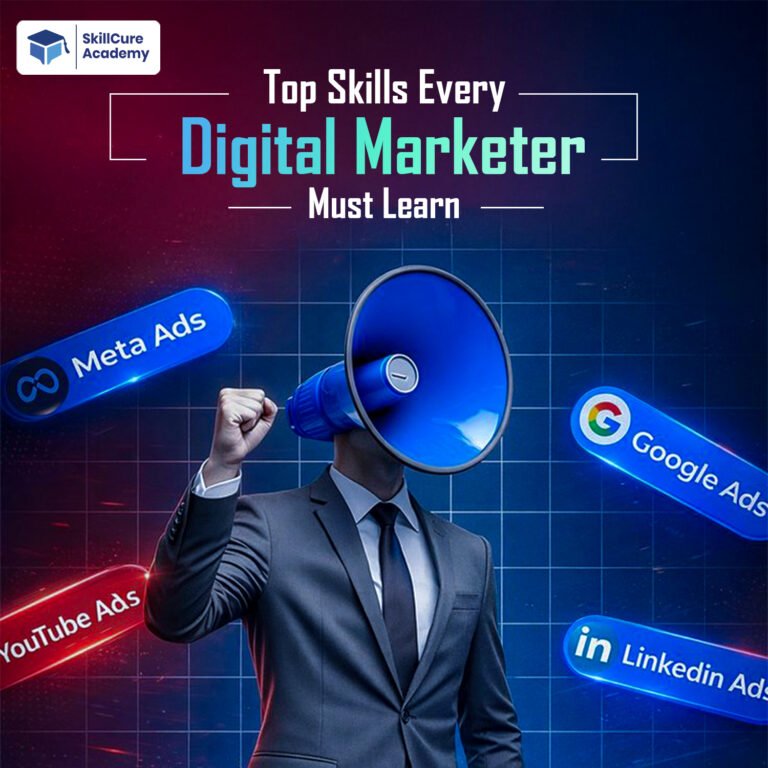
- Google Ads and Meta Ads
- Content Marketing
- Email Marketing
- Website Management
- Digital Marketing Analytics
- Affiliate Marketing
- AI-Powered Marketing
A beginner does not need to master every area immediately. You can start by understanding the fundamentals and gradually develop expertise in the fields that interest you most.
Why Choose Digital Marketing as a Career in 2026?
Digital marketing offers different career paths for people with creative, analytical, and communication skills. Businesses across industries use online platforms to connect with customers, making digital marketing relevant to companies of different sizes.
Here are some reasons to consider this career.
1. Opportunities for Freshers
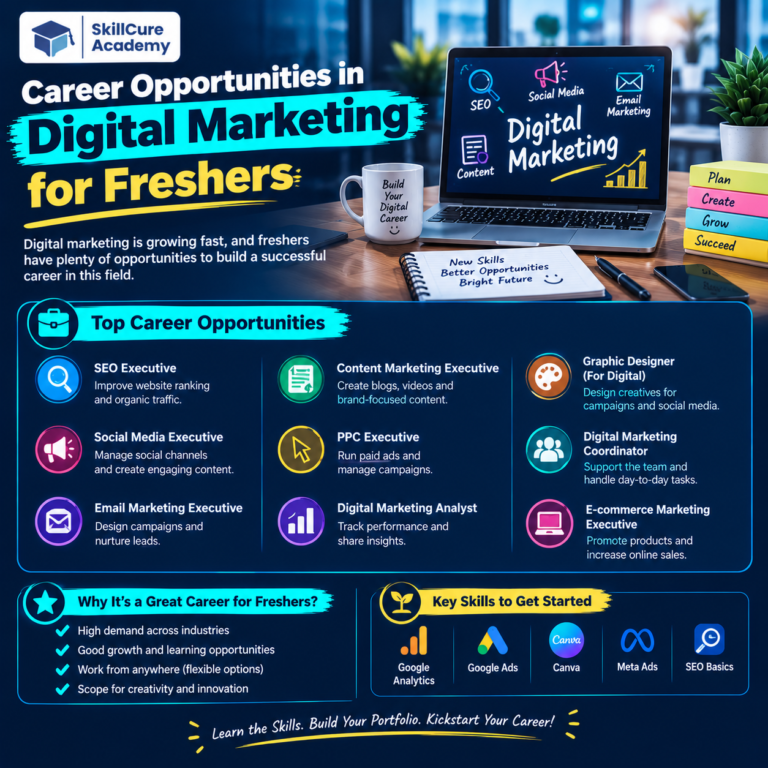
Freshers can explore entry-level positions such as Digital Marketing Executive, SEO Executive, Social Media Executive, and PPC Executive.
Employers may consider candidates from different educational backgrounds, although individual job requirements vary.
2. Multiple Career Paths
You can specialize in SEO, paid advertising, social media, content marketing, email marketing, or performance marketing. Each specialization requires a different combination of skills.
3. Freelancing Opportunities
Digital marketers can work with small businesses, startups, creators, and online stores. Freelancing can be an option for people who want to work independently.
4. Opportunities for Career Growth
With practical experience, professionals may progress to specialist, team leader, digital marketing manager, or performance marketing manager roles.
5. AI Is Changing Digital Marketing
AI tools can assist with content ideas, keyword research, campaign planning, audience analysis, and reporting. Learning to use these tools responsibly can improve productivity, but understanding marketing fundamentals remains essential.
Step-by-Step Guide: How to Become a Digital Marketer in 2026
If you are starting from zero, follow this step-by-step roadmap to build your digital marketing skills.
Step 1: Understand the Fundamentals of Digital Marketing
Begin by understanding how online marketing works and how businesses attract customers through digital channels.
Learn the difference between organic marketing and paid marketing. Organic marketing includes activities such as SEO and unpaid social media content, while paid marketing involves advertisements for which businesses pay.
You should also understand the customer journey, target audience, marketing funnels, brand awareness, lead generation, and conversion rates.
These concepts will help you understand why businesses choose particular marketing strategies.
Step 2: Learn Search Engine Optimization (SEO)
SEO helps websites improve their visibility in organic search results. It is an important skill for digital marketers who want to understand website traffic and search behaviour.
Start with these topics:
- Keyword research and search intent
- On-page SEO
- Technical SEO fundamentals
- Internal linking
- Content optimization
- Website indexing
- Google Search Console
- SEO performance tracking
For practical experience, create a blog on a topic you understand and optimize it for a relevant keyword. Monitor its indexing, impressions, clicks, and search performance.
This project will help you understand how SEO works beyond theoretical lessons.
Step 3: Learn Social Media Marketing
Social media marketing involves creating and publishing content to reach an audience, build a brand, and encourage engagement.
Digital marketers may work with platforms such as Instagram, Facebook, LinkedIn, and YouTube.
You should learn how to:
- Create a social media content calendar.
- Write captions and calls to action.
- Understand audience behaviour.
- Develop creative post and video ideas.
- Track reach, engagement, and conversions.
- Analyse content performance.
- Maintain a consistent brand identity.
Practical project: Select a business and prepare a 30-day social media content calendar. Create sample posts, write captions, and explain the objective of each post.
Step 4: Learn Google Ads and Meta Ads
Paid advertising is an important area of digital marketing. Businesses use advertising platforms to reach specific audiences and generate traffic, enquiries, leads, or sales.
Start by understanding campaign objectives, audience targeting, budgets, bidding, ad creatives, landing pages, and conversion tracking.
Learn the basics of:
| Advertising Platform | What You Should Learn |
|---|---|
| Google Ads | Search campaigns, keywords, bidding, and conversion tracking |
| Meta Ads | Facebook and Instagram campaigns, audience targeting, and lead generation |
| YouTube Ads | Video campaigns, audience selection, and campaign performance |
| Display Advertising | Banner ads, audience reach, and remarketing concepts |
Do not focus only on creating advertisements. Learn how to measure their effectiveness using metrics such as cost per lead, click-through rate, conversion rate, and return on ad spend.
You can begin with practice campaigns and simulated campaign plans before spending money on live advertisements.
Step 5: Learn Content Marketing and Copywriting
Content marketing involves creating useful content to attract and engage a target audience.
Digital marketers often write website pages, blog articles, social media captions, advertisements, video scripts, and email campaigns.
To develop your content skills, learn:
- Headline writing
- Basic copywriting principles
- Blog writing
- Storytelling
- Calls to action
- Content planning
- Audience research
- Content performance analysis
AI tools can help you brainstorm ideas and create initial drafts. However, you should review the information, improve the writing, check accuracy, and make the content relevant to the audience.
Step 6: Learn Digital Marketing Tools
Practical knowledge of marketing tools can help you perform everyday tasks more efficiently.
| Tool | Main Purpose |
|---|---|
| Google Analytics 4 | Understand website traffic and user behaviour |
| Google Search Console | Monitor organic search performance and indexing |
| Google Ads | Create and manage advertising campaigns |
| Meta Ads Manager | Manage Facebook and Instagram advertising |
| WordPress | Create and manage website content |
| Canva | Design social media creatives and marketing materials |
| Google Trends | Explore search interest and topic trends |
| ChatGPT | Assist with research, content ideas, planning, and analysis |
| Excel or Google Sheets | Organize campaign data and prepare reports |
You do not need to master every tool on your first day. Start with the tools relevant to your chosen specialization and expand your knowledge as you progress.
Step 7: Learn AI Tools for Digital Marketing
In 2026, AI-assisted workflows can help digital marketers complete several tasks more efficiently.
You can use AI tools to generate content ideas, develop campaign variations, summarize research, organize keywords, brainstorm audience segments, and assist with reporting.
However, AI-generated content and recommendations should not be accepted without review.
A skilled digital marketer understands the business objective, verifies information, protects customer data, and evaluates whether a campaign is actually producing results.
Focus on using AI to support your decision-making rather than relying on it to make every marketing decision.
Step 8: Work on Live Projects
This is one of the most important steps for beginners.
Watching tutorials and completing courses can help you understand concepts, but practical projects help you demonstrate that you can apply them.
You can build experience through personal projects, internships, supervised institute assignments, freelance work, or projects for local businesses.
Try completing projects such as:
- Creating an SEO strategy for a website.
- Writing and publishing SEO-friendly blog posts.
- Managing a social media content calendar.
- Developing a Google Ads campaign plan.
- Creating a Meta lead generation campaign structure.
- Analysing website traffic using Google Analytics.
- Preparing a monthly digital marketing performance report.
Record what you did, why you did it, which metrics you tracked, and what you learned.
Never invent campaign results for your portfolio. If a project is simulated, clearly identify it as a sample project.
What Is the Best Digital Marketing Course for Beginners?
A structured digital marketing course can help beginners learn multiple skills in a logical order. However, the best course depends on your learning preferences, budget, career goals, and the quality of practical training offered.
Before choosing a course, evaluate the following factors.
| Factor | What to Look For |
|---|---|
| Course syllabus | SEO, social media, paid ads, content, analytics, and relevant AI tools |
| Practical training | Hands-on assignments and campaign-based projects |
| Trainer experience | Relevant industry knowledge and the ability to explain concepts |
| Portfolio development | Opportunities to build projects you can demonstrate to employers |
| Interview preparation | Mock interviews, presentations, and communication practice |
| Learning format | Online, offline, or a combination of both |
| Career support | Resume guidance, interview preparation, and placement assistance details |
Avoid selecting a course only because it advertises a certificate or promises a guaranteed job. Check what you will actually learn and whether you will have opportunities to practise.
Learn Digital Marketing at Skillcure Academy
Skillcure Academy, located in Noida Sector 15, offers digital marketing training for learners who want to develop practical marketing skills.
When comparing training institutes, look for opportunities to practise the concepts you learn, work on assignments, prepare presentations, and improve your interview performance.
Skillcure Academy emphasizes practical learning, along with mock interviews and presentation sessions that help students practise explaining their knowledge and communicating professionally.
The institute offers online and offline learning options. Before enrolling, contact the institute to confirm the current syllabus, batch timings, fees, and available training facilities.
How Long Does It Take to Become a Digital Marketer?
The time required depends on your starting point, learning schedule, practice, and chosen specialization.
Here is an illustrative learning plan for a beginner who studies consistently.
| Learning Period | Main Focus |
|---|---|
| Month 1 | Digital marketing fundamentals, SEO basics, and content planning |
| Month 2 | Social media marketing, copywriting, and website basics |
| Month 3 | Google Ads, Meta Ads, and campaign planning |
| Month 4 | Analytics, AI tools, practical projects, and portfolio development |
This is a suggested learning schedule, not a guarantee that you will be job-ready within four months. Some learners progress faster, while others need additional practice.
Your goal should be to develop demonstrable skills rather than simply complete a fixed number of lessons.
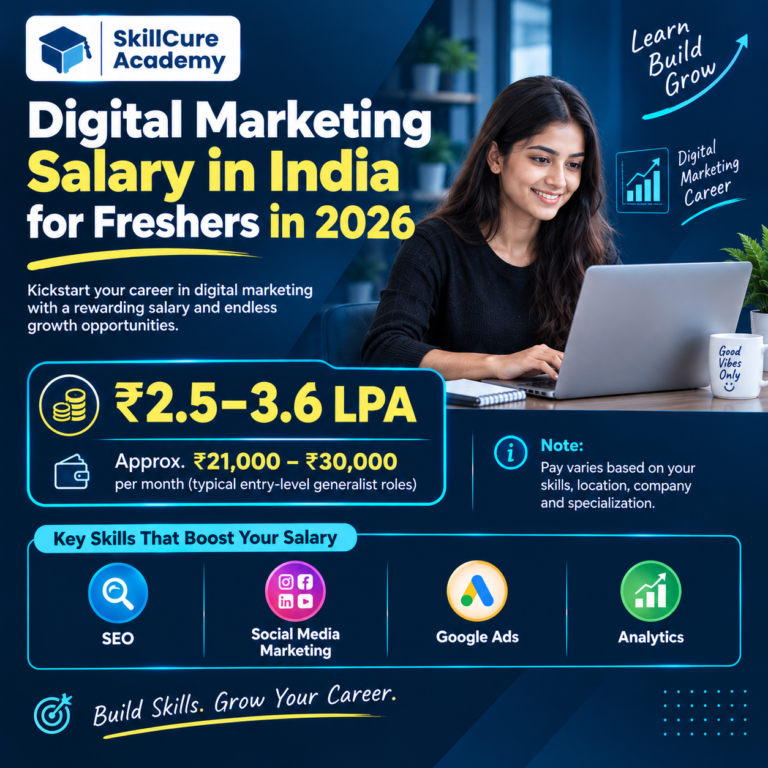
Digital Marketing Salary in India in 2026
Digital marketing salaries vary according to experience, location, specialization, company size, and practical skills.
The following table provides broad illustrative annual salary ranges for planning purposes, not verified national averages or guaranteed offers.
| Job Role | Experience | Illustrative Annual Salary |
|---|---|---|
| Digital Marketing Intern | Beginner | ₹1.2–2.4 LPA |
| Digital Marketing Executive | 0–2 years | ₹2–4.5 LPA |
| SEO Executive | 0–2 years | ₹2–4.5 LPA |
| Social Media Executive | 0–2 years | ₹2–4.5 LPA |
| PPC or Performance Marketing Executive | 0–2 years | ₹2.5–5 LPA |
| Digital Marketing Specialist | 2–4 years | ₹4–8 LPA |
| Digital Marketing Manager | Experienced professional | ₹8–18 LPA or more |
Actual salaries may fall outside these ranges. Check current job listings in your preferred city to understand the compensation offered for your target role.
To improve your earning potential, develop expertise in areas such as paid advertising, SEO, conversion optimization, marketing analytics, and campaign strategy. Employers value professionals who can explain their decisions and demonstrate measurable results.
How to Get Your First Digital Marketing Job
After learning the fundamentals and completing practical projects, prepare for the job application process.
Follow these steps to improve your chances.
1. Create a Digital Marketing Portfolio
Your portfolio should show the work you can perform. Include project descriptions, campaign plans, sample creatives, SEO audits, content calendars, and reports.
Where possible, explain the problem, your approach, the tools you used, and the results.
2. Prepare a Skills-Based Resume
Mention relevant skills, tools, projects, internships, and certifications. Keep the information accurate and focus on work that matches the job description.
If you are a fresher, academic projects and personal projects can help demonstrate your capabilities.
3. Practise Interview Questions
Prepare for questions about SEO, keyword research, social media strategy, Google Ads, Meta Ads, analytics, and content marketing.
Practise explaining concepts in your own words. Be ready to discuss your projects and the reasoning behind your decisions.
4. Apply for Entry-Level Roles
Search for positions such as:
- Digital Marketing Intern
- Digital Marketing Executive
- SEO Executive
- Social Media Executive
- Content Marketing Executive
- PPC Executive
- Performance Marketing Trainee
Read the job requirements carefully and customize your resume for relevant positions.
5. Improve Your Communication Skills
Digital marketers often explain campaign performance, discuss ideas with clients, and coordinate with designers or sales teams.
Practise presenting your work, writing clear reports, and explaining marketing results using simple language.
Common Mistakes to Avoid When Learning Digital Marketing
Beginners sometimes spend too much time collecting information without applying it.
Avoid these common mistakes:
- Learning only through videos without completing practical assignments.
- Trying to master every marketing specialization simultaneously.
- Ignoring analytics and campaign measurement.
- Using AI-generated content without checking its accuracy.
- Adding certificates to your resume without developing practical skills.
- Copying other brands’ work instead of creating original projects.
- Expecting an immediate job or a guaranteed salary after completing a course.
- Ignoring communication, presentation, and reporting skills.
The most effective approach is to learn a concept, apply it to a project, measure the outcome, and improve your work based on the findings.
Frequently Asked Questions (FAQs)
1. How can I become a digital marketer in 2026?
Start by learning digital marketing fundamentals, SEO, social media marketing, paid advertising, content creation, and analytics. Practise using relevant tools, complete projects, build a portfolio, and apply for internships or entry-level positions.
2. Can I become a digital marketer without a degree?
Yes, it is possible to enter digital marketing without a specific degree. Some employers prefer graduates, but many entry-level opportunities also consider practical skills, relevant projects, communication, and experience.
3. How much salary can a fresher earn in digital marketing in India?
A fresher’s salary depends on the role, employer, location, and skills. Entry-level positions may offer approximately ₹2–4.5 LPA, although actual offers can be lower or higher.
4. Which digital marketing skills are most important in 2026?
Important skills include SEO, social media marketing, Google Ads, Meta Ads, content writing, analytics, conversion tracking, and AI-assisted marketing. Beginners should develop a foundation before specializing in one or two areas.
5. Which is the best digital marketing course institute in Noida?
The best institute depends on your learning needs, budget, preferred schedule, and career goals. Compare course syllabuses, practical training, project opportunities, trainer experience, and interview preparation before enrolling. Skillcure Academy in Noida Sector 15 is one option to consider when comparing digital marketing training institutes.