


SAP MM salary in India for freshers in 2026 is an important topic for graduates and professionals who want to build a career in procurement, inventory management, and supply chain operations. SAP MM (Materials Management) is a popular SAP module that helps businesses manage purchasing, material availability, vendor information, and inventory-related activities.
With businesses using ERP systems to manage their daily operations, candidates with SAP MM knowledge can explore opportunities in IT services, manufacturing, retail, pharmaceuticals, logistics, and other industries.
For freshers, the expected salary depends on practical knowledge, educational background, company requirements, location, and the type of job role. In this guide, we will explore the SAP MM salary for freshers in India in 2026, job opportunities, factors affecting salary, required skills, and career growth.
1. What Is SAP MM?
SAP MM stands for SAP Materials Management. It is a module within the SAP ERP ecosystem that supports procurement and inventory management processes.
Companies use SAP MM to manage the purchasing of materials, maintain stock records, track goods receipts, and coordinate with vendors. It also helps connect purchasing activities with other business functions, including finance and warehouse operations.
For example, a manufacturing company needs raw materials to produce its products. The procurement team creates purchase orders, receives materials from suppliers, and records the transactions in its ERP system. SAP MM helps manage these activities in a structured way.
The main functions of SAP MM include:
- Material master data management
- Vendor and purchasing information management
- Purchase requisitions and purchase orders
- Goods receipt and goods issue
- Inventory management
- Invoice verification
- Procurement reporting
- Integration with SAP Finance and other modules
Understanding these processes is important for candidates who want to work in SAP MM support, procurement operations, or consulting roles.
2. SAP MM Salary in India for Freshers in 2026
The salary of an SAP MM fresher varies according to the employer, job responsibilities, location, and practical knowledge of SAP processes.
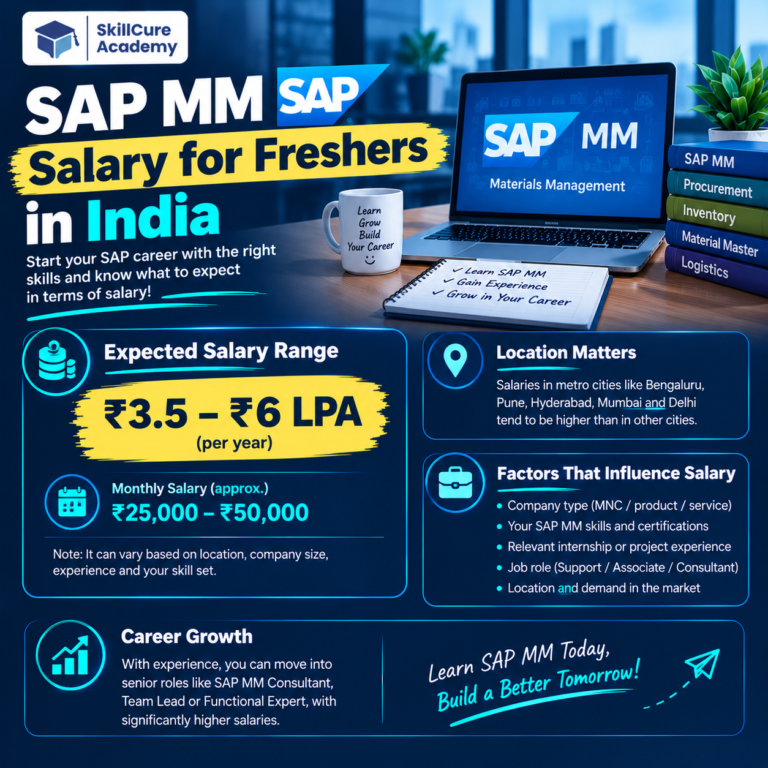
As an indicative estimate for 2026, entry-level candidates may encounter annual packages in the range of ₹2.5 lakh to ₹6 lakh. Candidates with relevant procurement experience, strong process knowledge, or suitable project exposure may qualify for better opportunities.
The following table provides an approximate salary guide, not a verified national average or guaranteed offer.
| Experience or Candidate Profile | Indicative Annual Salary |
|---|---|
| Fresher entering an entry-level role | ₹2.5–4 LPA |
| SAP MM-trained fresher with practical knowledge | ₹3–5 LPA |
| Candidate with relevant procurement or inventory experience | ₹3.5–6 LPA |
| Junior SAP MM support professional | ₹3–6 LPA |
LPA means lakhs per annum. For example, a package of ₹4 LPA represents an annual cost to company of ₹4 lakh before applicable deductions and other adjustments.
These figures are broad estimates. Actual offers can fall below or above these ranges depending on the position and employer.
3. SAP MM Salary Based on Experience
Experience plays an important role in determining salary in the SAP MM field. Freshers generally begin with support, operations, or junior-level responsibilities. As professionals gain experience, they can progress towards consulting, implementation, and senior functional roles.
| Experience Level | Indicative Annual Salary |
|---|---|
| Fresher: 0–1 year | ₹2.5–6 LPA |
| Junior professional: 1–3 years | ₹5–9 LPA |
| Mid-level professional: 3–5 years | ₹8–15 LPA |
| Senior consultant: 5–8 years | ₹12–20 LPA |
| Experienced specialist or lead | ₹18 LPA and above |
These ranges are indicative market estimates rather than fixed salary benchmarks. The upper ranges are generally associated with stronger experience, complex project responsibilities, and specialised skills.
A candidate who has worked in procurement or inventory operations may also benefit from their existing business knowledge when moving into an SAP-related role.
4. What Factors Affect SAP MM Fresher Salary?
Not every SAP MM fresher receives the same salary. Employers evaluate candidates according to their understanding of business processes and their ability to perform the responsibilities associated with the role.
The following factors can influence an entry-level salary.
Practical SAP MM Knowledge
Candidates who understand how procurement and inventory processes work have an advantage over those who only know theoretical definitions.
Employers may ask questions about purchase orders, goods receipts, stock movements, and invoice verification. Practical familiarity with these processes can help candidates demonstrate their readiness for the job.
Educational Background
Graduates from commerce, engineering, business administration, and supply chain-related backgrounds may find SAP MM relevant to their career goals.
However, educational qualifications and eligibility requirements differ across employers and job positions.
Previous Work Experience
Candidates with experience in purchasing, warehouse operations, inventory management, or vendor coordination may be able to apply their existing knowledge to SAP MM roles.
For example, someone who has worked in procurement may already understand purchase orders, supplier communication, and material availability.
Company and Job Role
A position in a large consulting organisation may have different responsibilities and compensation from an entry-level procurement support role at a smaller company.
It is important to compare job descriptions rather than assuming that every position mentioning SAP MM offers the same salary.
Location
Salary packages can vary between cities because of differences in employer concentration, living costs, and hiring requirements.
Bengaluru, Hyderabad, Pune, Mumbai, Delhi NCR, and Noida are among the locations where candidates can explore ERP-related opportunities. Actual openings and salaries depend on the employer and current recruitment requirements.
5. SAP MM Job Roles for Freshers in India
After learning SAP MM, candidates can explore several entry-level job opportunities. The available roles depend on their qualifications, practical knowledge, and previous experience.
Some positions require direct SAP experience, while others focus on procurement or inventory operations.
| Job Role | Main Responsibilities |
|---|---|
| Junior SAP MM Consultant | Assisting with SAP MM configuration, testing, and documentation |
| SAP Support Associate | Helping resolve user issues and supporting routine SAP processes |
| Procurement Executive | Managing purchasing activities and supplier coordination |
| Inventory Executive | Maintaining stock records and monitoring inventory movements |
| ERP Support Executive | Supporting ERP users and maintaining transaction accuracy |
| Purchase Executive | Preparing purchase orders and coordinating with vendors |
| Supply Chain Analyst | Supporting inventory, procurement, and supply chain reporting |
Freshers should read job descriptions carefully because titles alone do not indicate whether a role requires SAP implementation experience.
A candidate without professional SAP experience may find procurement or inventory operations roles more accessible than a consultant position that requires previous implementation work.
6. Skills Required to Get an SAP MM Job in 2026
Learning SAP MM involves more than memorising transaction codes. Candidates should understand how purchasing and inventory activities connect to real business requirements.
The following skills can help prepare candidates for entry-level opportunities.
Important Technical and Functional Skills
- Material master and vendor-related master data concepts
- Purchase requisition and purchase order processes
- Procurement and purchasing document flow
- Goods receipt and goods issue
- Inventory management and stock movements
- Invoice verification and the GR/IR process
- Basic SAP MM configuration concepts
- Understanding of SAP MM integration with SAP FI
- Familiarity with SAP S/4HANA procurement processes
- Basic troubleshooting and documentation
Candidates should also practise explaining how a transaction moves through the procurement process instead of simply memorising definitions.
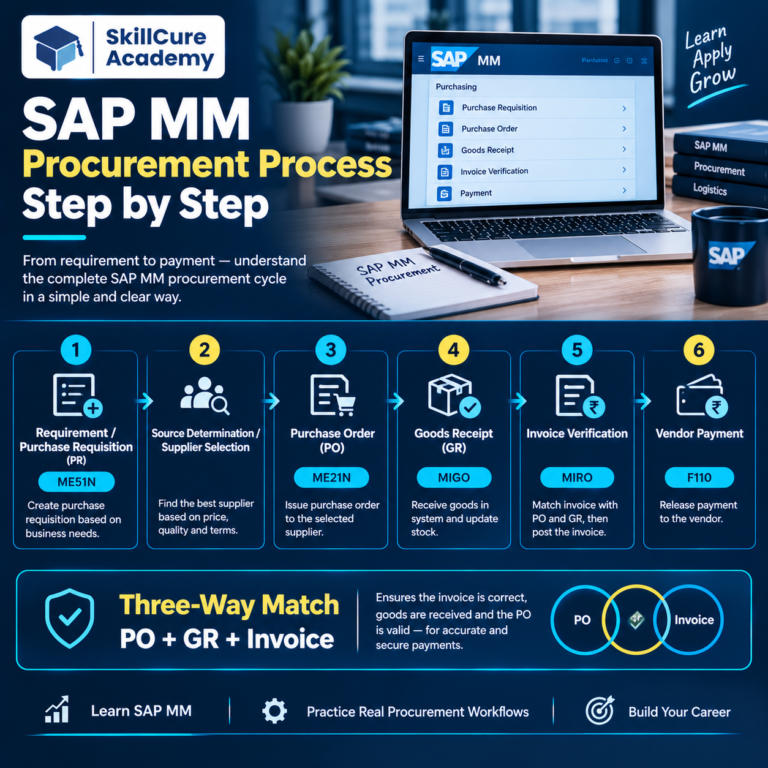
Example: Understanding the Procure-to-Pay Process
The procure-to-pay (P2P) process is one of the important topics for SAP MM interviews.
A simplified process looks like this:
- A department identifies a requirement for materials.
- A purchase requisition is created.
- The purchasing team creates a purchase order.
- The supplier delivers the materials.
- The goods receipt is recorded in SAP.
- The supplier invoice is verified.
- The invoice is processed for payment through the relevant finance process.
Candidates who can explain this workflow clearly may be better prepared for functional interview questions.
7. How to Get an SAP MM Job as a Fresher
Getting an SAP MM job without previous SAP experience can be challenging, but a structured preparation plan can improve your readiness.
Step 1: Learn the Fundamentals
Start by understanding procurement, inventory management, material master data, purchasing documents, and goods movements.
Before moving to advanced topics, make sure you understand why each activity is performed in a business.
Step 2: Practise SAP Transactions
Where access to a suitable SAP training system is available, practise the processes you learn.
Focus on understanding how transactions work, what information they require, and how one step affects the next.
Step 3: Understand SAP S/4HANA
Learn the fundamentals of SAP S/4HANA procurement and understand how it relates to modern ERP environments.
The depth of S/4HANA knowledge required depends on the job description and the employer’s system landscape.
Step 4: Prepare for Interviews
Practise answering common SAP MM interview questions, including:
- What is SAP MM?
- What is the difference between a purchase requisition and a purchase order?
- What is a goods receipt?
- What is the procure-to-pay process?
- What is material master data?
- What is the GR/IR clearing account?
- How does SAP MM integrate with SAP FI?
Try to explain each concept using a practical business example.
Step 5: Build a Relevant Resume
Include your SAP MM training, relevant business knowledge, practical exercises, and any genuine project or internship experience.
Do not describe training exercises as professional implementation experience. Present your skills accurately and prepare to explain your work during an interview.
Step 6: Apply for Suitable Roles
Search for entry-level SAP support, ERP support, procurement, inventory, and junior functional opportunities.
Review the experience requirements before applying, and customise your resume to match the responsibilities listed in each job description.
8. Is SAP MM a Good Career Option in 2026?
SAP MM can be a suitable career option for candidates interested in procurement, inventory management, and enterprise resource planning.
Its relevance comes from the role purchasing and inventory processes play in businesses. Organisations need ways to manage suppliers, materials, purchasing transactions, and stock movements accurately.
However, completing an SAP MM course does not automatically guarantee employment or a particular salary. Career outcomes depend on practical ability, business knowledge, communication skills, employer requirements, and available opportunities.
SAP MM may be particularly relevant for:
- Commerce and business graduates interested in ERP systems
- Engineering graduates interested in manufacturing and supply chain operations
- Procurement and purchase executives looking to expand their SAP skills
- Inventory and warehouse professionals exploring ERP-related roles
- Working professionals planning a career transition into SAP functional consulting
Candidates should evaluate job requirements and their own interests before choosing a specialisation.
9. SAP MM Salary Growth: How Can You Increase Your Earning Potential?
Salary growth generally depends on the responsibilities a professional can handle and the value they bring to a project.
After gaining foundational knowledge, candidates can work towards developing the following capabilities.
Develop end-to-end process knowledge: Understand how purchasing, goods receipt, inventory, invoice verification, and finance integration work together.
Gain practical experience: Real project work, support experience, testing, and troubleshooting can help develop skills that employers value.
Learn SAP S/4HANA procurement: Familiarity with relevant modern SAP processes can help candidates prepare for positions involving S/4HANA systems.
Improve communication skills: SAP professionals often interact with users, business teams, technical teams, and clients. Clear communication is important when explaining problems and documenting requirements.
Build cross-functional knowledge: Understanding how SAP MM interacts with finance and warehouse-related processes can help professionals handle broader responsibilities.
Prepare for scenario-based interviews: Practise explaining how you would investigate a purchase order issue, an incorrect stock quantity, or a goods receipt and invoice mismatch.
Rather than focusing only on salary figures, candidates should aim to build skills that help them progress from basic support responsibilities to more complex functional work.
10. Conclusion
SAP MM salary in India for freshers in 2026 depends on several factors, including practical knowledge, qualifications, employer, location, and job responsibilities. As a broad estimate, entry-level candidates may encounter packages of approximately ₹2.5–6 LPA, although actual offers vary considerably.
SAP MM provides a pathway into procurement, inventory management, ERP support, and functional consulting. Candidates who understand business processes, practise SAP transactions, and prepare for interviews can improve their readiness for suitable opportunities.
For aspiring SAP MM professionals, the most important first step is to develop a clear understanding of procurement and inventory processes and learn how these activities are managed within SAP.
Frequently Asked Questions (FAQs)
1. What is the SAP MM salary for freshers in India in 2026?
Freshers may encounter annual salary packages of approximately ₹2.5–6 LPA, depending on their skills, qualifications, location, and employer. These figures are indicative estimates, not guaranteed offers.
2. Can I get an SAP MM job without experience?
Yes, it is possible to apply for suitable entry-level opportunities. However, some SAP MM consultant positions require previous SAP or implementation experience. Freshers can also explore ERP support, procurement, and inventory-related roles.
3. Is SAP MM a good career option for freshers?
SAP MM can be a suitable option for candidates interested in procurement, inventory management, and ERP systems. Career opportunities depend on practical skills, business knowledge, and employer requirements.
4. What skills are required for an SAP MM fresher job?
Important skills include procurement processes, purchase orders, material master data, inventory management, goods movements, invoice verification, and basic SAP MM integration concepts.
5. What is the salary of an SAP MM professional after three years?
An SAP MM professional with around three years of experience may encounter packages in the approximate range of ₹6–12 LPA, depending on actual experience, employer, project exposure, and technical and functional skills. This is an indicative estimate, not a guaranteed salary.