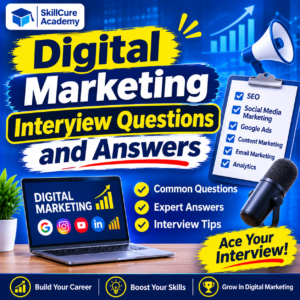

Digital Marketing has become one of the most popular career options in 2026. From small businesses to large companies, every organization wants to build its online presence, attract customers, and increase sales through digital platforms.
As a result, the demand for skilled digital marketers is increasing. However, learning digital marketing tools and concepts is not enough to get a job. You must also prepare for digital marketing interview questions and understand how to explain your practical knowledge confidently.
Whether you are a fresher, student, working professional, or someone planning to switch careers, preparing common digital marketing interview questions can help you perform better in interviews.
In this blog, we will cover the top 35 digital marketing interview questions and answers, including SEO, Google Ads, social media marketing, content marketing, email marketing, and performance marketing.
What Is Digital Marketing?
Digital Marketing is the process of promoting products, services, or brands through online platforms such as search engines, social media, websites, emails, and mobile applications.
Unlike traditional marketing, digital marketing allows businesses to reach targeted audiences, track campaign performance, and measure results.
Major Areas of Digital Marketing
| Digital Marketing Skill | What It Does |
|---|---|
| SEO | Improves website visibility on search engines |
| Google Ads | Runs paid advertisements on Google |
| Social Media Marketing | Promotes brands on social platforms |
| Content Marketing | Attracts audiences through valuable content |
| Email Marketing | Connects with customers through emails |
| Affiliate Marketing | Promotes products through affiliate partners |
| Performance Marketing | Focuses on measurable marketing results |
| Analytics | Tracks and analyzes marketing performance |
Top 35 Digital Marketing Interview Questions and Answers
Section 1: Basic Digital Marketing Interview Questions
Q1. What is Digital Marketing?
Answer: Digital Marketing is the promotion of products and services using online channels such as Google, Facebook, Instagram, YouTube, websites, and email. It helps businesses reach their target audience and generate leads, traffic, and sales.
Q2. What are the different types of Digital Marketing?
Answer: The major types of digital marketing include:
- Search Engine Optimization (SEO)
- Search Engine Marketing (SEM)
- Social Media Marketing (SMM)
- Content Marketing
- Email Marketing
- Affiliate Marketing
- Influencer Marketing
- Performance Marketing
- Mobile Marketing
Q3. What is the difference between SEO and SEM?
Answer:
SEO focuses on improving organic website rankings on search engines without paying for individual clicks.
SEM generally refers to search engine marketing, which includes paid search advertising and may be used more broadly to describe search marketing.
| SEO | SEM |
|---|---|
| Focuses on organic visibility | Commonly focuses on paid search campaigns |
| No direct payment for organic clicks | Advertisers pay for ad interactions |
| Takes time to show results | Can generate traffic quickly |
| Requires content and technical optimization | Requires campaign and budget management |
Q4. What is a Target Audience?
Answer: A target audience is a specific group of people who are most likely to purchase a company’s products or services.
For example, if a company sells digital marketing courses, its target audience could include students, freshers, job seekers, and working professionals.
Q5. What are Keywords in Digital Marketing?
Answer: Keywords are words or phrases that users type into search engines when looking for information, products, or services.
For example:
- Digital marketing course in Noida
- Best digital marketing institute
- Digital marketing interview questions
Keywords help marketers understand user search intent and optimize website content.
Section 2: SEO Interview Questions and Answers
Q6. What is SEO?
Answer: SEO stands for Search Engine Optimization. It is the process of improving a website’s visibility in organic search engine results to attract relevant visitors.
Q7. What are the three main types of SEO?
Answer:
- On-Page SEO: Optimizing website content, titles, headings, URLs, images, and internal links.
- Off-Page SEO: Building website authority through backlinks, brand mentions, and other external activities.
- Technical SEO: Improving website speed, mobile friendliness, crawling, indexing, and website structure.
Q8. What is a Backlink?
Answer: A backlink is a link from one website to another. Quality backlinks from relevant and trustworthy websites can help improve a website’s authority and search visibility.
Q9. What is Keyword Research?
Answer: Keyword research is the process of identifying search terms that people use on search engines.
Popular keyword research tools include:
- Google Keyword Planner
- Ahrefs
- SEMrush
- Ubersuggest
- Google Trends
Q10. What is the difference between On-Page SEO and Off-Page SEO?
Answer: On-Page SEO involves optimizing elements within your website, whereas Off-Page SEO focuses on activities outside your website to build credibility and authority.
Q11. What is Google Search Console?
Answer: Google Search Console is a free Google tool that helps website owners monitor their website’s performance in Google Search.
It provides information about:
- Search clicks and impressions
- Average search position
- Indexing issues
- Sitemap status
- Website experience
- Search queries
Q12. What is the difference between Crawling and Indexing?
Answer:
- Crawling: Search engine bots discover and visit website pages.
- Indexing: Search engines analyze and store eligible pages in their search index.
A crawled page is not necessarily indexed.
Section 3: Google Ads and PPC Interview Questions
Q13. What is Google Ads?
Answer: Google Ads is Google’s online advertising platform that allows businesses to display advertisements across Google Search, YouTube, websites, and other partner platforms.
Q14. What is PPC?
Answer: PPC stands for Pay-Per-Click. It is an advertising model in which advertisers pay when someone clicks on their advertisement.
Q15. What is CPC?
Answer: CPC stands for Cost Per Click. It represents the amount an advertiser pays for each click on an advertisement.
Formula:
CPC = Total Advertising Cost / Total Clicks
Q16. What is CTR?
Answer: CTR stands for Click-Through Rate. It measures the percentage of people who clicked on an advertisement after seeing it.
Formula:
CTR = (Total Clicks / Total Impressions) × 100
Q17. What is Quality Score in Google Ads?
Answer: Quality Score is Google’s diagnostic rating of the quality and relevance of keywords, ads, and landing pages in Search campaigns.
It is reported on a scale of 1 to 10 and can help advertisers identify areas for improvement.
Q18. What is Conversion Tracking?
Answer: Conversion tracking is a method of measuring important actions taken by users after interacting with an advertisement.
Examples include:
- Form submissions
- Phone calls
- Product purchases
- Course registrations
- Website enquiries
Section 4: Social Media Marketing Interview Questions
Q19. What is Social Media Marketing?
Answer: Social Media Marketing involves promoting a business, product, or service through platforms such as Instagram, Facebook, LinkedIn, and YouTube.
It helps businesses increase brand awareness, engagement, website traffic, and leads.
Q20. What is the difference between Organic and Paid Social Media Marketing?
Answer:
| Organic Marketing | Paid Marketing |
|---|---|
| Does not require advertising spend | Requires an advertising budget |
| Uses regular posts and content | Uses sponsored advertisements |
| Growth may take time | Can reach targeted audiences quickly |
| Focuses on long-term engagement | Often focuses on specific campaign goals |
Q21. What is Engagement Rate?
Answer: Engagement Rate measures how actively users interact with social media content through likes, comments, shares, saves, and other interactions.
A common formula is:
Engagement Rate = (Total Engagements / Total Reach) × 100
Q22. Which Social Media Platform Is Best for Business Promotion?
Answer: It depends on the business and its target audience.
- Instagram: Visual content and brand awareness.
- Facebook: Community building and advertising.
- LinkedIn: B2B marketing and professional networking.
- YouTube: Video marketing and educational content.
- Pinterest: Visual discovery and product inspiration.
Q23. What is a Social Media Content Calendar?
Answer: A content calendar is a planned schedule of social media posts. It helps marketers organize content topics, posting dates, captions, creatives, and publishing platforms.
Section 5: Content Marketing and Email Marketing Questions
Q24. What is Content Marketing?
Answer: Content Marketing is a strategy of creating and sharing valuable information to attract, engage, and retain a target audience.
Examples include blogs, videos, infographics, social media posts, and e-books.
Q25. What is Email Marketing?
Answer: Email Marketing is the process of communicating with customers or potential customers through emails.
Businesses use it for promotions, newsletters, product updates, lead nurturing, and customer retention.
Q26. What is A/B Testing?
Answer: A/B Testing is a method of comparing two versions of an advertisement, landing page, email, or other marketing element to identify which performs better.
For example, a marketer can test two different email subject lines to see which generates a higher open rate.
Q27. What is a Landing Page?
Answer: A landing page is a dedicated web page designed to encourage visitors to complete a particular action, such as submitting a form, registering for a course, or purchasing a product.
Section 6: Google Analytics and Performance Marketing Questions
Q28. What is Google Analytics 4 (GA4)?
Answer: Google Analytics 4 is Google’s analytics platform that helps businesses understand website and app user behaviour.
It tracks events such as page views, clicks, purchases, and form submissions.
Q29. What is Bounce Rate?
Answer: Bounce Rate in GA4 is the percentage of sessions that were not engaged sessions.
An engaged session generally lasts longer than 10 seconds, includes a key event, or has at least two page or screen views.
Q30. What is ROAS?
Answer: ROAS stands for Return on Ad Spend. It measures how much revenue a business generates for every rupee spent on advertising.
Formula:
ROAS = Revenue from Advertising / Advertising Cost
For example, if a company spends ₹10,000 on advertisements and generates ₹50,000 in revenue, its ROAS is 5x.
Q31. What is Lead Generation?
Answer: Lead Generation is the process of attracting potential customers and collecting their information, such as name, phone number, and email address.
Common lead generation methods include Google Ads, Meta Ads, landing pages, SEO, and social media campaigns.
Q32. What is the Difference Between CPL and CPA?
Answer:
- CPL (Cost Per Lead): The amount spent to generate one lead.
- CPA (Cost Per Acquisition): The amount spent to acquire a customer or achieve a defined acquisition action.
Section 7: Practical and Scenario-Based Digital Marketing Interview Questions
These questions are especially important because interviewers often want to understand whether candidates can apply their knowledge in real business situations.
Q33. How Would You Generate Leads for a Digital Marketing Institute?
Answer: I would first identify the target audience, including students, freshers, and working professionals.
My strategy would include:
- Running Google Search Ads targeting course-related keywords.
- Running Meta Lead Ads on Facebook and Instagram.
- Creating SEO-friendly blogs to generate organic traffic.
- Publishing student testimonials and project presentations.
- Creating dedicated landing pages with enquiry forms.
- Tracking leads and campaign performance.
Q34. What Would You Do If Your Google Ads Campaign Is Generating Clicks but No Leads?
Answer: I would analyze the complete campaign funnel to identify the problem.
My approach would include:
- Checking keyword relevance and search intent.
- Reviewing the advertisement copy.
- Checking landing page speed and design.
- Testing the enquiry form.
- Verifying conversion tracking.
- Reviewing audience targeting.
- Testing different landing pages and ad variations.
The objective would be to improve conversion rates rather than simply increasing website traffic.
Q35. How Do You Measure the Success of a Digital Marketing Campaign?
Answer: I would measure campaign performance using KPIs based on the campaign objective.
Important metrics include:
- Website Traffic
- Click-Through Rate (CTR)
- Cost Per Click (CPC)
- Cost Per Lead (CPL)
- Conversion Rate
- Return on Ad Spend (ROAS)
- Engagement Rate
- Customer Acquisition Cost (CAC)
Important Digital Marketing Tools You Should Know Before an Interview
Employers often prefer candidates who have practical knowledge of popular digital marketing tools.
| Tool | Purpose |
|---|---|
| Google Analytics 4 | Website and app analytics |
| Google Search Console | SEO performance monitoring |
| Google Ads | Paid search advertising |
| Meta Ads Manager | Facebook and Instagram advertising |
| Canva | Graphic design and creatives |
| SEMrush | SEO and competitor research |
| Ahrefs | Backlink and keyword analysis |
| Mailchimp | Email marketing |
| Google Keyword Planner | Keyword research |
| Google Tag Manager | Managing website tracking tags |
| ChatGPT | Content ideas and marketing assistance |
| Google Trends | Search trend analysis |
Tips to Prepare for a Digital Marketing Interview in 2026
Knowing interview answers is important, but practical knowledge can make a significant difference.
Here are some tips to improve your interview preparation:
- Understand the Fundamentals: Learn SEO, Google Ads, social media marketing, and content marketing concepts.
- Work on Live Projects: Practice creating campaigns, optimizing websites, and analyzing marketing performance.
- Learn Important Tools: Get hands-on experience with Google Analytics 4, Google Ads, Search Console, and Meta Ads Manager.
- Prepare a Portfolio: Keep examples of your SEO work, social media creatives, ad campaigns, and reports.
- Practice Scenario-Based Questions: Learn how to solve real marketing problems instead of memorizing definitions.
- Improve Communication Skills: Explain your strategies clearly and confidently during interviews.
- Understand AI in Digital Marketing: Explore how AI tools can support content creation, keyword research, campaign analysis, and marketing automation.
Conclusion
Digital Marketing offers excellent career opportunities for freshers and experienced professionals in 2026. However, getting a job requires more than theoretical knowledge. You need to understand different marketing channels, work with industry tools, and develop practical problem-solving skills.
Preparing these 35 digital marketing interview questions and answers will help you understand the topics commonly discussed during interviews.
If you want to build a career in digital marketing, focus on practical learning, live projects, campaign management, SEO, Google Ads, and analytics.
At Skillcure Academy, students can develop practical digital marketing skills through hands-on training, real-world projects, and interview preparation. The goal is to help learners build the confidence and skills required to explore digital marketing career opportunities.
Start learning Digital Marketing today and take your first step towards a successful digital career!
Frequently Asked Questions (FAQs)
1. What are the most common digital marketing interview questions for freshers?
Common questions include What is Digital Marketing, What is SEO, What is PPC, What is Google Ads, What is Social Media Marketing, and What is Google Analytics?
2. Is Digital Marketing a good career option in 2026?
Yes. Digital Marketing offers opportunities in SEO, paid advertising, social media management, content marketing, email marketing, and performance marketing.
3. Can a fresher get a job in Digital Marketing without experience?
Yes. Freshers can apply for entry-level positions if they understand digital marketing fundamentals, have practical tool knowledge, and can demonstrate their skills through projects or internships.
4. Which tools should I learn before a Digital Marketing interview?
Start with Google Analytics 4, Google Ads, Google Search Console, Meta Ads Manager, Canva, Google Keyword Planner, and ChatGPT.
5. How long does it take to prepare for a Digital Marketing interview?
It depends on your existing knowledge and practical experience. Beginners should focus on learning the fundamentals, practicing important tools, and working on projects before appearing for interviews.