
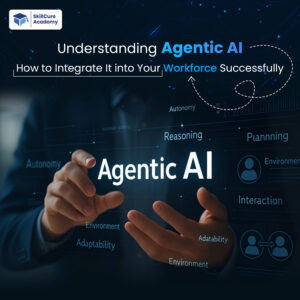

Artificial Intelligence is no longer just about automation—it’s evolving into something far more dynamic and impactful. Enter Agentic AI: systems that don’t just follow instructions but actively pursue goals, make decisions, and adapt in real time. As businesses look to stay competitive, understanding and integrating Agentic AI into the workforce is becoming essential.
What Is Agentic AI?
Agentic AI refers to AI systems designed to act as “agents.” Unlike traditional AI tools that perform specific, predefined tasks, agentic systems can:
- Set and pursue goals.
- Make decisions based on changing data.
- Interact with tools, systems, and even humans.
- Learn and improve over time.
Think of it less like a calculator and more like a proactive digital teammate.
Agentic AI vs Traditional AI?
| Feature | Traditional AI | Agentic AI |
|---|---|---|
| Functionality | Task-specific | Goal-oriented |
| Decision Making | Rule-based | Context-aware |
| Adaptability | Limited | High |
| Human Involvement | High | Moderate |
| Learning Capability | Static or slow | Continuous |
Why Agentic AI Matters for Modern Workforces?
The shift toward Agentic AI is significant because it changes how work gets done.
| Benefit | Impact on Workforce |
|---|---|
| Automation of complex tasks | Reduces workload on employees |
| Faster decision-making | Improves efficiency |
| Scalability | Handles growth without proportional hiring |
| Innovation boost | Frees time for creative work |
Key Use Cases Across Industries?
1. Customer Support.
AI agents can resolve queries, escalate issues intelligently, and even anticipate customer needs.
2. Operations & Supply Chain.
They can monitor logistics, adjust inventory strategies, and respond to disruptions autonomously.
3. Marketing & Sales.
Agentic systems can run campaigns, analyze performance, and optimize strategies without constant input.
4. HR & Recruitment.
From screening candidates to scheduling interviews, AI agents can manage large parts of the hiring pipeline.
Challenges to Consider?
| Challenge | Description |
|---|---|
| Trust & Control | Balancing autonomy with oversight |
| Data Quality | Poor data leads to poor decisions |
| Integration Complexity | Difficult to align with existing systems |
| Workforce Resistance | Fear of job displacement |
How to Integrate Agentic AI Successfully?
1. Start with Clear Objectives.
Define what you want Agentic AI to achieve.
2. Begin Small, Then Scale.
Pilot projects help you understand impact and risks.
3. Keep Humans in the Loop.
Create checkpoints where humans can intervene.
4. Invest in Data Infrastructure.
Ensure clean, structured, and accessible data.
5. Upskill Your Workforce.
Train employees to collaborate with AI.
6. Establish Governance & Ethics.
Define boundaries and accountability.
The Human-AI Partnership.
The most successful organizations won’t replace humans with AI—they’ll augment them.
Looking Ahead.
Agentic AI is not a distant future—it’s already here and evolving rapidly.
Frequently Asked Questions (FAQs).
1. What is Agentic AI in simple terms?
Agentic AI is an AI system that can act independently to achieve goals, rather than just following instructions.
2. How is Agentic AI different from generative AI?
Generative AI creates content, while Agentic AI takes actions and makes decisions to complete tasks.
3. Is Agentic AI safe for businesses?
Yes, if implemented with proper governance, monitoring, and ethical guidelines.
4. Will Agentic AI replace human jobs?
It is more likely to augment jobs rather than replace them, shifting focus to higher-value work.
5. How can small businesses adopt Agentic AI?
Start with small pilot projects, use existing AI tools, and scale gradually as you gain confidence.