
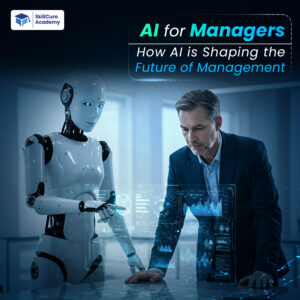

Artificial Intelligence (AI) is no longer limited to technology companies or data scientists. Today, AI has become a powerful business tool that is transforming the way managers lead teams, make decisions, and improve productivity. From automating repetitive tasks to providing real-time insights, AI is helping managers work smarter and make better strategic decisions.
In modern organizations, managers are expected to handle multiple responsibilities such as planning, team coordination, performance tracking, customer engagement, and decision-making. AI simplifies these processes by analyzing large amounts of data quickly and accurately. As businesses continue to adopt digital transformation, AI is becoming an essential part of management practices.
What is AI in Management?
AI in management refers to the use of artificial intelligence technologies such as machine learning, predictive analytics, automation tools, and natural language processing to improve business operations and managerial decision-making.
Managers use AI-powered systems to:
- Analyze business data
- Predict future trends
- Automate routine tasks
- Improve employee productivity
- Enhance customer experience
- Support strategic planning
AI does not replace managers; instead, it assists them in making faster and more informed decisions.
Importance of AI for Managers?
AI helps managers save time, reduce errors, and improve efficiency. It allows businesses to make data-driven decisions rather than relying only on assumptions.
Key Benefits of AI in Management:
| Benefit | Description |
|---|---|
| Faster Decision-Making | AI analyzes data quickly to provide actionable insights |
| Improved Productivity | Automation reduces manual and repetitive tasks |
| Better Resource Management | AI helps allocate resources effectively |
| Enhanced Customer Experience | AI tools improve customer support and personalization |
| Accurate Forecasting | Predictive analytics helps predict market trends |
| Reduced Human Errors | Automation minimizes operational mistakes |
How AI is Transforming Different Areas of Management?
1. AI in Human Resource Management.
AI is changing the recruitment and employee management process. HR managers use AI tools to screen resumes, conduct candidate assessments, and track employee performance.
Applications in HR:
- Automated resume screening
- Employee engagement analysis
- AI chatbots for HR support
- Workforce planning
- Performance evaluation systems
2. AI in Project Management.
Project managers use AI tools to monitor project progress, allocate resources, and identify risks before they become major issues.
| AI Feature | Impact on Project Management |
|---|---|
| Task Automation | Reduces repetitive project tasks |
| Predictive Analytics | Identifies project risks early |
| Smart Scheduling | Improves time management |
| Resource Allocation | Optimizes team utilization |
3. AI in Marketing Management.
Marketing managers use AI to understand customer behavior, automate campaigns, and improve targeting strategies.
| Marketing Activity | Role of AI |
|---|---|
| Customer Segmentation | Groups audiences based on behavior and interests |
| Email Automation | Sends personalized email campaigns |
| Content Recommendations | Suggests relevant products and services |
| Chatbots | Provides 24/7 customer support |
| Social Media Analytics | Tracks engagement and audience trends |
Common AI applications in marketing include:
- Personalized recommendations.
- Email marketing automation.
- Customer segmentation.
- Chatbots and virtual assistants.
- Social media analytics.
4. AI in Financial Management.
Finance managers use AI to detect fraud, analyze financial risks, and improve forecasting accuracy.
| Financial Task | AI Benefit |
|---|---|
| Fraud Detection | Identifies suspicious financial activities quickly |
| Revenue Forecasting | Predicts future business growth |
| Expense Tracking | Automates monitoring of business expenses |
| Risk Analysis | Evaluates financial risks accurately |
| Financial Reporting | Generates reports with minimal manual effort |
AI-powered financial systems can:
- Monitor transactions in real-time.
- Predict revenue growth.
- Detect suspicious activities.
- Generate financial reports automatically.
5. AI in Operations Management.
AI helps operations managers improve supply chain efficiency, inventory management, and production planning.
| Area | AI Contribution |
|---|---|
| Inventory Management | Predicts stock requirements |
| Supply Chain | Improves logistics planning |
| Manufacturing | Supports automation and quality control |
| Customer Service | AI chatbots provide instant support |
AI Tools Commonly Used by Managers?
Today, many businesses use AI-powered software to simplify management activities.
| AI Tool Category | Purpose |
|---|---|
| Chatbots | Customer and employee support |
| CRM Systems | Customer relationship management |
| Predictive Analytics Tools | Business forecasting |
| AI Scheduling Tools | Meeting and task management |
| Business Intelligence Platforms | Data analysis and reporting |
Popular examples include ChatGPT, Microsoft Copilot, Salesforce Einstein, Tableau AI, and Google Gemini.
Challenges of AI in Management?
Although AI offers many advantages, managers also face certain challenges while implementing AI technologies.
Major Challenges:
- High implementation costs.
- Data privacy and security concerns.
- Lack of AI-skilled employees.
- Dependence on data quality.
- Resistance to technological change.
- Ethical concerns related to AI decisions.
Managers must balance automation with human judgment to ensure responsible AI usage.
Skills Managers Need in the AI Era?
To succeed in the AI-driven workplace, managers need to develop both technical understanding and leadership skills.
Important Skills for Future Managers:
| Skill | Why It Matters |
|---|---|
| Data Literacy | Helps managers understand AI insights |
| Critical Thinking | Supports better decision-making |
| Adaptability | Important for digital transformation |
| Communication | Helps explain AI-driven strategies |
| Leadership | Encourages team collaboration with AI tools |
| Problem-Solving | Helps manage AI-related challenges |
Future of AI in Management?
The future of management will be heavily influenced by AI technologies. Businesses are expected to adopt more intelligent automation systems to improve efficiency and competitiveness.
Emerging AI Trends in Management:
| Trend | Expected Impact |
|---|---|
| AI-Powered Decision Making | Faster and more accurate business decisions |
| Intelligent Automation | Reduced manual workload |
| Remote Workforce Management | Improved virtual team collaboration |
| Predictive Analytics | Better future planning and forecasting |
| Personalized Employee Experience | Improved employee satisfaction and productivity |
Future trends include:
- AI-powered virtual managers.
- Advanced predictive analytics.
- Personalized employee experiences.
- Smart decision-support systems.
- Increased automation in business operations.
- AI-driven remote workforce management.
Managers who understand AI will have a competitive advantage in the evolving business environment.
Best Practices for Managers Using AI?
Managers should follow a strategic approach while implementing AI in organizations.
Recommended Practices:
- Start with small AI projects.
- Train employees on AI tools.
- Ensure data security and compliance.
- Combine human intelligence with AI insights.
- Monitor AI performance regularly.
- Use AI ethically and transparently.
Successful AI adoption depends on both technology and effective leadership.
Conclusion.
AI is reshaping the future of management by improving decision-making, productivity, and operational efficiency. From HR and marketing to finance and operations, AI is helping managers simplify complex tasks and make smarter business decisions.
However, AI should be viewed as a support system rather than a replacement for human managers. Leadership, creativity, emotional intelligence, and strategic thinking remain essential qualities that AI cannot fully replace.
Organizations that successfully combine human expertise with AI technologies will be better prepared for future business challenges and opportunities.
Frequently Asked Questions (FAQs).
1. How is AI used in management?
AI is used in management for automation, data analysis, forecasting, employee management, customer service, and strategic decision-making.
2. Can AI replace managers?
No, AI cannot completely replace managers. AI supports managers by improving efficiency and providing insights, but human leadership and decision-making are still important.
3. What are the benefits of AI for managers?
AI helps managers improve productivity, reduce errors, automate tasks, and make faster data-driven decisions.
4. What industries use AI in management?
Industries such as healthcare, finance, retail, education, manufacturing, and marketing widely use AI for management purposes.
5. What skills should managers learn for AI adoption?
Managers should learn data literacy, communication, adaptability, leadership, and critical thinking skills to work effectively with AI technologies.