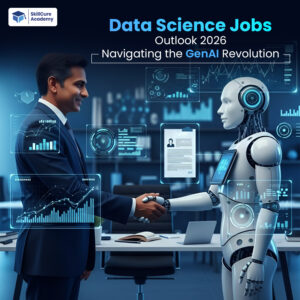

The data science job market is undergoing a major transformation as Generative AI (GenAI) reshapes how businesses operate and make decisions. In 2026, organizations are no longer just hiring data scientists—they are looking for professionals who can work alongside AI systems, interpret outputs, and drive business value.
This blog explores the evolving landscape of data science careers, the impact of GenAI, emerging roles, required skills, and actionable strategies to stay competitive.
The Impact of GenAI on Data Science Roles?
Generative AI has significantly reduced manual workloads while enhancing productivity. Tasks that once required hours—such as data preprocessing or model selection—can now be automated.
Key Transformations:
- Automation of repetitive data tasks.
- Faster experimentation and deployment cycles.
- Increased reliance on AI-assisted decision-making.
- Shift from coding-heavy roles to strategy-driven roles.
Evolution of Data Science Roles:
| Traditional Role | Evolved Role (2026) | Key Change |
|---|---|---|
| Data Analyst | AI-Augmented Analyst | Uses AI tools for faster insights |
| Data Scientist | Decision Scientist | Focus on business impact |
| ML Engineer | AI Engineer | Works with GenAI systems |
| Data Engineer | AI Data Engineer | Handles AI-ready pipelines |
Emerging Data Science Job Roles in 2026?
| Job Role | Description | Key Skills |
|---|---|---|
| AI Engineer | Builds scalable AI systems | Python, Deep Learning, APIs |
| GenAI Specialist | Works with LLMs and generative models | NLP, Transformers, Prompting |
| MLOps Engineer | Deploys and monitors ML systems | Docker, Kubernetes, CI/CD |
| Data Product Manager | Bridges AI and business goals | Strategy, Analytics |
| AI Research Analyst | Conducts AI-driven research | Statistics, ML, Domain Knowledge |
In-Demand Skills for 2026?
Technical Skills:
| Skill Area | Importance | Tools/Technologies |
|---|---|---|
| Machine Learning | High | Scikit-learn, XGBoost |
| Deep Learning | High | TensorFlow, PyTorch |
| GenAI & LLMs | Very High | OpenAI, Hugging Face |
| Data Engineering | High | Spark, Kafka |
| Cloud Computing | High | AWS, Azure, GCP |
Soft Skills:
| Skill | Why It Matters |
|---|---|
| Critical Thinking | Interpreting AI outputs effectively |
| Communication | Explaining insights to stakeholders |
| Adaptability | Keeping up with rapid tech changes |
| Business Acumen | Aligning data with business goals |
Tools & Technologies Shaping the Future?
| Category | Tools | Use Case |
|---|---|---|
| Programming | Python, R | Data analysis & modeling |
| AI/ML | TensorFlow, PyTorch | Model development |
| GenAI | OpenAI, Hugging Face | Content & automation |
| Visualization | Power BI, Tableau | Business insights |
| Cloud | AWS, Azure | Scalable infrastructure |
Salary Trends in 2026 (India)?
| Role | Experience Level | Average Salary |
|---|---|---|
| Data Scientist | 2–5 Years | ₹10–20 LPA |
| AI Engineer | 3–6 Years | ₹12–25 LPA |
| MLOps Engineer | 4–8 Years | ₹15–30 LPA |
| GenAI Specialist | 3–7 Years | ₹18–35 LPA |
Key Challenges in the GenAI Era?
- Rapid skill obsolescence due to evolving AI tools.
- Increased competition from AI-augmented professionals.
- Ethical and bias-related concerns in AI systems.
- Dependence on third-party AI platforms.
How to Stay Ahead in 2026?
Strategic Actions:
- Continuously upskill with AI and GenAI technologies.
- Build real-world, portfolio-ready projects.
- Learn prompt engineering and AI tool integration.
- Focus on domain expertise (finance, healthcare, etc.).
- Stay updated with industry trends and research.
Conclusion.
The future of data science in 2026 is not about competing with AI—but collaborating with it. Professionals who adapt to this shift, embrace GenAI tools, and focus on delivering business value will thrive in this new era.
FAQs.
1. Is data science still a good career in 2026?
Yes, data science remains a strong career option, especially for professionals who adapt to AI-driven tools and focus on strategic roles.
2. What role is most in demand in 2026?
AI Engineers and GenAI Specialists are among the most in-demand roles due to increasing adoption of generative AI.
3. Do data scientists need to learn GenAI?
Absolutely. Understanding GenAI tools and prompt engineering is becoming essential for modern data professionals.
4. How can beginners start a data science career in 2026?
Start with Python, statistics, and machine learning basics, then move to AI tools and build practical projects.
5. Will AI replace data science jobs?
AI will not replace data scientists entirely but will transform their roles, making them more strategic and less manual.