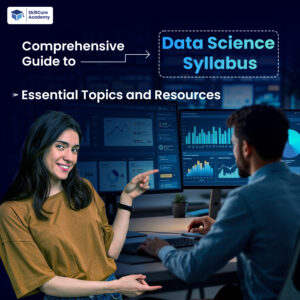

Data science has become one of the most in-demand fields globally, blending statistics, programming, and domain expertise to extract insights from data. Whether you’re a beginner or transitioning from another field, understanding a structured syllabus is key to mastering data science effectively.
This guide breaks down the essential topics you should cover and highlights useful resources to help you stay consistent—just like a daily learning routine.
1. Foundations of Data Science.
🔹 Key Areas:
| Topic | What to Learn | Importance |
|---|---|---|
| Mathematics | Probability, Linear Algebra, Calculus | Core for ML algorithms |
| Statistics | Hypothesis testing, distributions | Data interpretation |
| Programming | Python/R basics | Implementation |
2. Data Handling & Visualization.
| Tool/Library | Use Case |
|---|---|
| Pandas | Data manipulation |
| NumPy | Numerical computing |
| Matplotlib | Basic visualization |
| Seaborn | Advanced visualization |
3. Machine Learning.
| Type | Algorithms |
|---|---|
| Supervised | Linear Regression, Logistic Regression, SVM |
| Unsupervised | K-Means, PCA |
| Ensemble | Random Forest |
4. Deep Learning.
- Neural Networks.
- CNN.
- RNN/LSTM.
- TensorFlow, PyTorch.
5. Databases & Big Data.
| Category | Tools |
|---|---|
| SQL | MySQL, PostgreSQL |
| NoSQL | MongoDB |
| Big Data | Hadoop, Spark |
6. Data Science Workflow.
| Step | Description |
|---|---|
| Problem Definition | Define objective |
| Data Collection | Gather data |
| Data Cleaning | Handle missing values |
| EDA | Explore patterns |
| Modeling | Train models |
| Deployment | Production use |
7. Deployment & Real-World Skills?
- APIs (Flask, FastAPI).
- Docker.
- Git & GitHub.
Daily Learning Plan!
| Phase | Duration | Focus |
|---|---|---|
| Phase 1 | 30 Days | Python + Math |
| Phase 2 | 30 Days | Data Analysis |
| Phase 3 | 30 Days | Machine Learning |
| Phase 4 | 30 Days | Projects |
Projects to Build?
- Titanic Dataset
- House Price Prediction
- Customer Segmentation
- Sentiment Analysis
FAQs.
1. What is the best language for data science?
Python is the most popular due to its simplicity and powerful libraries.
2. Do I need a strong math background?
Basic understanding of statistics and linear algebra is enough to start.
3. How long does it take to learn data science?
Typically 3–6 months with consistent daily practice.
4. Is data science a good career in 2026?
Yes, demand continues to grow across industries.
5. Can I learn data science without a degree?
Yes, many professionals are self-taught through online resources and projects.
Final Thoughts.
Consistency is key. Focus on learning daily, building projects, and applying concepts. Over time, your skills will compound and open career opportunities in data science.