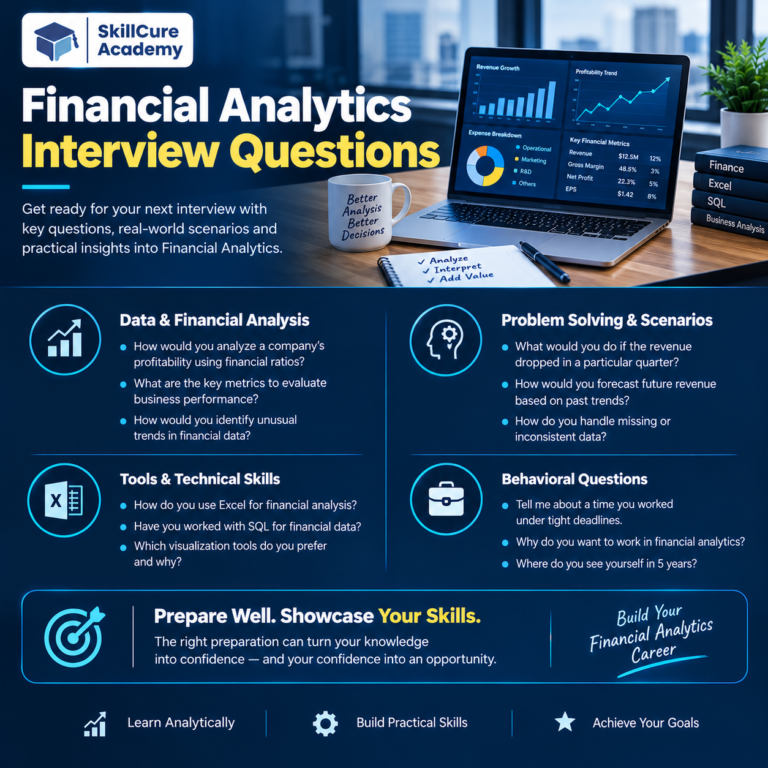



The finance industry continues to offer excellent career opportunities for commerce graduates, and Financial Analyst is one of the most sought-after roles. A Financial Analyst helps organizations make informed financial decisions by analyzing data, evaluating investments, forecasting future performance, and identifying business opportunities.
If you are a B.Com graduate wondering how to build a successful career in finance, this guide will explain how to become a Financial Analyst after B.Com, including the required skills, certifications, salary expectations, and career growth opportunities.
Who is a Financial Analyst?
A Financial Analyst is responsible for analyzing financial data, assessing company performance, preparing reports, and helping businesses make strategic financial decisions.
Key Responsibilities of a Financial Analyst:
| Responsibility | Description |
|---|---|
| Financial Analysis | Analyze financial statements and reports |
| Budget Planning | Assist in budgeting and forecasting |
| Investment Analysis | Evaluate investment opportunities |
| Market Research | Study industry and market trends |
| Financial Modeling | Build financial models for decision-making |
| Risk Assessment | Identify and analyze financial risks |
| Reporting | Prepare business and financial reports |
Why Choose Financial Analysis After B.Com?
Financial analysis is a rewarding career path that offers stability, growth, and excellent earning potential.
Benefits of Becoming a Financial Analyst:
| Benefit | Advantage |
|---|---|
| High Demand | Opportunities across multiple industries |
| Competitive Salaries | Attractive compensation packages |
| Career Growth | Clear progression into leadership roles |
| Global Recognition | Skills are valued internationally |
| Diverse Industries | Banking, consulting, IT, FinTech, and more |
| Continuous Learning | Exposure to financial markets and business strategy |
Step-by-Step Guide to Become a Financial Analyst After B.Com?
Step 1: Strengthen Your Financial Knowledge.
A B.Com degree provides a strong foundation, but employers expect deeper understanding of financial concepts.
Focus on Learning:
| Subject Area | Importance |
|---|---|
| Financial Accounting | Understanding company finances |
| Corporate Finance | Business financial management |
| Taxation | Compliance and tax planning |
| Economics | Market and economic analysis |
| Business Statistics | Data interpretation and forecasting |
| Cost Accounting | Cost management and profitability analysis |
Step 2: Develop Core Financial Analyst Skills.
To succeed as a Financial Analyst, you need both technical and analytical skills.
Essential Skills:
| Technical Skills | Analytical Skills |
|---|---|
| Financial Modeling | Critical Thinking |
| Advanced Excel | Problem Solving |
| Financial Forecasting | Decision Making |
| Power BI | Business Analysis |
| SQL | Data Interpretation |
| Tableau | Attention to Detail |
| Budgeting | Strategic Planning |
Step 3: Master Advanced Excel.
Excel remains one of the most important tools used by Financial Analysts.
Excel Skills Employers Look For:
| Excel Feature | Application |
|---|---|
| Pivot Tables | Data Summarization |
| VLOOKUP/XLOOKUP | Data Retrieval |
| IF Functions | Conditional Analysis |
| Power Query | Data Cleaning |
| Charts & Dashboards | Reporting |
| Financial Functions | Financial Calculations |
Step 4: Learn Financial Modeling.
Financial modeling is considered one of the most valuable skills in finance.
Important Financial Modeling Concepts:
| Concept | Purpose |
|---|---|
| Income Statement Modeling | Revenue and profit forecasting |
| Balance Sheet Analysis | Financial position assessment |
| Cash Flow Modeling | Liquidity evaluation |
| DCF Valuation | Business valuation |
| Ratio Analysis | Performance measurement |
| Scenario Analysis | Risk and opportunity assessment |
Step 5: Learn Data Analytics Tools.
Modern finance roles increasingly require data-driven decision-making skills.
Recommended Tools:
| Tool | Use Case |
|---|---|
| Power BI | Data Visualization |
| Tableau | Business Intelligence |
| SQL | Database Management |
| Python | Financial Analytics |
| Excel | Financial Reporting |
Professionals who combine finance and analytics skills often receive better job opportunities and higher salaries.
Step 6: Obtain Relevant Certifications.
Certifications can significantly improve your credibility and employability.
Top Certifications for Financial Analysts:
| Certification | Suitable For |
|---|---|
| CFA (Chartered Financial Analyst) | Investment Analysis |
| FRM (Financial Risk Manager) | Risk Management |
| NISM Certifications | Financial Markets |
| Financial Modeling Certification | Corporate Finance |
| Power BI Certification | Data Reporting |
| Data Analytics Certification | Financial Analytics |
Step 7: Gain Practical Experience.
Employers value practical exposure as much as academic qualifications.
Ways to Gain Experience:
| Method | Benefits |
|---|---|
| Internships | Real-world finance exposure |
| Financial Modeling Projects | Practical skill development |
| Virtual Internships | Industry experience |
| Equity Research Projects | Investment analysis skills |
| Freelance Projects | Portfolio building |
| Case Studies | Problem-solving experience |
Step 8: Build a Professional Resume.
A strong resume increases your chances of securing interviews.
Important Resume Sections:
| Section | Details to Include |
|---|---|
| Education | B.Com and academic achievements |
| Certifications | Finance and analytics certifications |
| Technical Skills | Excel, Power BI, SQL, Financial Modeling |
| Projects | Relevant finance projects |
| Internships | Work experience and achievements |
| Achievements | Awards and recognitions |
Step 9: Apply for Entry-Level Roles.
Once you have the required skills and experience, start applying for relevant positions.
Entry-Level Jobs for B.Com Graduates:
| Job Role | Experience Required |
|---|---|
| Financial Analyst | Fresher |
| Junior Financial Analyst | Fresher |
| Finance Executive | Fresher |
| Investment Analyst Trainee | Fresher |
| Business Analyst | Fresher |
| Risk Analyst | Fresher |
| Financial Planning Associate | Fresher |
Financial Analyst Salary in India (2026).
Salary depends on skills, certifications, location, and company size.
Average Salary Structure:
| Experience Level | Average Annual Salary |
|---|---|
| Fresher | ₹3 LPA – ₹6 LPA |
| 1–3 Years | ₹6 LPA – ₹10 LPA |
| 3–5 Years | ₹10 LPA – ₹15 LPA |
| 5–8 Years | ₹15 LPA – ₹25 LPA |
| 8+ Years | ₹25 LPA+ |
Professionals with CFA certification, financial modeling expertise, and analytics skills generally earn higher compensation.
Career Growth Path of a Financial Analyst:
| Career Stage | Typical Experience |
|---|---|
| Financial Analyst | 0–2 Years |
| Senior Financial Analyst | 2–5 Years |
| Finance Manager | 5–8 Years |
| Senior Finance Manager | 8–12 Years |
| Finance Director | 12–15 Years |
| Chief Financial Officer (CFO) | 15+ Years |
Industries Hiring Financial Analysts:
Financial Analysts are required across various sectors.
| Industry | Demand Level |
|---|---|
| Banking | Very High |
| Investment Firms | Very High |
| FinTech | High |
| Consulting | High |
| Insurance | High |
| IT Services | High |
| Manufacturing | Medium to High |
| E-Commerce | High |
| Startups | Growing |
| Multinational Corporations | Very High |
Tips to Succeed as a Financial Analyst:
| Tip | Impact |
|---|---|
| Stay Updated with Financial Markets | Better decision-making |
| Learn Advanced Excel | Increased productivity |
| Develop Financial Modeling Skills | Higher employability |
| Gain Internship Experience | Practical exposure |
| Pursue Certifications | Career advancement |
| Learn Data Analytics Tools | Better salary opportunities |
| Improve Communication Skills | Professional growth |
Conclusion.
Understanding how to become a Financial Analyst after B.Com is the first step toward building a successful finance career. By strengthening your financial knowledge, mastering Excel and financial modeling, learning modern analytics tools, obtaining relevant certifications, and gaining practical experience, you can position yourself for excellent career opportunities in the finance industry.
With businesses increasingly relying on data-driven financial decisions, Financial Analysts are expected to remain in high demand in 2026 and beyond. A structured learning path and continuous skill development can help you secure rewarding roles and achieve long-term career success.
Frequently Asked Questions (FAQs).
1. Can I become a Financial Analyst immediately after B.Com?
Yes. Many companies hire B.Com graduates for entry-level Financial Analyst roles, especially candidates with Excel, financial modeling, and analytical skills.
2. Which certification is best for Financial Analysts?
CFA is widely recognized globally, while Financial Modeling and Data Analytics certifications are highly valuable for corporate finance roles.
3. Is coding required for Financial Analysts?
Basic knowledge of SQL and Python can be beneficial but is not mandatory for all Financial Analyst positions.
4. What is the average starting salary of a Financial Analyst in India?
Freshers typically earn between ₹3 LPA and ₹6 LPA, depending on their skills, certifications, and employer.
5. Is Financial Analysis a good career option in 2026?
Yes. Financial Analysis remains one of the fastest-growing and most stable career options in finance with strong salary growth and advancement opportunities.