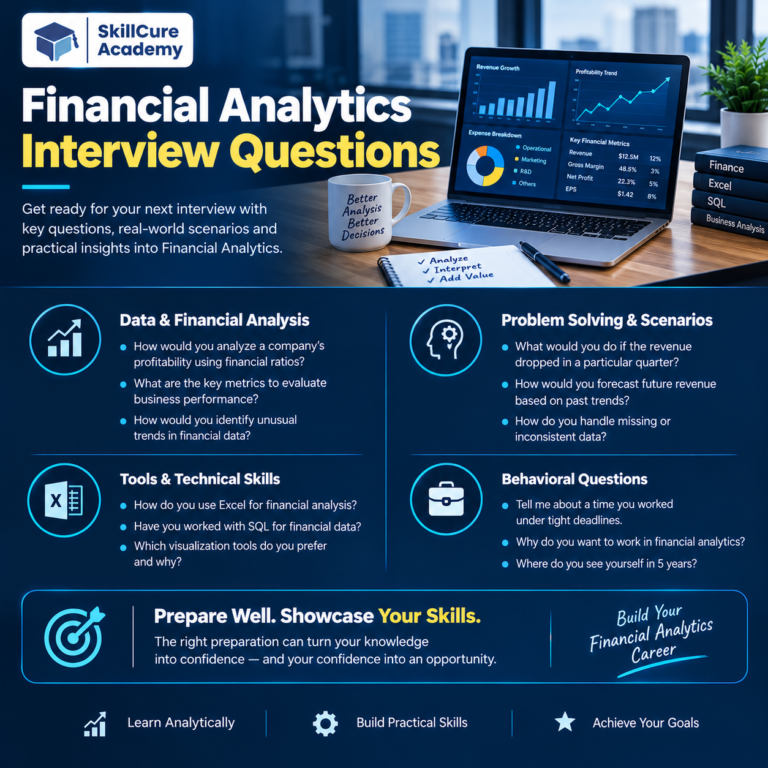


Financial analytics is helping companies make smarter business decisions using financial data. Businesses today use analytics tools to track profits, reduce risks, improve budgeting, and predict future growth. From banks and healthcare companies to e-commerce businesses and investment firms, financial analytics plays a major role in improving performance and efficiency.
With the increasing use of data-driven decision-making, the demand for financial analytics professionals is growing rapidly across industries.
What is Financial Analytics?
Financial analytics is the process of analyzing financial data to improve business decisions and financial performance. Companies use analytics tools to study revenue, expenses, investments, customer behavior, and business risks.
Popular tools used in financial analytics include:
| Tool | Purpose |
|---|---|
| Excel | Financial calculations and reporting |
| Power BI | Data visualization and dashboards |
| SQL | Managing financial databases |
| Python | Data analysis and automation |
| Tableau | Business intelligence reporting |
Importance of Financial Analytics
Financial analytics helps organizations understand their financial health and improve long-term planning.
| Benefit | Description |
|---|---|
| Better Decision Making | Supports data-driven business decisions |
| Risk Reduction | Identifies financial risks early |
| Cost Control | Helps reduce unnecessary expenses |
| Forecasting | Predicts future revenue and sales |
| Profit Growth | Improves business profitability |
Real-Life Use Cases of Financial Analytics
1. Banking and Loan Approval
Banks use financial analytics to evaluate customer credit scores, repayment history, and income before approving loans. Analytics helps banks reduce loan default risks and improve customer verification.
For example, banks analyze customer transaction patterns and financial history before providing personal or business loans.
2. Fraud Detection
Fraud detection is one of the most important real-life use cases of financial analytics. Banks and online payment companies use analytics systems to detect suspicious financial activities.
These systems can identify:
- Unusual transactions
- Multiple login attempts
- Large unexpected payments
- Suspicious account activity
This helps organizations prevent financial fraud and protect customer accounts.
3. Investment and Portfolio Management
Investment firms use financial analytics to study stock market trends and investment risks. Analytics helps investors make better decisions about where to invest money.
| Analytics Area | Purpose |
|---|---|
| Risk Analysis | Identifies investment risks |
| Portfolio Optimization | Balances investment returns |
| Market Forecasting | Predicts market performance |
| Asset Allocation | Improves investment planning |
Financial analytics helps investors maximize profits while reducing financial risks.
4. Budget Planning and Forecasting
Companies use financial analytics to create budgets and forecast future revenue. By analyzing previous sales and expenses, organizations can predict future business performance.
Retail companies often use forecasting during festival seasons to estimate product demand and inventory requirements.
5. Business Performance Analysis
Businesses use financial analytics to measure overall company performance. Managers analyze financial reports to understand whether the company is achieving its goals.
Common metrics analyzed include:
- Revenue growth
- Profit margins
- Operational costs
- Return on Investment (ROI)
- Customer acquisition costs
This helps businesses identify areas where improvements are needed.
6. Insurance Claim Analysis
Insurance companies use financial analytics to verify insurance claims and detect fraudulent activities. Analytics helps insurers calculate customer risk profiles and improve pricing strategies.
For example, insurance companies can identify suspicious claims by analyzing customer history and claim frequency.
7. Retail and E-Commerce Analytics
Retail and e-commerce companies use financial analytics to improve sales and customer experience.
| Use Case | Business Benefit |
|---|---|
| Sales Analysis | Tracks product performance |
| Pricing Optimization | Improves profitability |
| Inventory Management | Reduces stock shortages |
| Customer Insights | Understands buying behavior |
Online shopping platforms use analytics to recommend products based on customer purchase history.
8. Healthcare Financial Management
Hospitals and healthcare organizations use financial analytics to manage operational costs and improve financial planning.
Healthcare analytics helps hospitals:
- Monitor treatment costs
- Track department expenses
- Manage insurance payments
- Improve resource allocation
This improves operational efficiency and reduces unnecessary spending.
9. Expense and Cost Reduction
Companies use financial analytics to identify areas where operational costs can be reduced. Manufacturing businesses analyze production expenses, raw material costs, and supply chain spending to improve efficiency.
Cost analysis helps businesses increase profitability without affecting product quality.
10. Tax Planning and Compliance
Organizations use financial analytics to maintain financial records and comply with tax regulations. Analytics tools help businesses calculate taxes accurately and avoid penalties.
Automated reporting systems also improve transparency and simplify financial reporting.
Skills Required for Financial Analytics
Students interested in financial analytics should develop technical and analytical skills.
| Skill | Importance |
|---|---|
| Excel | Reporting and calculations |
| SQL | Database management |
| Power BI/Tableau | Dashboard creation |
| Financial Knowledge | Understanding business finance |
| Analytical Thinking | Solving business problems |
These skills can help students build careers in finance, banking, and analytics.
Career Opportunities in Financial Analytics
Financial analytics offers excellent career opportunities in multiple industries.
Popular job roles include:
- Financial Analyst
- Risk Analyst
- Investment Analyst
- Business Analyst
- Data Analyst
- Fraud Analyst
Industries such as banking, healthcare, retail, insurance, and IT companies regularly hire financial analytics professionals.
Conclusion
The real-life use cases of financial analytics show how businesses use data to improve financial performance, reduce risks, and make smarter decisions. From banking and fraud detection to healthcare and e-commerce, financial analytics is becoming essential in every industry.
As companies continue adopting data-driven strategies, the demand for financial analytics professionals will continue growing. Students and professionals who learn analytics tools and financial management skills can build successful careers in this rapidly growing field.
FAQs
1. What are the real-life use cases of financial analytics?
Financial analytics is used for fraud detection, loan approval, investment management, forecasting, budgeting, and business performance analysis.
2. Which industries use financial analytics?
Industries such as banking, healthcare, insurance, retail, e-commerce, and manufacturing use financial analytics.
3. What tools are used in financial analytics?
Popular tools include Excel, SQL, Power BI, Tableau, and Python.
4. Is financial analytics a good career?
Yes, financial analytics is a high-demand career with strong salary growth and opportunities across industries.
5. What skills are needed for financial analytics?
Important skills include financial knowledge, data analysis, Excel, SQL, Power BI, and analytical thinking.