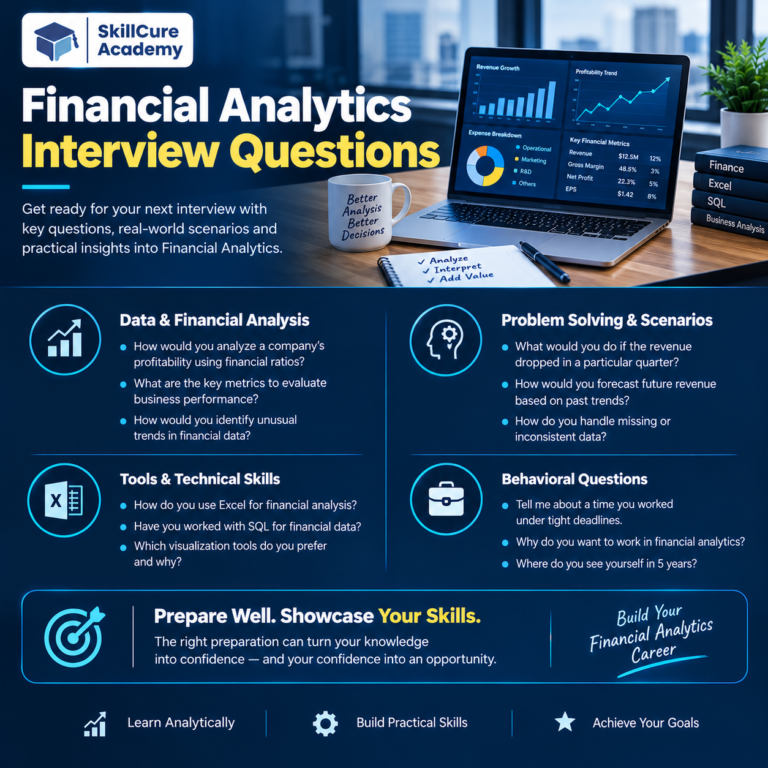



Financial analytics has become one of the fastest-growing career fields in India. With businesses relying heavily on data-driven financial decisions, the demand for skilled financial analysts continues to rise across industries. Whether it’s banking, investment firms, insurance companies, fintech startups, or multinational corporations, professionals with financial analytics skills are highly valued.
If you’re planning a career in finance and data, understanding the Financial Analytics Career Scope in India can help you make an informed decision. This article explores career opportunities, required skills, salaries, job roles, and future prospects.
What is Financial Analytics?
Financial analytics is the process of collecting, analyzing, and interpreting financial data to help businesses make informed decisions. It combines finance, statistics, business intelligence, and data analytics to identify trends, predict future outcomes, and improve financial performance.
Financial analysts use tools like Excel, SQL, Power BI, Python, Tableau, and financial modeling techniques to generate insights from financial data.
Why is Financial Analytics Growing in India?
India has witnessed rapid digital transformation over the past decade. Businesses are generating massive amounts of financial data every day, creating an increasing demand for professionals who can analyze and interpret that data effectively.
Some major reasons behind the growing Financial Analytics Career Scope in India include:
- Increasing adoption of AI and data analytics
- Growth of fintech companies
- Digital banking expansion
- Demand for data-driven investment decisions
- Government initiatives promoting digital finance
- Rising need for financial risk management
As organizations continue investing in analytics, career opportunities are expected to expand significantly.
Skills Required for Financial Analytics?
To build a successful career in financial analytics, candidates should develop both financial and technical skills.
| Financial Skills | Technical Skills |
|---|---|
| Financial Statements | Microsoft Excel |
| Budgeting | SQL |
| Financial Modeling | Power BI |
| Risk Analysis | Tableau |
| Investment Analysis | Python |
| Forecasting | Data Visualization |
| Cost Analysis | Statistics |
Soft skills are equally important.
Essential Soft Skills:
- Analytical thinking
- Problem-solving
- Communication
- Attention to detail
- Business understanding
- Decision-making
- Presentation skills
Educational Qualification.
The good news is that students from multiple educational backgrounds can enter this field.
Common qualifications include:
- B.Com
- BBA
- MBA Finance
- B.Sc Mathematics
- Economics
- CA
- CMA
- CFA
- Data Analytics Certification
- Financial Analytics Certification
Many employers now prefer candidates with practical skills rather than only academic qualifications.
Top Financial Analytics Job Roles?
The Financial Analytics Career Scope in India includes various specialized positions.
| Job Role | Primary Responsibility |
|---|---|
| Financial Analyst | Analyze company financial performance |
| Investment Analyst | Evaluate investment opportunities |
| Risk Analyst | Identify financial risks |
| Budget Analyst | Plan and monitor budgets |
| Business Analyst | Improve financial processes |
| Credit Analyst | Assess customer creditworthiness |
| Treasury Analyst | Manage cash flow |
| Financial Planning Analyst | Forecast business growth |
| Data Analyst (Finance) | Analyze financial datasets |
| Corporate Finance Analyst | Support strategic financial decisions |
Industries Hiring Financial Analytics Professionals?
Financial analytics professionals are required in almost every industry.
Some major sectors include:
- Banking
- Financial Services
- Insurance
- FinTech
- Stock Market Firms
- Consulting Companies
- E-commerce
- Healthcare
- Manufacturing
- IT Companies
- Retail
- Government Organizations
This wide industry demand significantly increases the Financial Analytics Career Scope in India.
Salary of Financial Analytics Professionals in India?
Salary depends on experience, location, company, and technical skills.
| Experience Level | Average Annual Salary |
|---|---|
| Fresher | ₹4 LPA – ₹7 LPA |
| 2–5 Years | ₹7 LPA – ₹12 LPA |
| 5–8 Years | ₹12 LPA – ₹20 LPA |
| Senior Professionals | ₹20 LPA – ₹35 LPA+ |
Professionals skilled in SQL, Python, Power BI, and financial modeling often receive higher salary packages.
Tools Used in Financial Analytics?
Companies expect candidates to work with industry-standard tools.
Popular tools include:
- Microsoft Excel
- SQL
- Power BI
- Tableau
- Python
- R
- SAP
- Oracle Financials
- Bloomberg Terminal
- Microsoft Power Query
Learning these tools can improve employability and salary potential.
Career Growth Path?
One of the biggest advantages of the Financial Analytics Career Scope in India is the structured career progression.
Typical career path:
- Financial Analytics Intern
- Junior Financial Analyst
- Financial Analyst
- Senior Financial Analyst
- Finance Manager
- Analytics Manager
- Finance Director
- Chief Financial Officer (CFO)
With certifications and continuous learning, professionals can progress quickly into leadership roles.
Benefits of Choosing Financial Analytics?
There are several reasons why students and working professionals are choosing this career.
High Demand.
Companies increasingly depend on financial data for strategic planning.
Excellent Salary.
Financial analytics offers attractive salary packages with rapid growth opportunities.
Multiple Career Options.
Professionals can work in banking, consulting, investment firms, fintech, and multinational companies.
Global Opportunities.
Financial analytics skills are valued worldwide, opening doors to international careers.
Future-Proof Career.
As businesses become more data-driven, financial analytics professionals will remain in high demand.
How to Start a Career in Financial Analytics?
If you’re interested in entering this field, follow these steps:
- Learn accounting and finance basics.
- Master Microsoft Excel.
- Learn SQL for data management.
- Practice Power BI or Tableau.
- Understand financial modeling.
- Learn Python for data analysis.
- Build real-world finance projects.
- Earn a Financial Analytics certification.
- Create a strong resume.
- Apply for internships and entry-level jobs.
Following this roadmap can help you build a successful career in financial analytics.
Future of Financial Analytics in India?
The future of Financial Analytics Career Scope in India looks highly promising. Artificial Intelligence, Machine Learning, and automation are transforming financial operations, but they are also increasing the demand for professionals who can interpret complex financial data and make strategic business decisions.
Organizations are investing heavily in analytics platforms, creating thousands of new job opportunities every year. Professionals who combine finance knowledge with analytical tools will have a significant advantage in the job market.
Conclusion.
The Financial Analytics Career Scope in India is expanding rapidly due to digital transformation, increasing financial data, and growing demand for business intelligence. With competitive salaries, diverse job roles, and opportunities across industries, financial analytics is an excellent career choice for graduates and professionals looking to build a future-proof career.
By learning the right combination of finance concepts, analytical tools, and practical skills, you can position yourself for long-term success in this high-demand industry.
Frequently Asked Questions (FAQs).
1. Is Financial Analytics a good career in India?
Yes, financial analytics is one of the fastest-growing careers in India, offering excellent salaries, diverse job opportunities, and strong long-term growth.
2. What qualifications are required for Financial Analytics?
Candidates with B.Com, BBA, MBA Finance, Economics, CA, CMA, CFA, or Data Analytics certifications can pursue a career in financial analytics.
3. What is the salary of a Financial Analyst in India?
Freshers can earn around ₹4–₹7 LPA, while experienced professionals can earn ₹20 LPA or more depending on their skills and experience.
4. Which tools should I learn for Financial Analytics?
The most important tools include Microsoft Excel, SQL, Power BI, Tableau, Python, SAP, and financial modeling software.
5. Is coding necessary for Financial Analytics?
Basic coding knowledge in SQL and Python is highly beneficial, but many entry-level financial analytics roles primarily require Excel and Power BI skills.