


Commerce students already have a strong foundation in accounting, finance, economics, and business concepts. However, as companies increasingly depend on data for decision-making, traditional finance knowledge alone may not be enough to build a competitive career.
This is where a Financial Analytics Course for Commerce Students can make a difference. It combines financial knowledge with analytical tools and techniques, helping students understand how financial data can be used for budgeting, forecasting, performance analysis, and business decision-making.
What Is Financial Analytics?
Financial analytics is the process of analyzing financial and business data to identify trends, measure performance, manage risks, and support better business decisions.
It combines concepts from finance, accounting, statistics, and data analytics. Professionals use financial analytics to study revenue, expenses, profitability, investments, cash flow, sales performance, and other important financial indicators.
A financial analytics course focuses on both concepts and practical applications, allowing students to understand how financial data is handled in real business situations.
Why Should Commerce Students Learn Financial Analytics?
Commerce students already understand many of the fundamental concepts required for financial analysis. Learning analytics allows them to apply this knowledge using modern tools and technologies.
Some important benefits include:
- Builds on commerce knowledge: Students can apply accounting, finance, and business concepts to real datasets.
- Develops analytical thinking: Learners understand how to identify trends, patterns, and relationships in financial data.
- Expands career opportunities: Financial analytics skills can be useful in banking, finance, consulting, insurance, and corporate sectors.
- Provides practical skills: Students learn tools used for reporting, visualization, analysis, and financial modelling.
- Supports data-driven decisions: Analytics helps businesses make decisions based on financial information and measurable insights.
What Will You Learn in a Financial Analytics Course?
The syllabus can vary depending on the training institute, but a practical course can cover several important areas.
1. Financial Fundamentals
Students can strengthen their understanding of financial statements, revenue, expenses, assets, liabilities, profitability, cash flow, and other important financial concepts.
2. Advanced Excel
Excel is widely used for financial analysis and reporting. Students can learn:
- Advanced formulas and functions
- Pivot Tables
- Data cleaning
- Lookup functions
- Financial calculations
- Charts and dashboards
- What-if analysis
- Financial reporting
These skills help students manage and analyze financial information efficiently.
3. Financial Modelling
Financial modelling is an important skill for modern finance professionals. Students can learn how to create models for budgeting, forecasting, profitability analysis, and business planning.
Common applications include:
- Revenue forecasting
- Expense forecasting
- Profit projections
- Cash flow forecasting
- Scenario analysis
- Investment analysis
4. Data Visualization
Financial information can sometimes be difficult to understand when presented only through spreadsheets. Visualization tools can convert complex datasets into interactive reports and dashboards.
Students may learn tools such as Power BI to create financial dashboards and track important business KPIs.
5. Data Analysis
Students can learn how to collect, clean, organize, and analyze financial data. Basic statistical concepts can also help them interpret trends and patterns more effectively.
Important Skills for Financial Analytics
A successful financial analytics professional needs a combination of financial knowledge and technical skills.
| Skill | Importance |
|---|---|
| Accounting | Helps understand financial statements |
| Finance | Supports financial decision-making |
| Advanced Excel | Useful for analysis and modelling |
| Financial Modelling | Helps with forecasting and planning |
| Data Analysis | Helps identify trends and patterns |
| Power BI | Helps create interactive dashboards |
| Statistics | Supports data interpretation |
| Business Understanding | Connects analysis with business decisions |
| Communication | Helps present financial insights clearly |
Career Opportunities After Financial Analytics
A Financial Analytics Course for Commerce Students can help learners prepare for various finance and analytics-related roles.
Potential career options include:
- Financial Analyst
- Business Analyst
- Financial Planning Analyst
- Investment Analyst
- MIS Analyst
- Credit Analyst
- Risk Analyst
- FP&A Analyst
- Data Analyst – Finance
- Reporting Analyst
The exact career path depends on a student’s educational background, technical skills, experience, and specialization.
Is Financial Analytics Suitable for B.Com Students?
Yes. B.Com students can benefit significantly from financial analytics because their academic curriculum already covers accounting, finance, economics, taxation, and business concepts.
By adding skills such as Advanced Excel, Power BI, financial modelling, and data analysis, B.Com graduates can explore opportunities beyond traditional accounting roles.
Students interested in corporate finance, financial planning, analytics, consulting, and business intelligence can consider financial analytics as an additional career specialization.
Is Financial Analytics Suitable for M.Com Students?
M.Com students can also benefit from financial analytics. Their advanced understanding of commerce, finance, and accounting can help them focus on applying these concepts to real-world financial datasets.
Developing technical and analytical skills alongside postgraduate education can make their profile more suitable for modern finance and analytics roles.
Financial Analytics vs Traditional Accounting
Traditional accounting primarily focuses on recording, organizing, and reporting financial transactions. Financial analytics goes a step further by using financial and business data to identify insights and support future decisions.
For example, an accountant may prepare a company’s profit and loss statement, while a financial analyst may study historical financial data to identify profitability trends and prepare future forecasts.
Both areas are important, but financial analytics has a stronger focus on data-driven decision-making, forecasting, and business insights.
How Commerce Students Can Start Learning Financial Analytics
Students do not need an advanced technical background to begin learning financial analytics. A structured learning path can make the process easier.
A beginner-friendly roadmap can include:
- Strengthen accounting and finance fundamentals.
- Learn Advanced Excel.
- Understand financial statements and financial ratios.
- Learn basic statistics and data analysis.
- Develop financial modelling skills.
- Learn Power BI or another data visualization tool.
- Work with real-world financial datasets.
- Create financial dashboards and analytical projects.
- Build a portfolio to demonstrate practical skills.
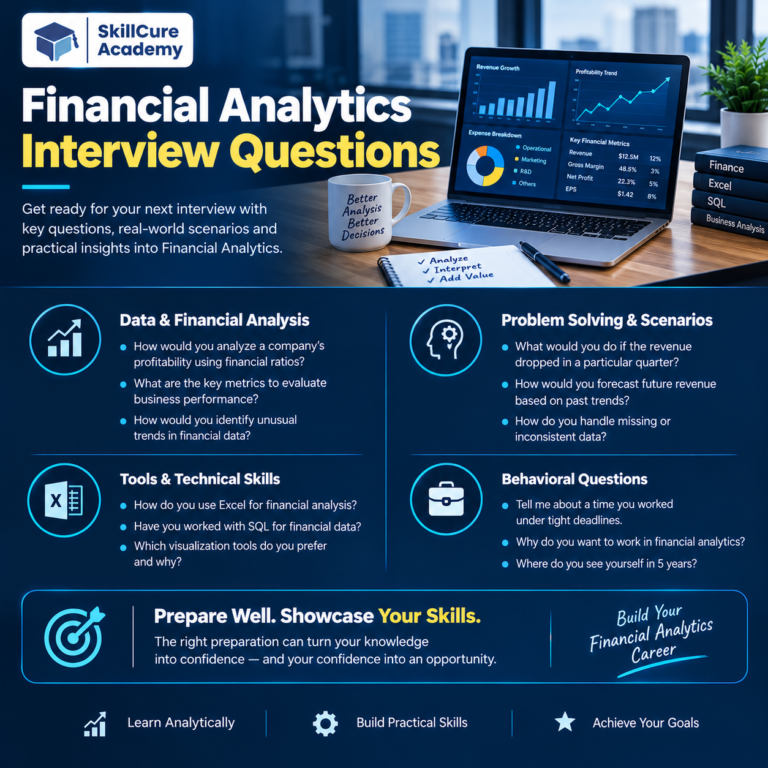
- Prepare for finance and analytics interviews.
Why Practical Projects Matter
Learning financial tools without applying them to real problems may not be enough. Practical projects help students understand how financial analytics is used in actual business situations.
Students can work on projects such as:
- Company financial performance dashboard
- Sales and revenue analysis
- Expense analysis
- Profitability analysis
- Cash flow forecasting model
- Financial KPI dashboard
- Budget vs actual analysis
- Business performance report
These projects can also become part of a student’s portfolio when applying for internships and entry-level positions.
Financial Analytics Course in Noida for Commerce Students
For commerce students in Noida and Delhi NCR, choosing a practical Financial Analytics Course can be a useful step toward developing industry-relevant skills.
While selecting a course, students should look beyond the course name and check whether it includes practical training, financial modelling, analytical tools, dashboard creation, real-world projects, and career guidance.
A course that combines commerce knowledge with financial analytics skills can help students become more confident in handling financial data and preparing for modern finance-related roles.
Who Should Consider a Financial Analytics Course?
A financial analytics course can be suitable for:
- B.Com students
- M.Com students
- Commerce graduates
- Finance students
- Accounting professionals
- MBA Finance students
- Students interested in financial analysis
- Professionals looking to move toward finance analytics
- Beginners interested in data-driven finance careers
FAQs
1. Is Financial Analytics a good career option for commerce students?
Yes. Commerce students already have knowledge of accounting, finance, and business concepts. Adding financial analytics skills can help them explore roles involving financial analysis, reporting, forecasting, business intelligence, and data-driven decision-making.
2. Do I need programming knowledge to learn financial analytics?
Not necessarily. Beginners can start with tools such as Advanced Excel and Power BI. Programming can be learned later if it becomes necessary for a particular career path.
3. What tools should commerce students learn for financial analytics?
Advanced Excel is an important starting point. Students can also learn Power BI, financial modelling, data analysis, and basic statistics to develop a stronger skill set.
4. Can B.Com students pursue financial analytics?
Yes. B.Com students are well-positioned to learn financial analytics because their academic background already includes accounting, finance, economics, and business concepts.
5. What jobs can I get after learning financial analytics?
Depending on your qualifications and skills, you can explore roles such as Financial Analyst, FP&A Analyst, Business Analyst, MIS Analyst, Reporting Analyst, Investment Analyst, Risk Analyst, and Data Analyst in finance.