

Goods and Services Tax (GST) is one of the most important indirect taxes in India. It affects businesses, shopkeepers, service providers, manufacturers, and consumers. Whether you are a student, a business owner, or someone planning to work in accounting, understanding GST can help you learn how taxation works in India.
But what exactly is GST? How does it work? What are the different types of GST, and how do businesses calculate and pay it?
GST stands for Goods and Services Tax. It is an indirect tax charged on the supply of goods and services. It was introduced in India on 1 July 2017 to bring several central and state indirect taxes under a more unified tax system.
In this beginner’s guide, we will explain the meaning of GST, its types, GST rates, registration, returns, input tax credit, and practical examples to help you understand the basics.
What Is GST in India?
GST, or Goods and Services Tax, is a destination-based indirect tax levied on the supply of goods and services.
Before GST was introduced, businesses dealt with several indirect taxes, including service tax, central excise duty, and state VAT. GST brought many of these taxes into a common framework.
Under the GST system, tax is generally collected at different stages of the supply chain, while eligible businesses can claim credit for GST paid on business purchases. The final consumer generally bears the tax cost.
For example, imagine a manufacturer sells a product to a wholesaler, who then sells it to a retailer. The retailer finally sells the product to a customer.
GST may apply at each stage, but eligible businesses can generally claim input tax credit on qualifying purchases. This helps prevent the repeated taxation of the same value throughout the supply chain.
GST is administered through the central and state tax authorities under the applicable GST laws.
What Are the Different Types of GST in India?
There are four main types of GST you should understand: CGST, SGST, IGST, and UTGST.
The type of GST charged depends on factors such as the location of the supplier and the place of supply.
1. CGST (Central Goods and Services Tax)
CGST is the central government’s share of GST on eligible intra-state supplies.
It generally applies when a taxable supply takes place within the same state or union territory under the relevant rules.
For example, if a business in Uttar Pradesh sells taxable goods to a customer in Uttar Pradesh, CGST may apply along with SGST.
2. SGST (State Goods and Services Tax)
SGST is the state government’s share of GST on eligible intra-state supplies.
Using the previous example, if a seller and the relevant place of supply are within Uttar Pradesh, SGST may be charged alongside CGST.
The central and state components are generally equal for a particular intra-state supply.
3. IGST (Integrated Goods and Services Tax)
IGST generally applies to inter-state supplies of goods and services, as well as certain other supplies covered by GST law.
For example, a business in Delhi sells taxable goods to a business in Haryana. If the transaction qualifies as an inter-state supply, IGST generally applies.
IGST is administered by the central government, with revenue apportioned according to the applicable rules.
4. UTGST (Union Territory Goods and Services Tax)
UTGST applies to eligible intra-territory supplies in union territories covered by the UTGST framework.
Depending on the location and applicable law, UTGST is generally charged alongside CGST rather than SGST.
Difference Between CGST, SGST, IGST, and UTGST
| Type of GST | Full Form | Generally Applies To | Collected or Administered By |
|---|---|---|---|
| CGST | Central Goods and Services Tax | Eligible intra-state supplies | Central Government |
| SGST | State Goods and Services Tax | Eligible intra-state supplies in states | State Government |
| IGST | Integrated Goods and Services Tax | Eligible inter-state supplies and other specified transactions | Central Government |
| UTGST | Union Territory Goods and Services Tax | Eligible intra-territory supplies in covered union territories | Union Territory administration under the applicable framework |
Understanding these four types is essential for anyone learning GST accounting or working with business invoices.
What Are the GST Rates in India?
GST rates vary depending on the type of goods or services being supplied.
Different products and services can fall under different tax classifications. Some supplies are exempt or taxed at a nil rate, while certain supplies may attract special provisions or compensation cess where applicable.
Commonly encountered GST rate categories include 5%, 12%, 18%, and 28%, along with nil-rated, exempt, and other specially treated supplies. However, not every category applies to every product or service, and rates can change following government notifications.
Examples of GST Rate Categories
| GST Rate Category | General Explanation |
|---|---|
| Nil-rated | Specified taxable supplies carrying a nil GST rate |
| 5% | Applies to certain specified goods and services |
| 12% | Applies to certain specified goods and services |
| 18% | Applies to many specified goods and services |
| 28% | Applies to certain specified goods and services |
| Exempt | Supplies exempted under the applicable GST provisions |
Important: These are general categories, not a definitive list of current product rates. The applicable rate depends on the product or service classification, relevant notifications, and any applicable conditions.
Before charging GST, businesses should verify the correct rate using the official rate schedules published by the Central Board of Indirect Taxes and Customs (CBIC).
How to Calculate GST: A Simple Example
GST calculation is one of the most important concepts for beginners.
The basic formula for calculating GST on a taxable value is:
GST Amount = Taxable Value × GST Rate ÷ 100
Let’s understand this with an example.
Suppose a business sells a product for ₹10,000 before GST, and the applicable GST rate is 18%.
| Particulars | Amount |
|---|---|
| Product price before GST | ₹10,000 |
| Applicable GST rate | 18% |
| GST amount | ₹1,800 |
| Total invoice value | ₹11,800 |
The customer pays ₹11,800, including ₹1,800 GST.
Example of Intra-State GST Calculation
Suppose the product is sold within the same state and the applicable rate is 18%, split equally between CGST and SGST.
| Particulars | Amount |
|---|---|
| Taxable value | ₹10,000 |
| CGST at 9% | ₹900 |
| SGST at 9% | ₹900 |
| Total GST | ₹1,800 |
| Final amount | ₹11,800 |
Example of Inter-State GST Calculation
Suppose the same product is sold in an eligible inter-state transaction with an applicable IGST rate of 18%.
| Particulars | Amount |
|---|---|
| Taxable value | ₹10,000 |
| IGST at 18% | ₹1,800 |
| Final amount | ₹11,800 |
These examples assume that the supply is taxable at 18% and that no special valuation or other adjustment applies.
What Is Input Tax Credit (ITC) Under GST?
Input Tax Credit, commonly called ITC, allows eligible registered businesses to claim credit for GST paid on qualifying business purchases.
This is an important feature of the GST system because it helps prevent tax from becoming a repeated cost at every stage of the supply chain.
Example of Input Tax Credit
Suppose a registered business purchases goods for ₹50,000 and pays GST at 18%.
The GST paid on the purchase is ₹9,000.
Later, the business sells taxable goods for ₹80,000 and charges GST at 18%.
The output GST collected is ₹14,400.
Assuming the entire purchase qualifies for ITC and all legal conditions are satisfied, the calculation would be:
| Particulars | Amount |
|---|---|
| Output GST on sales | ₹14,400 |
| Eligible input tax credit | ₹9,000 |
| Remaining GST liability | ₹5,400 |
The business can generally use the eligible ₹9,000 credit against its output tax liability, subject to GST rules.
However, ITC is not automatically available on every purchase. Businesses must satisfy the applicable conditions, documentation requirements, and restrictions under GST law.
What Is GST Registration?
GST registration is the process through which an eligible business obtains registration under the GST system.
A registered business receives a Goods and Services Tax Identification Number, known as a GSTIN.
GST registration requirements depend on factors such as aggregate turnover, the nature of the business, the type of supply, the state or union territory, and specific compulsory-registration provisions.
Who Needs GST Registration?
Depending on the applicable rules, GST registration may be required for:
- Businesses crossing the applicable turnover threshold
- Certain inter-state suppliers
- E-commerce sellers and operators covered by specific provisions
- Persons required to register under compulsory-registration rules
- Other businesses or persons specifically covered by GST law
There are exceptions and special provisions, so not every business that makes an inter-state sale or operates online automatically has the same registration obligation.
Some eligible businesses may also choose voluntary registration.
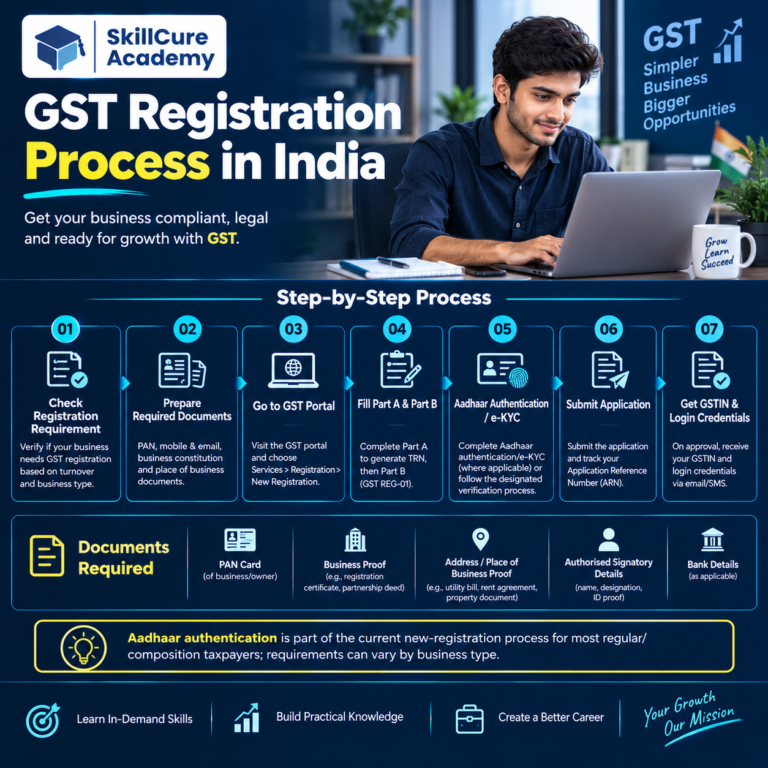
How to Apply for GST Registration
Businesses can apply through the official GST portal.
The general process includes:
- Visit the official GST portal.
- Select Services and then Registration.
- Choose New Registration.
- Enter the required business, PAN, contact, and state details.
- Verify the required mobile number and email address.
- Complete the application with the required information and supporting documents.
- Submit the application and track its status.
The exact requirements depend on the type of applicant and registration being requested.
What Is GSTIN?
GSTIN stands for Goods and Services Tax Identification Number.
It is a unique identification number assigned to a registered taxpayer under GST.
A GSTIN contains 15 characters and follows a defined structure.
The structure generally includes:
- The first two digits: State or union territory code
- The next ten characters: PAN of the registered person
- The thirteenth character: Registration-related code
- The fourteenth character: Usually the letter Z under the standard format
- The fifteenth character: A checksum character
Businesses use their GSTIN for tax invoices, GST returns, and other compliance-related activities.
When dealing with a registered supplier, checking the GSTIN can help verify the supplier’s registration details through the appropriate official facility.
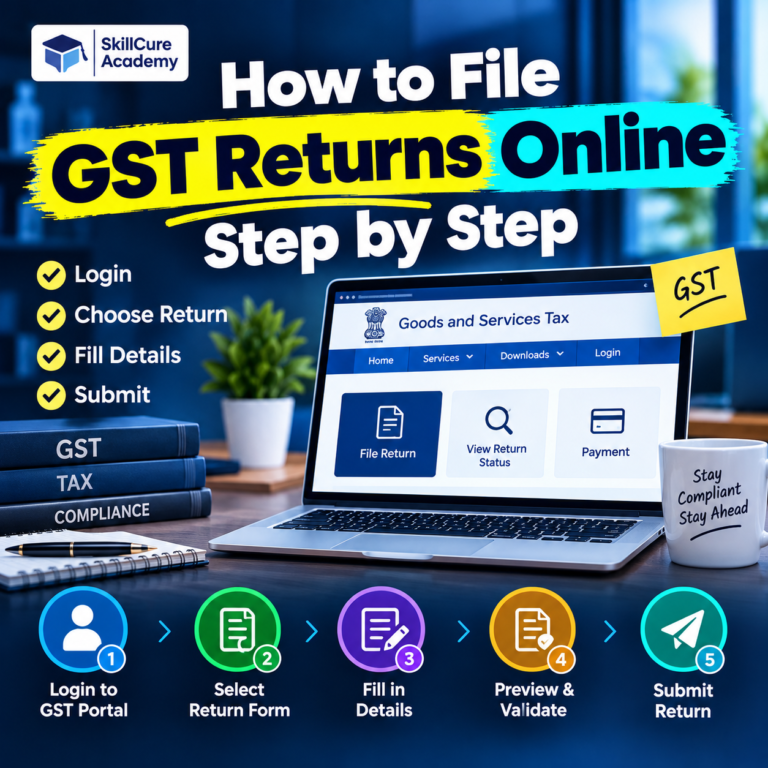
What Are GST Returns?
GST returns are statements that registered taxpayers submit to report specified business transactions, tax liabilities, input tax credit, and other relevant information.
The forms and filing frequency depend on the taxpayer’s registration type and applicable GST rules.
Common GST Returns
| GST Return | Purpose |
|---|---|
| GSTR-1 | Reports details of outward supplies |
| GSTR-3B | Summary return used to report tax liabilities and eligible ITC, among other details |
| GSTR-4 | Annual return for eligible composition taxpayers |
| GSTR-9 | Annual return for taxpayers required to file it |
| GSTR-10 | Final return in specified cases following cancellation of registration |
Not every registered taxpayer must file every return listed above. Applicability depends on the taxpayer category, turnover, scheme, and relevant provisions.
Why Is GST Return Filing Important?
GST return filing helps businesses report transactions, reconcile sales and purchase information, and meet their tax compliance obligations.
Incorrect information or missed filing deadlines can lead to interest, late fees, notices, or other consequences under applicable law.
Businesses should maintain accurate invoices, purchase records, sales records, and supporting documents to help ensure correct reporting.
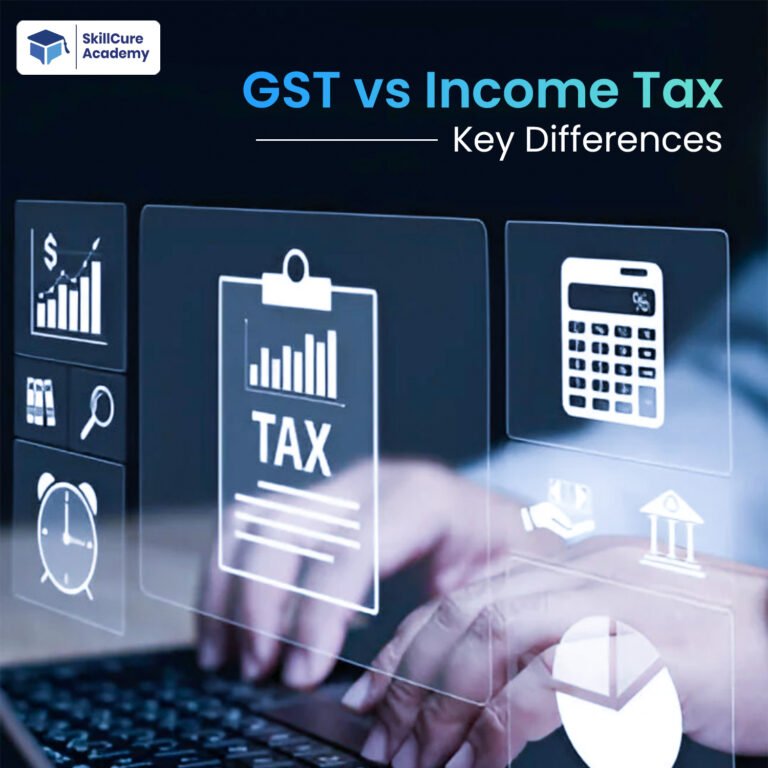
What Is the Difference Between GST and Income Tax?
GST and income tax are both important taxes in India, but they work differently.
| Comparison Factor | GST | Income Tax |
|---|---|---|
| Type of tax | Indirect tax | Direct tax |
| Generally charged on | Supply of goods and services | Taxable income |
| Who bears the tax | Generally the final consumer | The person or entity liable for the tax |
| Main calculation basis | Taxable supply value and applicable rate | Taxable income and applicable rates |
| Common compliance | GST invoices and applicable GST returns | Income tax returns and related obligations |
| Administration | Central and state tax authorities under GST law | Income tax authorities under income tax law |
For example, a customer may pay GST when purchasing a taxable product, while a business owner may separately owe income tax on taxable profits or other taxable income.
The two systems serve different purposes and have different compliance requirements.
Why Is GST Knowledge Important for Accounting Professionals?
GST knowledge is useful for people working in accounting, taxation, bookkeeping, finance, and business administration.
Companies need employees who understand how to prepare invoices, classify transactions, maintain records, reconcile tax information, and support compliance activities.
Learning GST can help beginners understand several practical business tasks.
Important GST Skills for Beginners
- Understanding CGST, SGST, IGST, and UTGST
- Calculating GST on taxable invoices
- Identifying applicable GST rates
- Understanding input tax credit
- Preparing and checking tax invoices
- Maintaining sales and purchase records
- Understanding GST return requirements
- Reconciling accounting records with GST information
- Learning GST-related features in accounting software
- Understanding basic compliance and documentation
Students who want to work in accounting may also benefit from learning accounting fundamentals and software such as TallyPrime alongside GST concepts.
Practical training can help learners understand how tax calculations, invoices, ledgers, and business records work together.
At Skillcure Academy, learners interested in accounting and job-oriented courses can enquire about available training options and practical learning opportunities.
Frequently Asked Questions (FAQs)
1. What is GST in India in simple words?
GST stands for Goods and Services Tax. It is an indirect tax charged on the supply of goods and services under India’s GST laws. The final consumer generally bears the tax cost.
2. What are the four types of GST in India?
The four main types are CGST, SGST, IGST, and UTGST. CGST and SGST generally apply to eligible intra-state supplies, IGST generally applies to inter-state supplies, and UTGST applies to eligible supplies in covered union territories.
3. How is GST calculated?
GST is generally calculated by multiplying the taxable value by the applicable GST rate and dividing the result by 100. For example, 18% GST on a taxable value of ₹10,000 equals ₹1,800.
4. Is GST registration mandatory for every business?
No. Registration depends on applicable turnover thresholds, the nature and location of supplies, compulsory-registration provisions, and other conditions. Some businesses may qualify for exceptions or special schemes.
5. Which GST returns should a beginner know?
Beginners should become familiar with GSTR-1 and GSTR-3B first. GSTR-1 reports outward supplies, while GSTR-3B is a summary return used to report tax liabilities and eligible input tax credit. Other returns apply to particular taxpayer categories or circumstances.