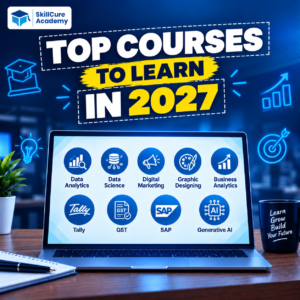

The professional world is changing rapidly as businesses adopt artificial intelligence, data-driven decision-making, digital platforms, and modern business software. As 2027 approaches, learning relevant skills can help students, freshers, and working professionals prepare for new career opportunities.
Choosing the right course is an important step toward building practical knowledge and improving employability. Whether you are interested in technology, creative work, accounting, or business management, several courses can help you develop industry-relevant skills.
In this guide, we explore the 8 best courses to learn before 2027: Data Analytics, Data Science, Digital Marketing, Graphic Designing, Business Analytics, Tally with GST, SAP, and Generative AI.
Why Should You Learn New Skills Before 2027?
Employers increasingly value candidates who can use digital tools, solve problems, communicate effectively, and adapt to changing business requirements. Learning a relevant skill can help you improve your existing qualifications and explore different career paths.
Here are some important benefits of learning new skills:
- Better career opportunities: Develop knowledge relevant to your preferred industry.
- Practical expertise: Learn tools and techniques used in real workplaces.
- Professional growth: Strengthen your resume with relevant skills and projects.
- Career flexibility: Explore opportunities across different industries.
- Continuous development: Stay prepared for evolving workplace requirements.
Top 8 Courses to Learn Before 2027
1. Data Analytics
Data Analytics is one of the most useful skills for individuals interested in working with data and supporting business decisions. It involves collecting, cleaning, analyzing, and presenting information to identify trends and patterns.
Businesses use data analytics to understand customers, measure performance, improve operations, and make informed decisions.
Key skills to learn:
- Microsoft Excel and advanced spreadsheet functions.
- SQL for querying databases.
- Power BI or Tableau for data visualization.
- Basic Python for data analysis.
- Reporting and data interpretation.
Career opportunities: Data Analyst, Reporting Analyst, MIS Executive, and Business Intelligence Analyst.
2. Data Science
Data Science combines statistics, programming, mathematics, and machine learning to extract insights from complex datasets. It is suitable for learners interested in solving analytical problems and developing predictive models.
Compared with basic data analysis, data science generally involves more advanced statistical techniques and machine learning.
Key skills to learn:
- Python programming.
- Statistics and probability.
- Data cleaning and visualization.
- Machine learning fundamentals.
- Model evaluation and interpretation.
Career opportunities: Junior Data Scientist, Machine Learning Associate, Data Science Intern, and Analytics Specialist.
A strong foundation in mathematics and programming is helpful for learners pursuing this field.
3. Digital Marketing
Digital Marketing helps businesses promote products and services through online channels. It combines creativity, communication, and performance measurement to reach target audiences and generate leads.
As organizations continue to use digital platforms to connect with customers, digital marketing knowledge can be useful for businesses of different sizes.
Key skills to learn:
- Search Engine Optimization (SEO).
- Social media marketing.
- Content writing and strategy.
- Google Ads and paid campaigns.
- Email marketing and campaign analytics.
Career opportunities: Digital Marketing Executive, SEO Executive, Social Media Manager, Content Marketer, and Performance Marketing Associate.
Practical experience with sample campaigns, keyword research, and analytics reports can help you build a portfolio.
4. Graphic Designing
Graphic Designing focuses on communicating ideas through visual elements such as images, typography, layouts, and illustrations. It is valuable for businesses that need branding, advertising, social media creatives, and marketing materials.
This course is suitable for learners who enjoy creativity and visual communication.
Key skills to learn:
- Design principles and color theory.
- Typography and layout design.
- Adobe Photoshop and Illustrator.
- Canva and other design tools.
- Brand identity and social media design.
Career opportunities: Graphic Designer, Visual Designer, Creative Assistant, and Social Media Designer.
Building a portfolio of original designs is an important step toward demonstrating your creative abilities to potential employers or clients.
5. Business Analytics
Business Analytics uses data, reporting, and analytical methods to help organizations improve performance and make strategic decisions. It combines business understanding with analytical thinking.
Professionals in this field may study sales trends, customer behavior, operational efficiency, and business performance.
Key skills to learn:
- Excel and business reporting.
- SQL fundamentals.
- Power BI or Tableau.
- Key performance indicators (KPIs).
- Business problem-solving and presentation.
Career opportunities: Business Analyst, Business Reporting Analyst, Operations Analyst, and Junior Business Intelligence Analyst.
Business Analytics can be a suitable option for learners interested in both business operations and data-driven decision-making.
6. Tally and GST
Tally with GST is a practical course for learners interested in accounting, bookkeeping, taxation, and financial record management. It introduces the accounting processes commonly used by businesses and accounting professionals.
The course can help learners understand day-to-day financial operations and maintain organized business records.
Key skills to learn:
- Accounting fundamentals.
- Voucher entry and ledger management.
- Sales and purchase transactions.
- GST invoicing and relevant compliance concepts.
- Financial reports and reconciliation.
Career opportunities: Accounts Assistant, Junior Accountant, Billing Executive, and Accounting Support Executive.
Learning Tally alongside GST concepts and Excel can strengthen your practical accounting skills. Tax rules and compliance requirements should always be learned from current, reliable resources.
7. SAP
SAP is enterprise software used by organizations to manage business processes, including finance, procurement, sales, inventory, and human resources. SAP training helps learners understand how these processes operate within integrated business systems.
The most suitable SAP course depends on your educational background, experience, and intended career path.
Key areas to explore:
- SAP S/4HANA fundamentals.
- SAP Finance (FI).
- SAP Materials Management (MM).
- SAP Sales and Distribution (SD).
- Business process integration and reporting.
Career opportunities: SAP Support Associate, SAP Functional Consultant, ERP Support Executive, and SAP Analyst.
Practical system exposure and a clear understanding of business processes are valuable when preparing for SAP-related roles.
8. Generative AI
Generative AI is changing how individuals and organizations create content, summarize information, generate ideas, and automate certain tasks. Learning to use AI tools effectively can complement skills in marketing, design, analytics, and business operations.
A Generative AI course can introduce learners to practical applications without necessarily requiring advanced programming knowledge.
Key skills to learn:
- Prompt engineering.
- AI-assisted writing and research.
- AI tools for productivity.
- Content generation and workflow automation.
- Responsible AI use, privacy, and output verification.
Career opportunities: AI Operations Associate, AI Content Specialist, AI-enabled Marketing Associate, and Automation Support Specialist.
Career outcomes depend on the depth of your training and the additional skills you develop. Combining Generative AI with a specific professional skill can make your knowledge more useful in practical work.
Comparison of the Best Courses to Learn Before 2027
The following table summarizes the main focus and potential career paths associated with each course.
| Course | Main Focus | Potential Career Roles |
|---|---|---|
| Data Analytics | Data analysis and visualization | Data Analyst, MIS Executive |
| Data Science | Statistics and machine learning | Junior Data Scientist |
| Digital Marketing | Online promotion and campaign performance | SEO Executive, Digital Marketer |
| Graphic Designing | Visual communication and branding | Graphic Designer |
| Business Analytics | Business performance and insights | Business Analyst |
| Tally and GST | Accounting and taxation | Accounts Assistant |
| SAP | Enterprise business processes | SAP Support Associate |
| Generative AI | AI tools and workflow improvement | AI Operations Associate |
Note: Job titles and entry requirements vary by employer, experience, location, and the depth of your training.
Which Course Should You Choose?
The right course depends on your interests, educational background, and career objectives. Instead of selecting a course only because it is popular, consider how it aligns with the work you want to do.
- For data-focused careers: Choose Data Analytics, Data Science, or Business Analytics.
- For creative careers: Explore Graphic Designing or Digital Marketing.
- For accounting and finance: Consider Tally with GST.
- For enterprise software careers: Explore SAP and its relevant modules.
- For AI-driven productivity: Start with Generative AI and practical AI applications.
Before enrolling, review the syllabus, training methodology, software covered, hands-on projects, and available career support.
How to Prepare for Career Growth Before 2027
Learning a course is only the beginning. Applying your knowledge through projects and practice helps you develop confidence and demonstrate your abilities.
Follow these steps to make your learning more effective:
- Set a clear career goal: Identify the industry or role you want to pursue.
- Choose a relevant course: Select a program that matches your current knowledge and career plans.
- Practice regularly: Apply concepts through assignments, exercises, and projects.
- Build a portfolio: Collect examples of your work, such as dashboards, designs, campaigns, or reports.
- Update your resume: Highlight relevant tools, projects, and demonstrated skills.
- Keep learning: Stay updated with new tools, industry practices, and changes in your chosen field.
Consistent practice and demonstrable skills can be more valuable than collecting certificates without applying what you have learned.
Conclusion
The best skills to learn before 2027 are those that match your career goals and help you solve real-world problems. Data Analytics, Data Science, Digital Marketing, Graphic Designing, Business Analytics, Tally with GST, SAP, and Generative AI offer different learning paths across technology, business, finance, and creative industries.
You do not need to master every skill at once. Choose one course that aligns with your interests, build practical experience, and continue developing your knowledge over time.
Start learning today to build relevant skills, strengthen your professional profile, and prepare for future career opportunities.
Frequently Asked Questions (FAQs)
1. What are the best courses to learn before 2027?
Some useful options include Data Analytics, Data Science, Digital Marketing, Graphic Designing, Business Analytics, Tally with GST, SAP, and Generative AI. The best choice depends on your career goals and interests.
2. Which course is best for beginners?
Digital Marketing, Graphic Designing, basic Data Analytics, Tally with GST, and introductory Generative AI can be accessible starting points. The ideal option depends on your interests and existing knowledge.
3. Which course is best for getting a job?
Data Analytics, Digital Marketing, accounting, and selected SAP training paths may prepare learners for relevant entry-level roles. Employment depends on practical skills, qualifications, portfolio quality, and local demand.
4. Is Data Analytics a good skill to learn before 2027?
Data Analytics can be useful for learners interested in working with data, creating reports, and supporting business decisions. Excel, SQL, and Power BI are practical starting points.
5. What is the difference between Data Analytics and Data Science?
Data Analytics primarily focuses on examining data to answer questions and support decisions. Data Science often involves more advanced statistics, programming, and machine learning to develop predictive models and analytical solutions.
6. Can I learn Digital Marketing without coding?
Yes. You can learn SEO, social media marketing, content strategy, email marketing, and paid advertising without becoming a programmer. Basic technical knowledge may be useful for some specialized tasks.
7. Is Tally with GST useful for accounting jobs?
Yes. Tally with GST can help learners develop practical knowledge of bookkeeping, accounting entries, invoicing, and taxation concepts relevant to many accounting support roles.
8. Who should learn SAP?
SAP may suit commerce graduates, finance professionals, supply chain learners, IT professionals, and others interested in enterprise business systems. The appropriate module depends on your background and career goals.
9. Do I need coding skills to learn Generative AI?
No. Many introductory Generative AI courses focus on using AI tools and writing effective prompts. Programming can be helpful for advanced applications and automation, but it is not essential for every use case.
10. How do I choose the right course before 2027?
Identify your career objective, compare course syllabuses, review practical training opportunities, and select a course that matches your background. Build projects and practice regularly to demonstrate your skills to employers.