
Completing graduation is an important milestone, but many students face the same question after getting their degree: What should I do next to build a successful career?
A graduation degree gives you academic knowledge, but the job market in 2026 is increasingly focused on practical skills, industry knowledge, projects, and job-ready abilities. A well-chosen professional course can help graduates build specialised skills without spending several more years pursuing another traditional degree.
Whether you are from B.Com, BBA, BA, B.Sc, BCA, B.Tech or another graduation background, there are several career-focused courses that can help you enter growing industries.
What Is a Job-Oriented Course?
A job-oriented course is a skill-based training program designed around a specific career or job role.
Instead of focusing mainly on academic theory, these courses generally emphasise:
- Practical tools and software
- Industry-relevant skills
- Real-world projects
- Portfolio development
- Interview preparation
- Problem-solving
- Job-specific knowledge
The right course can help bridge the gap between what you studied in college and what companies expect from candidates.
Why Choose a Job-Oriented Course After Graduation?
The competition among graduates has increased, and simply having a degree may not be enough to stand out.
A job-oriented course can help you:
| Benefit | How It Helps |
|---|---|
| Practical Skills | Learn tools used in real workplaces |
| Better Employability | Build skills relevant to specific job roles |
| Career Direction | Choose a specialised career path |
| Projects | Demonstrate practical knowledge to employers |
| Interview Preparation | Become more confident during interviews |
| Career Switch | Move into a new field after graduation |
The important point is that you should choose a course based on your career goal, interest and existing background rather than simply following trends.
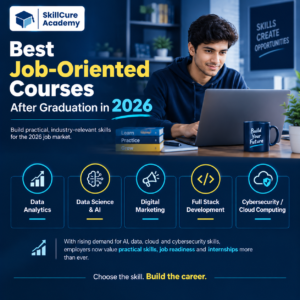
Best Job-Oriented Courses After Graduation in 2026
Here are some of the popular career-oriented options graduates can consider in 2026.
1. Data Analytics
Data Analytics is one of the most practical career options for graduates who enjoy numbers, problem-solving and business decision-making.
A good Data Analytics program generally covers tools such as:
- Advanced Excel
- SQL
- Power BI
- Python
- Statistics
- Data visualisation
- Real-world projects
Data Analytics skills are applicable across industries including IT, banking, fintech, retail, e-commerce, healthcare and FMCG.
Popular Job Roles
- Data Analyst
- Business Analyst
- MIS Analyst
- Reporting Analyst
- BI Analyst
Best suited for: B.Com, BBA, B.Sc, BA, BCA and other graduates interested in data and business.
2. Data Science and Artificial Intelligence
Data Science and AI are strong options for students who want to build a more technical career around data, machine learning and artificial intelligence.
Typical learning areas include:
- Python
- Statistics
- Machine Learning
- SQL
- Data Analysis
- Artificial Intelligence
- Machine Learning projects
This path generally requires stronger programming and mathematical skills than basic Data Analytics.
Popular Job Roles
- Data Scientist
- Machine Learning Engineer
- AI Engineer
- Junior Data Scientist
- ML Analyst
Best suited for: B.Tech, BCA, B.Sc Mathematics, Statistics, Computer Science and technically inclined graduates.
3. Digital Marketing
Digital Marketing is another job-oriented career option that does not require advanced programming skills.
Businesses across industries need professionals who can manage their online presence, advertising and customer acquisition.
A comprehensive Digital Marketing course may cover:
- SEO
- Google Ads
- Social Media Marketing
- Meta Ads
- Content Marketing
- Email Marketing
- Google Analytics
- Performance Marketing
Popular Job Roles
- Digital Marketing Executive
- SEO Executive
- Performance Marketing Executive
- Social Media Executive
- PPC Executive
- Digital Marketing Analyst
Best suited for: Graduates who enjoy marketing, communication, creativity and business.
4. Full Stack Web Development
Full Stack Development is suitable for graduates who want to enter software and web development.
Students generally learn both front-end and back-end technologies, along with databases and APIs.
Key Skills
- HTML
- CSS
- JavaScript
- React
- Backend development
- Databases
- APIs
- Git/GitHub
Popular Job Roles
- Full Stack Developer
- Front-End Developer
- Back-End Developer
- Web Developer
- Software Developer
Best suited for: BCA, B.Tech, MCA and graduates interested in programming.
5. Cloud Computing
Businesses are increasingly using cloud infrastructure, making cloud skills valuable for technology-focused careers.
Cloud courses may introduce students to platforms and concepts related to:
- AWS
- Microsoft Azure
- Google Cloud
- Cloud infrastructure
- Networking
- Security
- Deployment
Popular Job Roles
- Cloud Support Associate
- Cloud Engineer
- Cloud Administrator
- DevOps Associate
- Cloud Operations Engineer
Best suited for: B.Tech, BCA, MCA and graduates with an interest in IT infrastructure.
6. Cybersecurity
As organisations become more dependent on digital systems and cloud infrastructure, protecting data and systems has become increasingly important. Recent reporting has also highlighted growing cybersecurity demand in India alongside rising AI and cloud investments.
Cybersecurity learning may include:
- Network security
- Ethical hacking fundamentals
- Security monitoring
- Vulnerability assessment
- Cybersecurity tools
- Incident response
Popular Job Roles
- Cybersecurity Analyst
- Security Analyst
- SOC Analyst
- Information Security Analyst
- Security Operations Associate
Best suited for: Graduates interested in technology, networks and security.
7. Business Analytics
Business Analytics combines business knowledge with data analysis to help organisations make better decisions.
Students may learn:
- Excel
- SQL
- Power BI
- Statistics
- Data visualisation
- Business problem-solving
Popular Job Roles
- Business Analyst
- Business Intelligence Analyst
- Reporting Analyst
- Data Analyst
- Operations Analyst
This can be particularly useful for graduates from BBA, B.Com, economics and management backgrounds.
8. Financial Analytics and Financial Modelling
Graduates interested in finance can explore Financial Analytics and Financial Modelling.
These programs may cover:
- Advanced Excel
- Financial statements
- Financial modelling
- Business analysis
- Forecasting
- Data analysis
- Financial reporting
Popular Job Roles
- Financial Analyst
- Finance Analyst
- Business Finance Analyst
- Investment Analyst
- FP&A Analyst
Best suited for: B.Com, BBA, Economics, Finance and management graduates.
Which Course Is Best After Graduation?
There is no single course that is best for every graduate.
Your choice should depend on your degree, interests, existing skills and career goals.
| Graduation Background | Courses to Consider | Potential Career Direction |
|---|---|---|
| B.Com | Data Analytics, Business Analytics, Digital Marketing, Financial Analytics | Analytics, Finance, Marketing |
| BBA | Business Analytics, Data Analytics, Digital Marketing | Business, Analytics, Marketing |
| BA | Digital Marketing, Data Analytics, UI/UX | Marketing, Analytics, Creative |
| B.Sc | Data Analytics, Data Science, AI | Data & Technology |
| BCA | Data Analytics, Data Science, Full Stack, Cloud | IT & Technology |
| B.Tech | Data Science, AI, Cloud, Cybersecurity, Full Stack | Technology |
| Economics | Data Analytics, Business Analytics, Financial Analytics | Analytics & Finance |
How to Choose the Right Job-Oriented Course
Before enrolling in any course, don’t choose only because it is advertised as a “high salary” career.
Check these important factors:
1. Look at the Skills Being Taught
Make sure the syllabus includes current industry tools rather than outdated technologies.
2. Check Practical Training
A job-oriented course should provide opportunities to work on practical assignments and projects.
3. Look at the Job Roles
Understand what positions the course is preparing you for.
4. Consider Your Background
Your graduation degree doesn’t necessarily limit your career, but your existing knowledge can make some courses easier to learn.
5. Check Interview Preparation
Resume building, mock interviews and communication practice can be valuable when preparing for fresher roles.
6. Don’t Choose Only Based on Salary
Salary depends on skills, experience, company, location and interview performance. No course can guarantee a particular salary.
Quick Comparison of Job-Oriented Courses
| Course | Coding Level | Suitable For | Career Area |
|---|---|---|---|
| Data Analytics | Low to Moderate | Analytical thinkers | Data & Business |
| Data Science | High | Technical graduates | Data & AI |
| Digital Marketing | Low | Creative & business-minded students | Marketing |
| Full Stack Development | High | Programming enthusiasts | Software |
| Cloud Computing | Moderate to High | IT graduates | Cloud & Infrastructure |
| Cybersecurity | Moderate to High | Tech & security enthusiasts | Cybersecurity |
| Business Analytics | Low to Moderate | Business graduates | Business & Analytics |
| Financial Analytics | Low to Moderate | Commerce & finance graduates | Finance |
Job-Oriented Course vs Traditional Degree
A traditional degree and a job-oriented course serve different purposes.
A degree can provide a broad academic foundation, while a professional course can help you develop specialised skills for a particular job role.
For many graduates, combining both can be useful:
Graduation Degree + Practical Skill + Projects + Interview Preparation = Stronger Job Profile
The goal should not simply be to collect certificates. The real objective should be to develop skills that you can demonstrate during an interview or through your portfolio.
What Should You Do After Graduation in 2026?
If you have recently completed graduation and are confused about your next step, start by answering three questions:
1. What type of work do I enjoy?
Do you prefer numbers, technology, marketing, finance, coding or creative work?
2. What skills can I realistically learn?
Choose a course that matches your current level and allows you to build skills progressively.
3. What job role do I want within the next 6–12 months?
Work backwards from the job role and identify the skills required for it.
For example:
Want to become a Data Analyst?
Learn Excel → SQL → Power BI → Python → Statistics → Projects → Interview Preparation
Want to enter Digital Marketing?
Learn SEO → Social Media → Google Ads → Meta Ads → Analytics → Projects → Interview Preparation
Want to become a Data Scientist?
Learn Python → Statistics → SQL → Data Analysis → Machine Learning → Projects → Interview Preparation
The best course is ultimately the one that takes you closer to a clearly defined career goal.
FAQs
1. Which is the best job-oriented course after graduation in 2026?
The best course depends on your background and career goals. Data Analytics, Data Science, Digital Marketing, Full Stack Development, Cloud Computing and Cybersecurity are among the career-focused options graduates can consider in 2026.
2. Which course is best for non-IT graduates?
Data Analytics, Business Analytics and Digital Marketing can be good options for graduates from non-technical backgrounds. Your choice should depend on whether you prefer analytical, business or marketing work.
3. Can a B.Com graduate learn Data Analytics?
Yes. B.Com graduates can learn Data Analytics and build careers in areas such as Data Analytics, Business Analytics, MIS and reporting. Excel, SQL, Power BI and basic Python are commonly useful skills.
4. Is a job-oriented course better than doing another degree?
It depends on your career goal. If you need specialised, practical skills for a particular job, a professional course may provide a faster skills-focused route. For careers requiring advanced academic qualifications, another degree may be more appropriate.
5. How should I choose a job-oriented course after graduation?
Compare the syllabus, practical training, projects, tools taught, trainer experience, career roles, interview preparation and overall learning approach. Most importantly, choose a course that matches the type of job you want.