

Artificial Intelligence (AI) is changing how businesses work, analyze data, and make decisions. Tools like ChatGPT can write SQL queries, generate Python code, explain Excel formulas, and summarize large amounts of information. Because of these capabilities, many students and professionals are asking an important question: Can ChatGPT replace a Data Analyst in 2026?
The short answer is that ChatGPT can automate many data analysis tasks, but it cannot completely replace the skills, judgment, and business understanding of a Data Analyst. Instead, it can help Data Analysts work more efficiently and focus on solving business problems.
In this blog, we will explore what ChatGPT can do, its limitations, and how aspiring Data Analysts can prepare for an AI-driven job market.
1. What Is ChatGPT, and How Does It Help Data Analysts?
ChatGPT is an AI-powered assistant that can understand questions, generate code, explain technical concepts, and help users work with information.
Data Analysts can use it at different stages of a project, from data cleaning to report preparation.
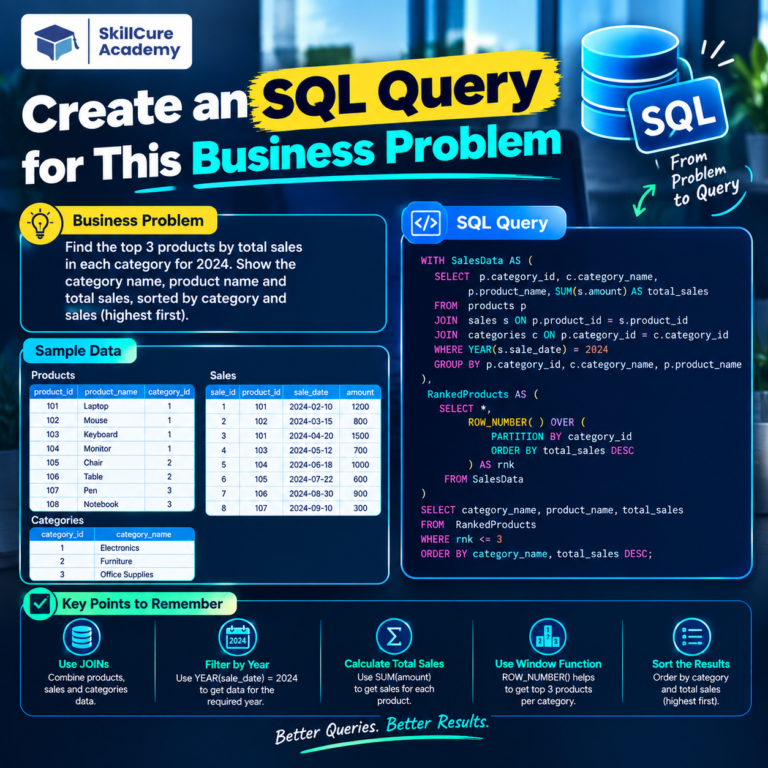
For example, a Data Analyst working with sales data can ask ChatGPT to write an SQL query to calculate monthly revenue or generate Python code to identify missing values.
Some common applications include:
- Excel: Generating formulas, explaining functions, and helping clean data.
- SQL: Writing queries, explaining JOINs, and identifying possible query improvements.
- Python: Generating code for data cleaning, analysis, and visualization.
- Power BI: Helping create DAX measures and troubleshoot formulas.
- Reporting: Summarizing findings and preparing initial report drafts.
However, the analyst must still verify the results before using them for business decisions.
2. Tasks ChatGPT Can Perform for Data Analysts
ChatGPT can assist with several repetitive and technical tasks, especially when the analyst provides clear instructions and relevant data.
| Data analysis task | How ChatGPT can help |
|---|---|
| Data cleaning | Suggest methods to handle missing values and duplicates |
| SQL queries | Generate queries for filtering, grouping, and joining tables |
| Excel formulas | Explain and create formulas such as XLOOKUP and SUMIFS |
| Python programming | Generate code for analysis and data transformation |
| Data visualization | Suggest suitable charts for different types of data |
| Report writing | Summarize findings and draft business reports |
| Documentation | Explain code and document analysis workflows |
For example, you can ask ChatGPT to write a SQL query that calculates total sales by product category.
It can generate the query, but you should check the table names, relationships, filters, and results to ensure the calculation matches the business requirement.
3. Can ChatGPT Replace a Data Analyst?
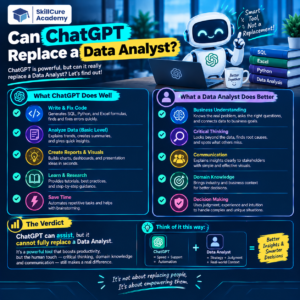
ChatGPT can automate parts of a Data Analyst’s workflow, but data analysis involves much more than writing code or creating charts.
A professional Data Analyst must understand business objectives, check data quality, interpret results, communicate with stakeholders, and recommend actions based on evidence.
Consider the following comparison:
| Responsibility | ChatGPT | Human Data Analyst |
|---|---|---|
| Generate SQL queries | Can generate queries from instructions | Validates and adapts queries to business needs |
| Clean data | Suggests cleaning methods and code | Determines appropriate treatment for the dataset |
| Create visualizations | Suggests charts and can help create code | Selects and validates visuals for the audience |
| Understand business context | Uses the context provided in prompts | Gathers context from stakeholders and business operations |
| Interpret results | Identifies patterns and suggests explanations | Evaluates whether explanations make business sense |
| Make business recommendations | Drafts possible recommendations | Evaluates trade-offs and takes responsibility for conclusions |
| Communicate with stakeholders | Helps prepare summaries | Clarifies requirements and explains findings in context |
The distinction is important: ChatGPT can help produce an analysis, but the analyst must determine whether that analysis is accurate, relevant, and useful.
4. Limitations of ChatGPT in Data Analytics
Although ChatGPT is useful, it has limitations that Data Analysts should understand.
A. It can generate incorrect answers
ChatGPT may produce SQL queries, formulas, or Python code that look correct but contain errors. Analysts should test the output against known results and business rules.
B. It may misunderstand business requirements
A request such as “calculate monthly revenue” can have different meanings depending on the business. It might require accounting for refunds, cancelled orders, taxes, or different currencies.
An analyst needs to clarify these requirements before calculating the final number.
C. Data privacy is important
Business datasets may contain customer details, employee information, or confidential financial records. Analysts must follow organizational policies and avoid sharing sensitive information with AI tools unless the use is authorized.
D. AI does not automatically understand every business situation
A sudden fall in sales might be related to pricing, seasonality, inventory shortages, marketing changes, or external factors. Identifying the actual cause requires reliable evidence and business context.
E. Human verification remains necessary
AI-generated insights should be checked before they are included in dashboards, reports, or management presentations.
5. Skills Data Analysts Should Learn in 2026
As AI tools become more common, aspiring Data Analysts can benefit from combining technical skills with analytical thinking.
Focus on building the following skills:
- SQL: Learn SELECT statements, JOINs, subqueries, CTEs, window functions, and aggregations.
- Excel: Practice PivotTables, XLOOKUP, IF, SUMIFS, data cleaning, and reporting.
- Power BI: Learn data modeling, Power Query, DAX, and interactive dashboard development.
- Python: Understand Pandas, NumPy, data cleaning, exploratory data analysis, and visualization.
- Statistics: Learn averages, distributions, correlation, sampling, and hypothesis testing.
- Business understanding: Learn to translate business questions into measurable metrics.
- Communication: Practice explaining findings and recommendations in simple language.
- AI-assisted analysis: Learn to write clear prompts, verify AI-generated code, and identify incorrect conclusions.
The goal is not just to use AI, but to understand the work well enough to evaluate its output.
6. How to Use ChatGPT in a Real-World Data Analytics Project
Suppose you are working on a retail sales analysis project. Your goal is to understand sales performance and identify areas for improvement.
You can use ChatGPT at different stages of the project.
| Project stage | How you can use ChatGPT | Your responsibility |
|---|---|---|
| Understanding data | Ask for explanations of column names and metrics | Confirm the actual meaning of each field |
| Data cleaning | Generate code to identify missing values and duplicates | Decide how to handle each issue |
| Data analysis | Write SQL queries or Python code | Validate calculations and business rules |
| Dashboard creation | Suggest KPIs and visualizations | Build a useful dashboard and check the metrics |
| Insight generation | Ask for possible patterns in the results | Test explanations against the data |
| Presentation | Draft a summary of findings | Communicate verified conclusions |
For example, your analysis may reveal that revenue decreased in one product category. ChatGPT can help you explore possible reasons, but you need to examine sales volume, pricing, returns, inventory, and other relevant data before concluding why revenue declined.
This approach allows you to use AI while developing the practical skills employers expect.
7. Will Data Analyst Jobs Disappear Because of AI?
AI adoption may change the responsibilities of Data Analysts by automating some repetitive tasks. However, automation of individual tasks does not automatically mean that an entire job will disappear.
The effect will vary by organization, industry, job responsibilities, and the way AI tools are implemented.
Analysts who can validate data, understand business problems, explain insights, and work effectively with AI may find that these capabilities are increasingly relevant.
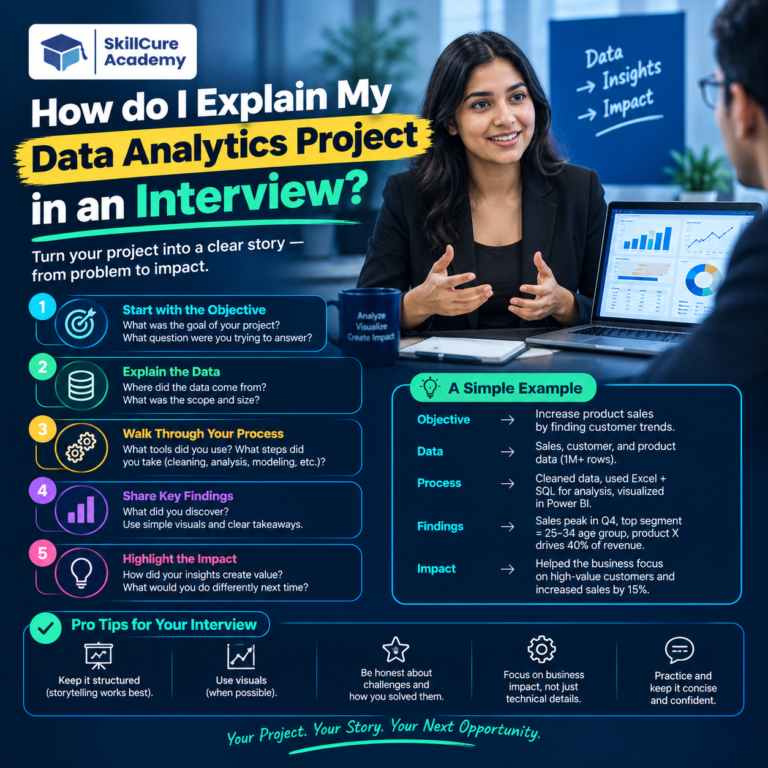
For students preparing for their first Data Analyst job, practical projects remain important. Build projects using real-world datasets, write SQL queries independently, create Power BI dashboards, and practice explaining the business value of your findings.
Do not rely entirely on AI-generated projects that you cannot explain during an interview.
8. How Data Analytics Students Can Prepare for an AI-Driven Future
If you want to start a career in Data Analytics, follow a structured learning approach.
- Learn Excel and SQL fundamentals.
- Practice cleaning and analyzing datasets.
- Develop Python skills for data analysis.
- Create Power BI dashboards using meaningful KPIs.
- Complete two or three end-to-end projects.
- Use ChatGPT to understand errors and explore alternative solutions.
- Verify AI-generated code instead of copying it blindly.
- Practice mock interviews and explain your project decisions clearly.
At Skillcure Academy, aspiring Data Analysts can focus on building practical skills, working on projects, and preparing to explain their analytical approach in interviews.
The important thing is to build a strong foundation rather than depending entirely on AI tools.
Conclusion
Can ChatGPT replace a Data Analyst? ChatGPT can automate many parts of data analysis, including writing SQL queries, generating Python code, creating formulas, and drafting reports. However, effective data analysis also requires business understanding, critical thinking, data validation, and clear communication.
For aspiring professionals, learning how to work with AI while strengthening core analytical skills can be a practical way to prepare for changing workplace expectations.
Rather than asking whether AI will do everything a Data Analyst does, focus on learning how to use AI responsibly to solve real business problems.
Frequently Asked Questions (FAQs)
1. Can ChatGPT do data analysis?
Yes. ChatGPT can help analyze data, generate SQL and Python code, identify possible patterns, explain calculations, and summarize findings. Its output should be verified before making decisions.
2. Will ChatGPT replace Data Analysts in 2026?
ChatGPT can automate certain tasks, but it does not automatically replace the full range of responsibilities involved in data analysis. The impact of AI will vary across roles and organizations.
3. Can I learn Data Analytics using ChatGPT?
Yes. ChatGPT can explain concepts, generate practice questions, help debug code, and guide you through projects. You should also practice independently and validate your results.
4. Which skills should a Data Analyst learn alongside AI?
Learn SQL, Excel, Power BI, Python, statistics, business understanding, and communication. Also practice checking AI-generated answers for accuracy.
5. Is Data Analytics a good career option in the age of AI?
Data Analytics remains a field to explore for people interested in data-driven problem-solving. Career opportunities and requirements vary by industry and employer, so develop practical skills and review current job descriptions to understand market expectations.