

In today’s data-driven world, companies use data to understand customers, improve business performance, and make better decisions. This has increased the demand for professionals who can analyse information and turn it into useful insights. Two popular career options in this field are Data Analytics and Business Analytics.
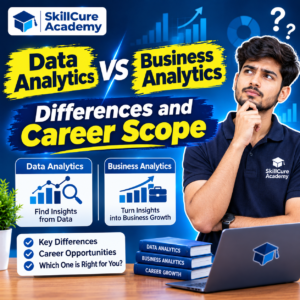
Although these fields are closely related, they have different goals, responsibilities, and career opportunities. Data Analytics focuses on examining data to identify patterns, trends, and insights, while Business Analytics uses data to solve business problems and support strategic decisions.
If you are planning to build a career in analytics, understanding the difference between Data Analytics and Business Analytics can help you choose the right career path.
In this blog, we will explain the key differences, required skills, tools, career opportunities, salary factors, and future scope of both fields.
What Is Data Analytics?
Data Analytics is the process of collecting, cleaning, organising, and analysing data to identify meaningful patterns and trends. It helps businesses understand what is happening, why it is happening, and what actions they can take based on the available information.
Data analysts work with large datasets to find useful insights that help organisations improve efficiency, understand customer behaviour, and monitor performance.
What Does a Data Analyst Do?
A Data Analyst performs several tasks, including:
- Collecting data from different sources.
- Cleaning and preparing data for analysis.
- Using SQL to extract information from databases.
- Analysing data using Python and Advanced Excel.
- Creating interactive dashboards using Power BI.
- Identifying trends, patterns, and unusual changes.
- Preparing reports to communicate findings.
- Helping teams make data-driven decisions.
Example of Data Analytics
Imagine an e-commerce company experiencing a sudden decline in sales. A Data Analyst examines sales records, customer behaviour, product performance, and website traffic to identify the possible reasons.
The analysis may reveal that sales have declined in a particular product category or that fewer customers are completing their purchases.
The company can then use these insights to improve its sales strategy.
What Is Business Analytics?
Business Analytics is the process of using data, statistical methods, and analytical techniques to solve business problems and improve organisational performance.
It focuses on applying insights to business decisions, such as increasing revenue, reducing costs, improving customer satisfaction, and planning future growth.
Business Analytics often combines data analysis with business knowledge to recommend practical solutions.
What Does a Business Analyst Do?
A Business Analyst may perform the following tasks:
- Understand business requirements and challenges.
- Identify opportunities to improve business processes.
- Analyse business performance and key performance indicators.
- Gather requirements from stakeholders.
- Prepare business reports and presentations.
- Evaluate potential solutions to business problems.
- Communicate with technical and non-technical teams.
- Recommend strategies to improve efficiency and profitability.
The exact responsibilities depend on the organisation. Some Business Analysts work extensively with data and dashboards, while others focus more on requirements gathering, process improvement, and project coordination.
Example of Business Analytics
Suppose a retail company wants to open a new store in another city. A Business Analyst may evaluate customer demand, operating costs, expected revenue, competition, and business objectives.
Based on this information, the analyst can help management assess whether opening the new store is a suitable business decision.
Data Analytics vs Business Analytics: Key Differences
Data Analytics and Business Analytics overlap in many areas, but their primary focus is different.
| Basis of Comparison | Data Analytics | Business Analytics |
|---|---|---|
| Main focus | Analysing data to identify insights | Using analysis to solve business problems |
| Primary objective | Understand patterns and trends | Improve business decisions and outcomes |
| Key activities | Data cleaning, querying, analysis, and visualisation | Business requirements, performance analysis, and recommendations |
| Common tools | SQL, Python, Power BI, Advanced Excel | Excel, Power BI, SQL, business intelligence and process-modelling tools |
| Technical skills | Often requires stronger data-handling and programming skills | Depends on the role; business knowledge and communication are important |
| Business knowledge | Useful for interpreting results | Usually central to the role |
| Typical outputs | Reports, dashboards, analytical findings | Business recommendations, requirements, process improvements, and performance reports |
| Common job titles | Data Analyst, BI Analyst, Reporting Analyst | Business Analyst, Business Intelligence Analyst, Business Process Analyst |
| Suitable for | People interested in data, technology, and problem-solving | People interested in business strategy, processes, and decision-making |
Important: Job titles and responsibilities vary between companies. Some organisations use the terms interchangeably, and some Business Analyst roles require advanced SQL, reporting, or data visualisation skills.
Which Tools Are Used in Data Analytics and Business Analytics?
Both fields use analytical tools, but the tools required depend on the job role and the organisation.
Tools Used in Data Analytics
1. Advanced Excel
Excel is widely used for data cleaning, calculations, pivot tables, data analysis, and reporting.
2. SQL
SQL helps analysts retrieve, filter, join, and aggregate data stored in relational databases.
3. Python
Python is used for data manipulation, automation, statistical analysis, and working with larger datasets.
4. Power BI
Power BI helps professionals build interactive dashboards, visualise important metrics, and communicate analytical findings.
5. Statistics
Statistical concepts help analysts understand distributions, relationships, trends, and uncertainty in data.
Tools Used in Business Analytics
1. Microsoft Excel
Excel helps analyse business performance, prepare financial calculations, compare results, and create reports.
2. Power BI
Power BI helps track sales, revenue, costs, customer performance, and other business KPIs.
3. SQL
SQL is useful when Business Analysts need to extract and analyse information from business databases.
4. Business Process Modelling Tools
Depending on the role, Business Analysts may use process diagrams and workflow tools to document existing processes and recommend improvements.
5. Presentation and Documentation Tools
PowerPoint, Word, and requirement-documentation tools help analysts present findings and communicate recommendations to stakeholders.
Learning Excel, SQL, Power BI, and analytical thinking can be valuable for both career paths.
Career Opportunities in Data Analytics
Data Analytics offers career opportunities across industries such as banking, healthcare, e-commerce, IT, consulting, telecommunications, and retail.
As organisations collect more information, they need professionals who can organise data and convert it into meaningful insights.
Popular Data Analytics Job Roles
1. Data Analyst
Analyses datasets, prepares reports, identifies trends, and supports business decisions.
2. Business Intelligence Analyst
Develops dashboards, tracks business metrics, and helps teams understand organisational performance.
3. Reporting Analyst
Creates recurring reports, monitors KPIs, and helps teams evaluate performance.
4. Marketing Analyst
Studies campaign performance, customer behaviour, audience segments, and marketing results.
5. Operations Analyst
Analyses operational data to identify inefficiencies and improve processes.
6. Senior Data Analyst
Handles more complex analytical problems, develops advanced reports, and may guide junior analysts.
With experience and additional skills, professionals can explore specialised roles in analytics, business intelligence, data engineering, or data science, depending on their qualifications and technical capabilities.
Career Opportunities in Business Analytics
Business Analytics offers opportunities for people who want to connect business requirements with data-driven decision-making.
Professionals may work with management teams, clients, product teams, operations departments, or technology teams.
Popular Business Analytics Job Roles
1. Business Analyst
Identifies business needs, gathers requirements, evaluates processes, and helps teams implement solutions.
2. Business Intelligence Analyst
Uses data and reporting tools to monitor performance and provide insights for business decisions.
3. Business Process Analyst
Examines workflows and recommends improvements to increase efficiency and reduce unnecessary costs.
4. Product Analyst
Studies product usage, user behaviour, and performance metrics to help product teams improve their offerings.
5. Operations Business Analyst
Evaluates business processes, operational performance, and opportunities for improvement.
6. Business Analytics Consultant
Helps organisations evaluate business challenges and develop analytical recommendations.
Some positions require industry knowledge, experience with business requirements, or familiarity with project management methods. The exact requirements depend on the employer.
Data Analytics vs Business Analytics: Salary in India
Salary is an important factor when choosing a career, but there is no single salary range that applies to every Data Analyst or Business Analyst.
Compensation depends on experience, technical skills, location, industry, company size, educational background, and the complexity of the role.
The following table provides a general career-planning overview rather than guaranteed salary figures.
| Experience Level | Data Analytics | Business Analytics |
|---|---|---|
| Fresher | Entry-level Data Analyst and Reporting Analyst positions | Junior Business Analyst and Business Operations Analyst positions |
| 1–3 years | Data Analyst, BI Analyst, and specialised reporting roles | Business Analyst, Product Analyst, and BI Analyst roles |
| 3–5 years | Senior Data Analyst and specialised analytics roles | Experienced Business Analyst and Business Analytics Consultant roles |
| 5+ years | Analytics Lead, BI Lead, and selected specialist roles | Senior Business Analyst, Business Consultant, and Business Analysis Lead roles |
For salary research, compare current job postings for the same location, experience level, and responsibilities. Do not assume that one field always pays more than the other.
Professionals who combine technical ability, business understanding, communication, and practical project experience may be better positioned to compete for suitable opportunities.
Which Career Has Better Scope in the Future?
Both Data Analytics and Business Analytics offer career opportunities as organisations continue to use data to improve their operations and decisions.
However, their future opportunities may develop in slightly different ways.
Future Scope of Data Analytics
Data Analytics is relevant to businesses that need to understand performance, customer behaviour, operational efficiency, and market trends.
Important developments include:
- Increased use of business intelligence dashboards.
- Greater adoption of cloud-based data platforms.
- Growing use of AI-assisted data analysis.
- More demand for professionals who can validate data and explain analytical results.
- Integration of analytics into marketing, finance, sales, and operations.
Knowledge of SQL, Python, Power BI, statistics, and data storytelling can help aspiring analysts develop a strong foundation.
Future Scope of Business Analytics
Business Analytics remains relevant because organisations need to turn information into practical business decisions.
Potential areas of opportunity include:
- Business performance monitoring.
- Process optimisation and automation.
- Customer experience improvement.
- Product and market analysis.
- Strategic planning and forecasting.
- Data-informed operational decision-making.
Business Analysts who understand business processes and can work effectively with technical teams may find opportunities across a wide range of industries.
Is AI Replacing Data Analysts and Business Analysts?
AI tools can automate some repetitive activities, including parts of report preparation, data exploration, documentation, and dashboard development.
However, organisations still need people who can check data quality, understand business context, validate findings, communicate with stakeholders, and make informed recommendations.
Learning to use AI responsibly alongside analytical and business skills can help professionals adapt to changing workplace requirements.
Data Analytics vs Business Analytics: Which Is Better for Freshers?
The right option depends on your interests, strengths, and career goals.
Choose Data Analytics If:
- You enjoy working with numbers and datasets.
- You are interested in SQL, Python, and Power BI.
- You want to create reports and interactive dashboards.
- You enjoy identifying patterns and solving analytical problems.
- You want to develop technical data-handling skills.
Choose Business Analytics If:
- You enjoy understanding how businesses operate.
- You are interested in solving organisational problems.
- You like communicating with teams and stakeholders.
- You enjoy evaluating processes and recommending improvements.
- You want to combine analytical thinking with business knowledge.
Can Freshers Learn Both?
Yes. Freshers can build a foundation in both areas by learning data analysis, business metrics, visualisation, and problem-solving.
A practical learning path could include:
- Advanced Excel for data handling and reporting.
- SQL for working with databases.
- Power BI for dashboards and business reporting.
- Basic statistics and analytical thinking.
- Business KPIs and performance measurement.
- Practical projects based on sales, finance, marketing, or operations.
- Presentation and interview preparation.
This combination can help you understand the technical side of analysis and how businesses use insights to make decisions.
Learn Data Analytics and Business Analytics at Skillcure Academy, Noida
If you want to build a career in analytics, choosing the right training programme is an important step. Along with theoretical knowledge, practical projects and experience with industry-relevant tools can help you develop job-ready skills.
Skillcure Academy in Noida Sector 15 offers training in Data Analytics and Business Analytics to help learners build their analytical knowledge and practical capabilities.
The learning journey can focus on important skills such as:
- Advanced Excel for data analysis and reporting.
- SQL for database querying.
- Python for data manipulation and analysis.
- Power BI for dashboards and visualisation.
- Practical projects based on business scenarios.
- Presentation practice and mock interview sessions.
Practical project work can help learners understand how to analyse a dataset, identify meaningful insights, build a dashboard, and explain their findings clearly.
Skillcure Academy also highlights live student project presentations and mock interview activities through its YouTube channel, allowing learners to observe how analytical concepts can be presented in practice.
Whether you are a fresher, a graduate, or a working professional planning a career transition, focus on developing practical skills and a portfolio of projects relevant to the roles you want to pursue.
Frequently Asked Questions (FAQs)
1. What is the main difference between Data Analytics and Business Analytics?
Data Analytics focuses on examining data to identify patterns, trends, and insights. Business Analytics uses data and business knowledge to solve organisational problems and support decision-making.
2. Which is better, Data Analytics or Business Analytics?
Neither is universally better. Data Analytics may suit people who enjoy technical data analysis, while Business Analytics may suit those who prefer business processes, requirements, and strategic problem-solving.
3. Can a fresher learn Data Analytics or Business Analytics?
Yes. Freshers can begin by learning Excel, SQL, Power BI, analytical thinking, and basic business concepts. Practical projects can help them demonstrate their skills to potential employers.
4. What is the salary of a Data Analyst or Business Analyst in India?
Salaries vary according to experience, skills, industry, location, and employer. To estimate current earning potential, compare recent job listings for similar roles and experience levels in your preferred city.
5. Which tools should I learn for Data Analytics and Business Analytics?
Advanced Excel, SQL, and Power BI are useful starting points for both fields. Python is particularly valuable for many Data Analytics roles, while Business Analytics professionals may also need business process modelling, requirements documentation, and stakeholder communication skills.