

The world is becoming more data-driven every year. From small businesses to multinational companies, organisations are using data to understand customers, improve performance, reduce costs, and make better business decisions.
In 2027, data analytics is expected to remain an important skill across industries. Companies are not just collecting information; they need professionals who can analyse that information and turn it into meaningful insights.
This is why learning data analytics can be a smart career decision for students, freshers, working professionals, and individuals looking to switch careers.
If you are planning to enter the technology industry, enrolling in a professional Data Analytics Course in Noida can help you develop practical skills and understand how businesses use data in real-world situations.
Let’s explore the top 10 reasons why you should learn data analytics in 2027.
What Is Data Analytics?
Data analytics is the process of collecting, cleaning, organising, and analysing data to identify useful patterns, trends, and insights.
Businesses use data analytics to answer important questions, such as:
- Which products are performing better?
- Why are customers leaving?
- Which marketing campaign generates more sales?
- How can a company reduce operational costs?
- What changes can improve business performance?
A data analyst uses different tools and techniques to answer these questions and help organisations make informed decisions.
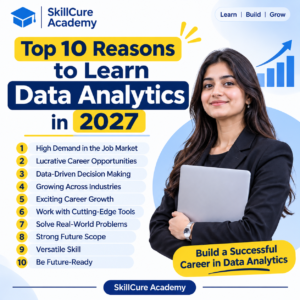
Top 10 Reasons to Learn Data Analytics in 2027
1. Growing Demand for Data Analysts
One of the biggest reasons to learn data analytics in 2027 is the increasing demand for professionals who can work with data.
Companies across different industries are generating huge amounts of information. However, raw data alone is not useful unless someone can understand and analyse it.
Businesses need professionals who can convert this information into actionable insights.
Some industries hiring data analytics professionals include:
- Banking and finance
- Healthcare
- E-commerce
- IT and software
- Education
- Retail
- Telecommunications
- Marketing and advertising
As businesses continue adopting digital technologies, data analysis skills can open doors to different career opportunities.
2. Attractive Salary Opportunities
Data analytics is also an attractive career option because skilled professionals can earn competitive salaries.
Your salary generally depends on your experience, technical skills, location, industry, and the complexity of your responsibilities.
Here is an illustrative salary range for data analytics roles in India.
| Job Role | Approximate Annual Salary |
|---|---|
| Junior Data Analyst | ₹2.5–4.5 LPA |
| Data Analyst | ₹4–7 LPA |
| Business Analyst | ₹4–8 LPA |
| Senior Data Analyst | ₹7–12 LPA |
| Analytics Manager | ₹12–20+ LPA |
Note: These are indicative salary ranges, not guaranteed salaries. Actual compensation varies by company and candidate.
Learning the right tools, building projects, and developing problem-solving abilities can help you improve your career prospects.
3. Multiple Career Opportunities
Another important reason to learn data analytics is the variety of career options available.
You are not restricted to working as a Data Analyst. After gaining relevant experience and developing specialised skills, you can explore several related roles.
Some popular career options include:
- Data Analyst
- Business Analyst
- Financial Analyst
- Power BI Developer
- Reporting Analyst
- Marketing Analyst
- SQL Developer
- Data Analytics Consultant
Each role involves working with information to solve business problems.
This flexibility makes data analytics a valuable skill for people from different educational and professional backgrounds.
4. AI Is Increasing the Importance of Data Skills
Artificial Intelligence is changing how businesses operate.
AI tools can automate repetitive tasks, generate reports, identify patterns, and assist with data analysis. However, businesses still need professionals who understand data, validate results, and interpret insights correctly.
Learning data analytics along with AI tools can help you stay relevant in the changing job market.
In 2027, professionals who understand both data analysis and AI-assisted workflows may have an advantage.
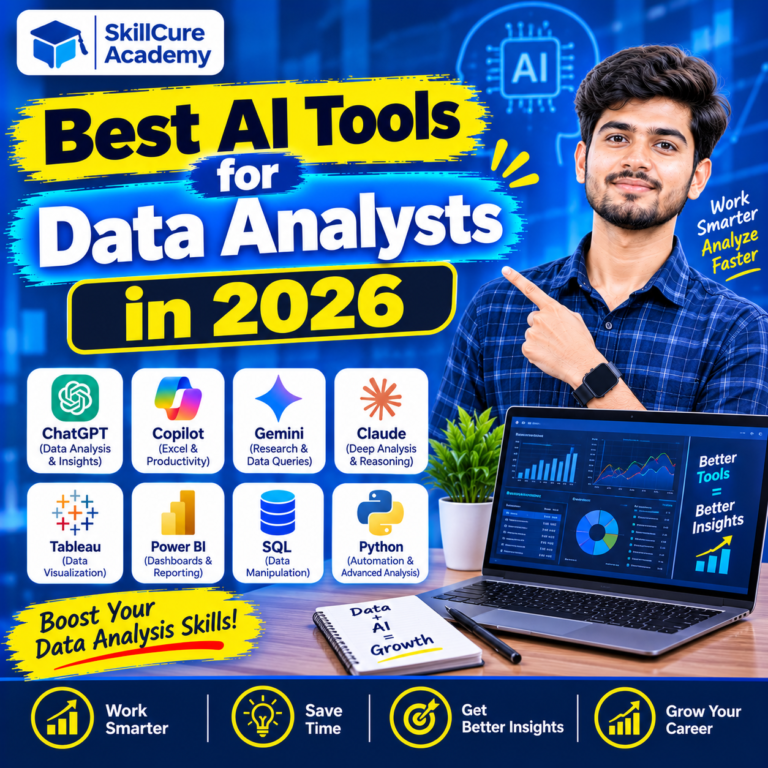
You can explore tools and technologies such as:
- ChatGPT
- Microsoft Copilot
- Power BI AI features
- Python libraries
- Automated reporting tools
The goal is not just to use AI but to understand the information it produces.
5. You Can Enter Data Analytics Without a Coding Background
Many beginners believe that data analytics requires advanced programming knowledge.
However, this is not entirely true.
You can start learning data analytics with beginner-friendly tools such as Microsoft Excel and Power BI.
As you progress, you can learn SQL and Python to handle more complex datasets and analytical tasks.
A beginner-friendly learning sequence looks like this:
| Tool | What You Learn |
|---|---|
| Advanced Excel | Data cleaning, formulas, pivot tables |
| SQL | Database management and data extraction |
| Power BI | Interactive dashboards and visualisation |
| Python | Data analysis and automation |
| Statistics | Understanding patterns and trends |
You do not need to master everything on the first day. Start with the fundamentals and gradually develop your technical skills.
6. Opportunities Across Different Industries
Data analytics is not limited to IT companies.
Almost every industry uses data to improve its operations and make better decisions.
For example:
| Industry | How Data Analytics Is Used |
|---|---|
| Healthcare | Patient data and hospital performance |
| Banking | Fraud detection and financial analysis |
| E-commerce | Customer behaviour and sales trends |
| Education | Student performance analysis |
| Retail | Inventory and product analysis |
| Marketing | Campaign performance and customer insights |
| Manufacturing | Production and quality analysis |
This means professionals with data analytics skills can explore opportunities across multiple industries.
7. Work on Real-World Projects
Learning concepts is important, but practical experience is equally necessary.
Companies often look for candidates who can demonstrate their ability to solve real business problems.
Working on projects helps you understand how to:
- Clean and organise raw datasets.
- Identify trends and patterns.
- Create interactive dashboards.
- Analyse business performance.
- Present findings through reports.
- Make data-driven recommendations.
Some beginner-friendly project ideas include:
- Sales Performance Dashboard
- Netflix Data Analysis
- Customer Churn Analysis
- E-commerce Sales Analysis
- Employee Performance Dashboard
- Financial Performance Analysis
These projects can become part of your portfolio and help you demonstrate your practical knowledge during interviews.
8. Data Analytics Supports Career Growth
Data analytics is not only useful for freshers. Working professionals can also benefit from learning these skills.
For example, someone working in sales can use data analytics to understand revenue trends and customer behaviour.
Similarly, marketing professionals can analyse campaign performance, while finance professionals can use data to understand expenses and financial patterns.
Learning data analytics can help professionals:
- Improve their existing job performance.
- Develop technical skills.
- Explore new career opportunities.
- Move towards analytical roles.
- Make better business decisions.
It can also help professionals transition into the analytics domain with the right training and preparation.
9. Develop Problem-Solving and Decision-Making Skills
Data analytics is not just about learning software.
A good data analyst should understand business problems and know how to find answers using data.
For example, imagine an e-commerce company experiencing a sudden decline in sales.
A data analyst may investigate:
- Monthly sales performance.
- Customer purchasing behaviour.
- Product-wise revenue.
- Website traffic.
- Marketing campaign performance.
After analysing these factors, the analyst can identify possible reasons behind the decline and recommend improvements.
This process develops logical thinking, analytical abilities, and problem-solving skills.
These skills are useful in almost every professional field.
10. A Strong Career Option for the Future
Technology is continuously evolving, and businesses are becoming increasingly dependent on data.
From AI-powered applications to automated business reporting, data is playing an important role in modern organisations.
Learning data analytics in 2027 can help you build a foundation for several future career opportunities.
You can start with Excel, SQL, and Power BI and gradually move towards Python, advanced analytics, and AI-powered data analysis.
The key is to keep learning, practise regularly, and build projects that demonstrate your abilities.
Which Skills Should You Learn to Become a Data Analyst in 2027?
If you are planning to enter the data analytics industry, focus on developing a combination of technical and professional skills.
| Skill | Importance |
|---|---|
| Advanced Excel | Data organisation and analysis |
| SQL | Extracting information from databases |
| Power BI | Creating interactive dashboards |
| Python | Advanced data analysis and automation |
| Statistics | Understanding data patterns |
| Data Visualisation | Presenting insights effectively |
| Communication | Explaining analytical findings |
| Problem-Solving | Identifying business solutions |
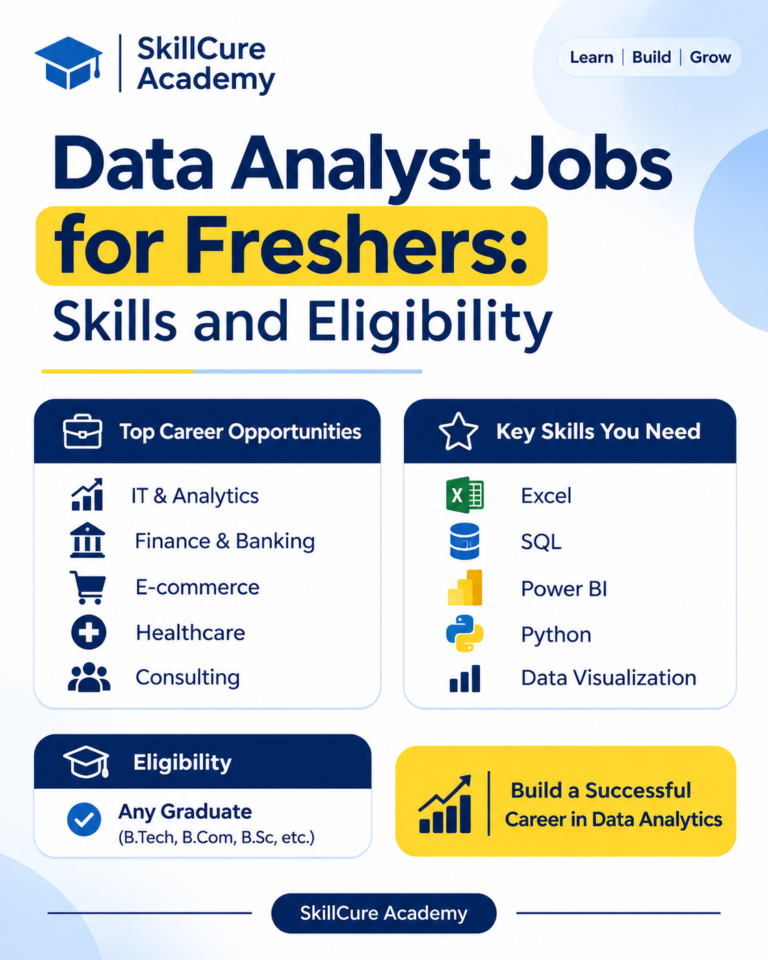
A combination of these skills can help you prepare for entry-level data analytics opportunities.
How to Start Learning Data Analytics in 2027?
If you are a beginner, follow a structured learning approach instead of trying to learn every tool simultaneously.
Here is a simple roadmap:
Step 1: Learn Advanced Excel
Start with formulas, functions, data cleaning, pivot tables, and charts.
Step 2: Understand SQL
Learn how databases work and practise writing SQL queries to extract and analyse information.
Step 3: Learn Power BI
Understand data modelling, DAX, data visualisation, and interactive dashboard development.
Step 4: Learn Python
Explore Python fundamentals, Pandas, NumPy, and Matplotlib for data analysis.
Step 5: Work on Practical Projects
Build dashboards and analytical projects using real-world datasets.
Step 6: Prepare for Interviews
Practise technical questions, SQL problems, project explanations, and mock interviews.
Following this roadmap can help you gradually develop the skills required for a data analytics career.
Why Choose Skillcure Academy for a Data Analytics Course in Noida?
Choosing the right training institute is an important step in your learning journey.
At Skillcure Academy, students get an opportunity to learn data analytics through practical training and industry-oriented activities.
Our training approach focuses on helping students understand concepts and apply them to real-world business problems.
What Makes Skillcure Academy Different?
- Practical training in Advanced Excel, SQL, Power BI, and Python.
- Hands-on projects based on real-world business scenarios.
- Live mock interview sessions.
- Live presentation sessions to improve communication skills.
- Practical dashboard development.
- Interview preparation and career guidance.
- Online and offline learning options.
One of the key highlights is our live mock interview and presentation activities, where students get opportunities to demonstrate their knowledge and improve their confidence.
Students can also explore real performances and learning activities on the Skillcure Academy YouTube channel.
If you are searching for a Data Analytics Course in Noida, Skillcure Academy can help you take the first step towards developing practical data analytics skills.
Conclusion
Data analytics is becoming an important skill for businesses across industries. With the increasing use of AI, automation, and digital technologies, professionals who understand how to analyse and interpret data can explore a wide range of career opportunities.
Whether you are a student, fresher, or working professional, 2027 can be a good time to start learning data analytics.
Focus on building your fundamentals, learning industry-relevant tools, working on practical projects, and preparing for interviews.
Remember, learning software is only the beginning. Your ability to understand data and solve real business problems is what makes you a valuable data analytics professional.
Start your data analytics journey with Skillcure Academy and take a step towards a skill-based career in 2027!
Frequently Asked Questions (FAQs)
1. Is data analytics a good career option in 2027?
Yes. Data analytics can be a good career option in 2027 because businesses across industries use data to understand performance, improve operations, and make informed decisions.
2. What are the best tools to learn for data analytics in 2027?
Some important tools include Advanced Excel, SQL, Power BI, and Python. Beginners should start with Excel and gradually learn the other tools.
3. Can a fresher become a data analyst in 2027?
Yes. Freshers can enter the data analytics field by developing the required technical skills, practising real-world projects, building a portfolio, and preparing for interviews.
4. Is coding compulsory to learn data analytics?
No. You can start learning data analytics without coding using Excel and Power BI. However, learning SQL and Python can help you handle more advanced analytical tasks.
5. Where can I learn data analytics in Noida?
You can explore Skillcure Academy in Noida Sector 15 for practical data analytics training. The course covers tools such as Advanced Excel, SQL, Power BI, and Python, along with projects, mock interviews, and presentation sessions.