
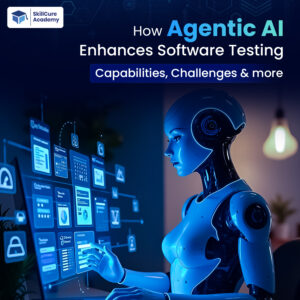

Software testing has always been a critical — and often time-consuming — part of the development lifecycle. As applications grow more complex and release cycles accelerate, traditional testing approaches struggle to keep up. This is where Agentic AI steps in, reshaping how testing is designed, executed, and optimized.
What is Agentic AI in Software Testing?
Agentic AI refers to systems that can act autonomously, make decisions, and adapt dynamically to changing environments — rather than just executing predefined scripts.
Key Characteristics:
| Capability | Description |
|---|---|
| Autonomy | Operates independently without constant human input |
| Adaptability | Adjusts to application changes dynamically |
| Learning | Improves performance using historical data |
| Decision-Making | Chooses optimal test paths and strategies |
Key Capabilities of Agentic AI in Testing?
Capability Overview:
| Capability | Traditional Testing | Agentic AI Testing |
|---|---|---|
| Test Creation | Manual | Automated & intelligent |
| Maintenance | High effort | Self-healing |
| Coverage | Limited | Extensive & adaptive |
| Execution | Script-based | Context-aware |
1. Autonomous Test Case Generation.
Agentic AI analyzes requirements, user journeys, and historical defects to generate high-quality test cases automatically.
2. Self-Healing Test Automation.
AI adapts to UI or API changes by updating locators and flows, reducing test failures.
3. Intelligent Test Prioritization.
Focuses on high-risk and business-critical areas to optimize testing efforts.
4. Continuous Learning.
Improves with every test cycle using feedback from execution and production data.
5. Root Cause Analysis.
Provides insights into failures by correlating logs and system behavior.
6. Exploratory Testing.
Simulates human-like interactions to uncover hidden defects.
Benefits of Agentic AI in Software Testing!
| Benefit | Impact |
|---|---|
| Faster Releases | Reduced testing cycles |
| Improved Coverage | Better detection of edge cases |
| Reduced Costs | Less manual intervention |
| Higher Accuracy | Fewer false positives/negatives |
Challenges of Agentic AI in Software Testing?
| Challenge | Description |
|---|---|
| Explainability | Difficulty understanding AI decisions |
| Initial Setup | Requires infrastructure and data readiness |
| Data Dependency | Needs high-quality historical data |
| Security Risks | Potential access to sensitive systems |
| Skill Gap | Requires AI knowledge in QA teams |
Best Practices for Adoption?
| Practice | Recommendation |
|---|---|
| Start Small | Begin with pilot projects |
| Human + AI | Combine expertise with automation |
| Monitor Systems | Track AI decisions continuously |
| Data Quality | Ensure clean and structured data |
| Focus Areas | Target high-impact testing scenarios |
Future of Agentic AI in Testing?
Agentic AI is moving toward fully autonomous testing ecosystems where systems can self-optimize, predict defects, and continuously validate applications in real-time.
Frequently Asked Questions (FAQs).
1. What makes Agentic AI different from traditional test automation?
Agentic AI goes beyond scripted automation by making decisions, learning from data, and adapting to changes without human intervention.
2. Is Agentic AI suitable for all types of applications?
It works best for complex, dynamic systems but can be adapted for most modern applications with proper setup.
3. Does Agentic AI replace human testers?
No, it augments human testers by handling repetitive tasks while humans focus on strategy and critical thinking.
4. What are the prerequisites for implementing Agentic AI?
Organizations need quality data, proper infrastructure, and integration with CI/CD pipelines.
5. What tools support Agentic AI in testing?
Several emerging platforms and frameworks support AI-driven testing, often integrated with existing DevOps ecosystems.
Final Thoughts.
Agentic AI is not just an upgrade to testing — it’s a transformation. Organizations that adopt it strategically will gain a competitive edge through faster releases, improved quality, and smarter testing processes.