
Data Science has become one of the fastest-growing and highest-paying career options in the world. Companies across industries are using data to make better business decisions, creating a huge demand for skilled data scientists.
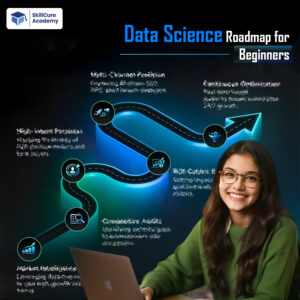
If you’re planning to start your journey but don’t know where to begin, this Data Science roadmap for beginners will help you understand every step—from learning the basics to becoming job-ready.
Whether you’re a student, working professional, or someone switching careers, this roadmap will help you build the right skills in the correct order.
What is Data Science?
Data Science is the process of collecting, cleaning, analyzing, and interpreting data to solve real-world business problems using statistics, programming, and machine learning.
A Data Scientist combines multiple skills, including:
- Programming
- Mathematics
- Statistics
- Data Analysis
- Machine Learning
- Business Understanding
- Data Visualization
Why Learn Data Science in 2026?
The demand for data professionals continues to rise every year.
Benefits of Learning Data Science:
| Benefit | Description |
|---|---|
| High Salary | One of the highest-paying technology careers |
| Huge Demand | Companies in every industry need data professionals |
| Multiple Career Options | Data Scientist, ML Engineer, AI Engineer, Data Analyst |
| Global Opportunities | Work in India or internationally |
| Future-Proof Career | AI and Data are shaping every business |
Complete Data Science Roadmap for Beginners?
Let’s understand the roadmap step by step.
Step 1: Learn Basic Mathematics.
Mathematics forms the foundation of Data Science.
Focus on:
- Algebra
- Probability
- Statistics
- Calculus (Basics)
- Linear Algebra
Don’t worry—you don’t need advanced mathematics initially. Understanding the concepts is more important than memorizing formulas.
Step 2: Learn Python Programming.
Python is the most popular programming language in Data Science.
Topics to learn:
- Variables
- Data Types
- Loops
- Functions
- Lists
- Tuples
- Dictionaries
- File Handling
- Object-Oriented Programming (Basics)
Popular Python libraries:
- NumPy
- Pandas
- Matplotlib
- Seaborn
Step 3: Learn SQL.
Almost every company stores data in databases.
SQL helps you retrieve and analyze that data.
Important SQL topics:
- SELECT
- WHERE
- GROUP BY
- ORDER BY
- HAVING
- JOINS
- Subqueries
- Window Functions
- CTEs
SQL is one of the most important skills recruiters look for.
Step 4: Learn Data Cleaning.
Real-world data is messy.
Before analysis, you’ll need to:
- Remove duplicate records
- Handle missing values
- Correct data types
- Detect outliers
- Standardize data formats
Data cleaning usually takes the majority of a data professional’s time.
Step 5: Learn Exploratory Data Analysis (EDA).
EDA helps you understand your data before building machine learning models.
Skills to learn:
- Distribution Analysis
- Correlation
- Outlier Detection
- Feature Relationships
- Summary Statistics
Tools:
- Pandas
- Matplotlib
- Seaborn
Step 6: Learn Data Visualization.
Presenting insights visually makes them easier to understand.
Popular visualization tools:
- Power BI
- Tableau
- Matplotlib
- Seaborn
- Plotly
Good visualization skills help stakeholders make informed business decisions.
Step 7: Learn Statistics.
Statistics helps you understand patterns and relationships in data.
Topics include:
- Mean
- Median
- Mode
- Standard Deviation
- Variance
- Probability
- Normal Distribution
- Hypothesis Testing
- Confidence Interval
Statistics is essential for data-driven decision-making.
Step 8: Learn Machine Learning.
Machine Learning enables computers to learn from data.
Start with supervised learning.
Algorithms to learn:
- Linear Regression
- Logistic Regression
- Decision Tree
- Random Forest
- KNN
- Naive Bayes
- Support Vector Machine
Then move to:
- Clustering
- Dimensionality Reduction
- Ensemble Learning
Popular library:
- Scikit-learn
Step 9: Learn Deep Learning (Optional for Beginners).
After mastering Machine Learning, learn Deep Learning.
Topics include:
- Neural Networks
- TensorFlow
- Keras
- PyTorch
- CNN
- RNN
This is especially useful for AI-related careers.
Step 10: Build Real Projects.
Projects are more valuable than certificates.
Some beginner-friendly projects include:
- Sales Dashboard
- Customer Churn Prediction
- House Price Prediction
- Movie Recommendation System
- Credit Card Fraud Detection
- Loan Approval Prediction
- COVID Data Analysis
- Employee Attrition Prediction
Projects demonstrate your practical skills to recruiters.
Step 11: Learn Git and GitHub.
Version control is an essential industry skill.
Learn:
- Git Basics
- Repositories
- Commits
- Branches
- Pull Requests
- GitHub Portfolio
Recruiters often review GitHub profiles during hiring.
Step 12: Build a Strong Portfolio.
Your portfolio should include:
- Python Projects
- SQL Projects
- Machine Learning Projects
- Dashboards
- GitHub Repository
- Resume
- LinkedIn Profile
A well-organized portfolio increases your chances of getting shortlisted.
Step 13: Practice Interview Questions.
Prepare for interviews by practicing:
- Python Questions
- SQL Queries
- Statistics Questions
- Machine Learning Concepts
- Case Studies
- Business Problems
- Project Explanations
Mock interviews can significantly improve your confidence.
Skills Required for Data Science:
| Technical Skills | Soft Skills |
|---|---|
| Python | Communication |
| SQL | Problem Solving |
| Statistics | Critical Thinking |
| Machine Learning | Business Understanding |
| Power BI/Tableau | Presentation Skills |
| Data Visualization | Teamwork |
| Git & GitHub | Analytical Thinking |
Best Tools to Learn:
| Category | Tool |
|---|---|
| Programming | Python |
| Database | SQL |
| Notebook | Jupyter Notebook |
| Visualization | Power BI |
| Visualization | Tableau |
| Machine Learning | Scikit-learn |
| Deep Learning | TensorFlow |
| Version Control | GitHub |
Beginner Learning Timeline:
| Month | Focus Area |
|---|---|
| Month 1 | Mathematics + Python Basics |
| Month 2 | SQL + Pandas + NumPy |
| Month 3 | Data Cleaning + EDA |
| Month 4 | Data Visualization |
| Month 5 | Statistics |
| Month 6 | Machine Learning |
| Month 7 | Projects |
| Month 8 | GitHub Portfolio + Interview Preparation |
Data Science Career Opportunities?
Popular job roles include:
- Data Scientist
- Machine Learning Engineer
- AI Engineer
- Data Analyst
- Business Analyst
- Research Scientist
- Data Engineer
- Analytics Consultant
These roles are available across industries such as healthcare, finance, e-commerce, education, manufacturing, and technology.
Average Data Science Salary in India (2026)?
| Experience | Average Annual Salary |
|---|---|
| Fresher | ₹5 LPA – ₹10 LPA |
| 2–4 Years | ₹10 LPA – ₹18 LPA |
| 5–8 Years | ₹18 LPA – ₹30 LPA |
| Senior Professionals | ₹30 LPA+ |
Salary depends on skills, company, location, projects, and interview performance.
Common Mistakes Beginners Should Avoid?
- Learning too many programming languages at once
- Ignoring SQL
- Skipping statistics
- Watching tutorials without practicing
- Not building projects
- Avoiding GitHub
- Focusing only on certificates instead of skills
- Not preparing for interviews
Final Thoughts.
Following a structured Data Science roadmap for beginners helps you learn the right skills in the right sequence. Instead of trying to master everything at once, focus on building a strong foundation in mathematics, Python, SQL, statistics, and data analysis before moving to machine learning and advanced topics.
Consistency, hands-on practice, and real-world projects are the keys to becoming a successful data professional. With dedication and continuous learning, you can build a rewarding career in Data Science in 2026 and beyond.
Frequently Asked Questions (FAQs).
1. Can a beginner learn Data Science without a technical background?
Yes. Many professionals from non-IT backgrounds successfully transition into Data Science by learning Python, SQL, statistics, and working on practical projects.
2. How long does it take to become job-ready in Data Science?
With consistent study and project work, most beginners can become job-ready in approximately 6–10 months, depending on their learning pace.
3. Is coding mandatory for Data Science?
Yes. Basic to intermediate Python programming is essential, along with SQL for working with databases. Advanced software development skills are not required for entry-level roles.
4. Which is better to learn first: Data Analytics or Data Science?
Starting with Data Analytics is often recommended because it builds a strong foundation in SQL, Python, data visualization, and business understanding before moving to Machine Learning.
5. Do I need a degree to become a Data Scientist?
Not necessarily. While a relevant degree can be helpful, many companies prioritize practical skills, project experience, problem-solving ability, and a strong portfolio over formal qualifications.