
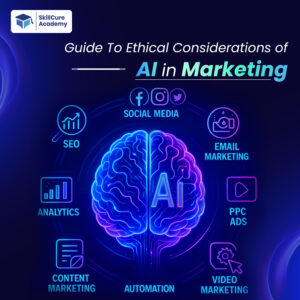

Artificial Intelligence (AI) is transforming the marketing industry by helping businesses automate campaigns, analyze customer behavior, personalize content, and improve decision-making. From chatbots to predictive analytics, AI tools are becoming an essential part of modern marketing strategies. However, with these advancements come important ethical concerns that companies must address responsibly.
In this guide, we will explore the ethical considerations of AI in marketing, why they matter, and how businesses can use AI responsibly while maintaining customer trust.
What is AI in Marketing?
AI in marketing refers to the use of artificial intelligence technologies such as machine learning, data analytics, automation, and natural language processing to improve marketing performance.
Common Uses of AI in Marketing:
| AI Application | Purpose |
|---|---|
| Personalized Recommendations | Suggests products/services based on user behavior. |
| Chatbots | Provides instant customer support. |
| Predictive Analytics | Forecasts customer trends and behavior. |
| Email Automation | Sends targeted campaigns automatically. |
| Content Generation | Creates blogs, ads, and social media content. |
| Customer Segmentation | Groups audiences for better targeting. |
AI allows marketers to save time, improve customer engagement, and increase conversion rates. However, misuse of customer data or biased AI decisions can create ethical challenges.
Why Ethical AI in Marketing Matters?
Ethics in AI marketing is important because businesses handle large amounts of customer data. Consumers expect companies to protect their privacy and use data responsibly.
| Ethical Benefit | Business Impact |
|---|---|
| Customer Trust | Builds long-term relationships. |
| Data Privacy | Protects sensitive customer information. |
| Brand Reputation | Prevents legal and public trust issues. |
| Fair Decision-Making | Reduces bias and discrimination. |
| Compliance | Helps follow regulations like GDPR. |
Key Ethical Considerations of AI in Marketing:
1. Data Privacy and Security.
AI systems rely heavily on customer data such as browsing history, location, and purchase behavior.
Businesses must ensure:
- Data is collected legally.
- Customers know how data is used.
- Data is securely stored.
- Sensitive information is protected.
2. Transparency and Explainability.
Customers should understand:
- Why they are seeing specific ads.
- How AI recommendations are generated.
- How their data influences marketing decisions.
Transparent AI builds stronger trust and accountability.
3. Bias and Discrimination.
AI can become biased if trained on incomplete or unfair data.
| Risk | Example |
|---|---|
| Demographic Bias | Ads shown only to certain age groups. |
| Gender Bias | Product recommendations favor one gender. |
| Cultural Bias | Content excludes specific communities. |
Regular AI audits help identify and reduce algorithmic bias.
4. Customer Manipulation.
AI can predict emotions and behavior very accurately. Ethical concerns arise when businesses use this power to:
- Encourage addictive engagement.
- Exploit emotional weaknesses.
- Push misleading recommendations.
Ethical marketing should support informed customer decisions.
5. Consent and User Awareness.
Businesses should:
- Ask for permission before collecting data.
- Offer opt-out options.
- Clearly explain AI policies.
Consent-based marketing strengthens customer confidence.
6. AI-Generated Content Authenticity.
AI-generated blogs, ads, and emails must be:
- Accurate.
- Original.
- Human-reviewed.
- Free from misinformation.
Human oversight remains essential.
Challenges in Ethical AI Marketing?
| Challenge | Description |
|---|---|
| Lack of Transparency | Customers may not understand AI decisions. |
| Data Misuse | Poor handling can lead to legal issues. |
| Algorithm Bias | May unfairly target or exclude groups. |
| Over-Automation | Can reduce human connection. |
| Compliance Complexity | Rules change frequently. |
Best Practices for Ethical AI in Marketing?
| Best Practice | Benefit |
|---|---|
| Responsible Data Collection | Builds trust and legal compliance. |
| Human Oversight | Prevents unethical decisions. |
| Regular AI Audits | Detects bias and errors early. |
| Customer Transparency | Improves loyalty and trust. |
| Focus on Customer Well-Being | Supports long-term brand growth. |
Future of Ethical AI in Marketing?
Future trends include:
- Stronger AI governance policies.
- Improved transparency standards.
- Ethical AI certifications.
- Increased customer control over personal data.
- Responsible personalization models.
Businesses that adopt ethical AI early will gain a competitive advantage and stronger customer loyalty.
Conclusion.
AI is revolutionizing marketing through smarter campaigns, automation, and personalized experiences. However, ethical concerns such as privacy, bias, transparency, and manipulation cannot be ignored.
Companies that balance innovation with responsibility will build stronger customer trust and long-term success.
FAQs.
1. What are ethical considerations in AI marketing?
They include data privacy, transparency, fairness, customer consent, and avoiding manipulative AI practices.
2. Why is transparency important in AI marketing?
It helps customers understand how AI uses their data and makes recommendations.
3. How can AI become biased in marketing?
Bias happens when AI is trained on incomplete or unfair datasets.
4. What is responsible AI marketing?
Using AI fairly, securely, and transparently while respecting customer privacy.
5. How can businesses ensure ethical AI usage?
By auditing algorithms, maintaining human oversight, and following privacy regulations.