

Artificial Intelligence (AI) is one of the fastest-growing industries in the world. Many people believe that building a career in AI requires advanced programming skills, but that is not always true. Today, businesses need professionals who can work with AI tools, manage AI projects, analyze AI-generated insights, and support AI-driven operations without writing code.
If you are a student, graduate, working professional, or career changer, this guide will help you understand how to start career in AI without coding and explore the best opportunities available in 2026.
Why Non-Coders Can Build a Career in AI?
The AI industry is expanding rapidly, creating roles beyond software development. Organizations need professionals who understand business processes, data interpretation, AI tools, customer requirements, and project management.
Some reasons why non-coders can succeed in AI include:
- Availability of no-code AI platforms.
- Growing demand for AI project managers.
- Rise of AI-powered business tools.
- Increased need for AI trainers and prompt engineers.
- AI adoption across industries like healthcare, finance, retail, and education.
Skills Required to Start an AI Career Without Coding?
Although coding is not necessary, you still need certain skills to work effectively in AI-related roles.
| Skill | Importance |
|---|---|
| AI Fundamentals | Understanding how AI works |
| Prompt Engineering | Creating effective prompts for AI tools |
| Business Analysis | Understanding business requirements |
| Data Interpretation | Analyzing AI-generated reports |
| Communication Skills | Working with teams and clients |
| Problem Solving | Identifying and solving business challenges |
| Project Management | Managing AI implementations |
Best AI Career Options Without Coding?
1. AI Business Analyst:
AI Business Analysts bridge the gap between business needs and AI solutions.
Responsibilities:
- Gather business requirements.
- Analyze AI project outcomes.
- Recommend AI-based solutions.
- Create reports and dashboards.
Average Salary in India: ₹5-12 LPA.
2. AI Project Manager:
AI Project Managers oversee AI implementation projects and coordinate teams.
Responsibilities:
- Manage project timelines.
- Coordinate stakeholders.
- Monitor AI project performance.
- Ensure successful deployment.
Average Salary in India: ₹8-20 LPA.
3. Prompt Engineer:
Prompt Engineers create effective instructions for AI tools like ChatGPT and other generative AI platforms.
Responsibilities:
- Design prompts.
- Optimize AI outputs.
- Test AI-generated responses.
- Improve content quality.
Average Salary in India: ₹6-18 LPA.
4. AI Product Specialist:
AI Product Specialists help companies market and support AI-powered products.
Responsibilities:
- Product demonstrations.
- Client training.
- Product documentation.
- Customer support.
Average Salary in India: ₹5-15 LPA.
5. AI Content Strategist:
Businesses use AI extensively for content creation and marketing.
Responsibilities:
- AI-assisted content planning.
- Content optimization.
- SEO strategy.
- Marketing campaigns.
Average Salary in India: ₹4-10 LPA.
6. AI Trainer:
AI Trainers help improve AI models by reviewing outputs and providing feedback.
Responsibilities:
- Data annotation.
- Quality assessment.
- Model evaluation.
- AI training support.
Average Salary in India: ₹4-12 LPA.
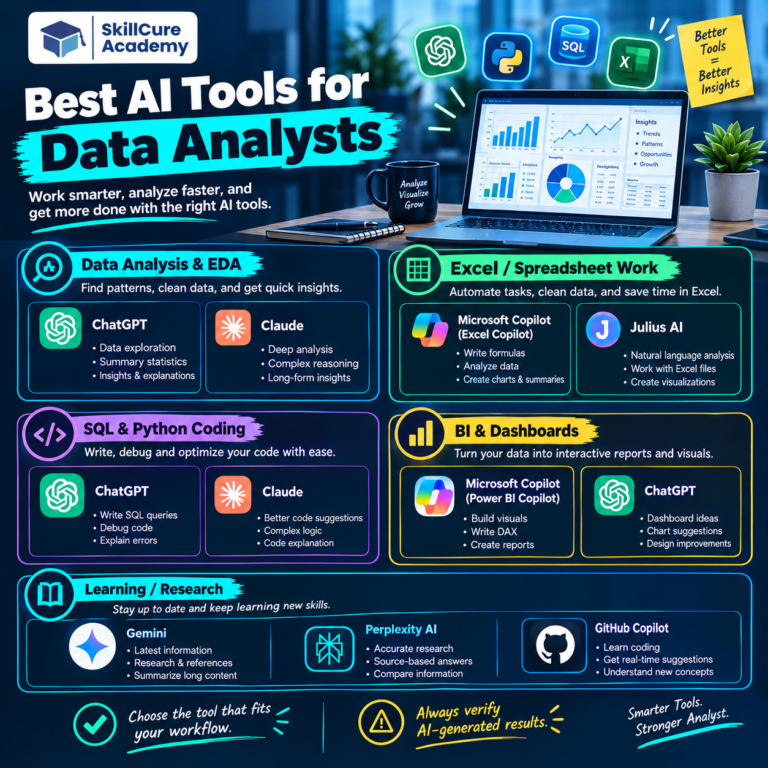
Top No-Code AI Tools to Learn:
Learning AI tools can significantly improve your employability.
| Tool | Purpose |
|---|---|
| ChatGPT | Content generation and automation |
| Claude | AI writing and analysis |
| Gemini | Research and productivity |
| Notion AI | Documentation and workflows |
| Zapier AI | Process automation |
| Canva AI | AI-powered design |
| Microsoft Copilot | Workplace productivity |
| Airtable AI | Data management |
Step-by-Step Roadmap to Start an AI Career Without Coding?
Step 1: Learn AI Basics:
Understand concepts such as:
- Artificial Intelligence.
- Machine Learning.
- Generative AI.
- Natural Language Processing (NLP).
- Automation.
Spend 2–4 weeks building foundational knowledge.
Step 2: Master AI Tools:
Focus on practical tools rather than technical programming.
Learn:
- ChatGPT.
- Gemini.
- Claude.
- Copilot.
- Canva AI.
Hands-on experience is more valuable than theory alone.
Step 3: Learn Prompt Engineering:
Prompt engineering is becoming one of the most valuable AI skills.
Practice:
- Role-based prompts.
- Chain-of-thought prompting.
- Content generation prompts.
- Research prompts.
- Business automation prompts.
Step 4: Build AI Projects:
Create a portfolio using AI tools.
Examples:
| Project Type | Example |
|---|---|
| Content Creation | AI-generated blog strategy |
| Marketing | AI-powered campaign plan |
| Business Analysis | AI-generated business reports |
| Customer Support | AI chatbot workflow |
| Automation | AI workflow using Zapier |
Step 5: Earn Certifications:
Certifications help validate your skills.
Popular options include:
- AI Fundamentals Certifications.
- Generative AI Certifications.
- Business Analytics Certifications.
- Prompt Engineering Courses.
- Microsoft AI Certifications.
Step 6: Create a Professional LinkedIn Profile?
Highlight:
- AI projects.
- Certifications.
- Prompt engineering skills.
- AI tools expertise.
- Business applications of AI.
Recruiters frequently search LinkedIn for AI talent.
Step 7: Apply for Entry-Level AI Roles?
Look for positions such as:
- AI Analyst.
- AI Associate.
- Prompt Engineer.
- AI Content Specialist.
- AI Operations Executive.
- AI Product Associate.
Industries Hiring Non-Coders in AI?
Many industries now use AI extensively.
| Industry | AI Opportunities |
|---|---|
| Healthcare | AI Operations & Analysis |
| Finance | AI Reporting & Analytics |
| Retail | Customer Experience AI |
| Education | AI Learning Solutions |
| Marketing | AI Content & Automation |
| E-commerce | AI Product Optimization |
| Consulting | AI Strategy & Implementation |
Common Mistakes to Avoid?
1. Thinking Coding is Mandatory.
Many AI roles focus on business, operations, and strategy rather than programming.
2. Ignoring Practical Experience.
Employers value projects and tool experience more than theoretical knowledge.
3. Learning Too Many Tools at Once.
Start with a few essential AI tools and master them.
4. Not Building a Portfolio.
A strong portfolio can significantly improve job opportunities.
5. Avoiding Networking.
Connect with AI professionals and recruiters through LinkedIn and industry events.
Future Scope of Non-Coding AI Careers?
The demand for AI professionals is expected to grow significantly over the next decade. As companies continue integrating AI into daily operations, non-technical roles will become increasingly important.
Professionals who combine business knowledge, communication skills, and AI tool expertise will have excellent career opportunities across industries.
Conclusion.
Understanding how to start career in AI without coding is becoming increasingly important as AI transforms workplaces worldwide. While programming skills can be beneficial, they are not essential for many AI-related careers. By learning AI fundamentals, mastering no-code AI tools, building practical projects, and developing strong business skills, you can successfully enter the AI industry and build a rewarding career.
Frequently Asked Questions (FAQs).
1. Can I start a career in AI without coding?
Yes, many AI roles such as AI Business Analyst, Prompt Engineer, AI Project Manager, and AI Product Specialist do not require coding skills.
2. Which AI tool should beginners learn first?
ChatGPT is often the best starting point because it is widely used across industries.
3. Is prompt engineering a good career option?
Yes, prompt engineering is a growing field with strong demand across businesses adopting generative AI.
4. What qualification is required for non-coding AI jobs?
A degree in commerce, business, management, marketing, or any discipline can be sufficient when combined with AI skills.
5. How long does it take to learn AI without coding?
Most beginners can gain foundational AI skills and build a portfolio within 3–6 months of consistent learning.