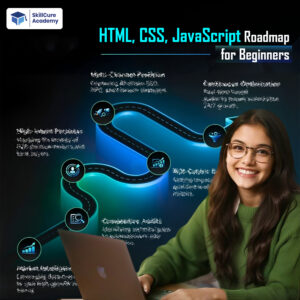

Web development remains one of the most in-demand skills in 2026. Whether you want to become a frontend developer, freelance web designer, or full-stack engineer, following a structured HTML CSS JavaScript Roadmap for Beginners can help you learn efficiently and build job-ready skills.
HTML, CSS, and JavaScript are the foundation of modern websites. Every website you visit uses these technologies in some form. By mastering them step by step, beginners can create responsive websites, interactive web applications, and eventually move toward advanced frameworks like React, Angular, or Vue.
In this guide, we will explore the complete HTML CSS JavaScript Roadmap for Beginners and understand what to learn at each stage.
Why Learn HTML, CSS, and JavaScript?
Before diving into the roadmap, let’s understand why these technologies are important.
| Technology | Purpose |
|---|---|
| HTML | Creates the structure of web pages |
| CSS | Styles and designs the website |
| JavaScript | Adds functionality and interactivity |
Together, these three technologies form the backbone of frontend web development.
Benefits of Learning Web Development?
- High demand in the job market.
- Opportunities for freelancing.
- Ability to build personal projects.
- Foundation for advanced technologies.
- Gateway to full-stack development.
Stage 1: Learn HTML Fundamentals.
HTML (HyperText Markup Language) is the first step in the HTML CSS JavaScript Roadmap for Beginners.
HTML defines the structure and content of web pages.
Topics to Learn:
- HTML document structure.
- Headings and paragraphs.
- Lists and tables.
- Links and navigation.
- Images and multimedia.
- Forms and input fields.
- Semantic HTML tags.
- Accessibility basics.
Beginner HTML Project Ideas:
| Project | Skills Learned |
|---|---|
| Personal Portfolio | Layout creation |
| Resume Website | Content organization |
| Landing Page | Semantic HTML |
| Contact Form | Form handling basics |
Time Required:
2–3 weeks of consistent practice.
Stage 2: Master CSS Styling.
Once HTML is complete, the next step in the HTML CSS JavaScript Roadmap for Beginners is learning CSS.
CSS (Cascading Style Sheets) controls the appearance of web pages.
Essential CSS Topics:
- CSS syntax and selectors.
- Colors and typography.
- Box model.
- Margins and padding.
- Positioning.
- Flexbox.
- CSS Grid.
- Responsive design.
- Media queries.
- Animations and transitions.
CSS Learning Progression:
| Level | Topics |
|---|---|
| Beginner | Selectors, Colors, Fonts |
| Intermediate | Flexbox, Grid |
| Advanced | Animations, Responsive Design |
CSS Project Ideas:
- Responsive Portfolio Website.
- Product Landing Page.
- Restaurant Website.
- Educational Institute Website.
Time Required:
3–4 weeks with hands-on practice.
Stage 3: Learn JavaScript Basics:
JavaScript is what makes websites interactive.
This stage is the most important part of the HTML CSS JavaScript Roadmap for Beginners.
Core JavaScript Concepts:
- Variables.
- Data Types.
- Operators.
- Conditional Statements.
- Loops.
- Functions.
- Arrays.
- Objects.
- DOM Manipulation.
- Events.
JavaScript Beginner Projects:
| Project | Concepts Used |
|---|---|
| Calculator | Functions |
| To-Do App | DOM Manipulation |
| Counter App | Events |
| Quiz Application | Logic Building |
Time Required:
4–6 weeks for fundamentals.
Stage 4: Advanced JavaScript Concepts.
After mastering basics, move toward advanced concepts.
Topics to Learn:
- ES6 Features.
- Arrow Functions.
- Template Literals.
- Destructuring.
- Modules.
- Promises.
- Async/Await.
- Fetch API.
- Error Handling.
- Local Storage.
Why Learn Advanced JavaScript?
Modern frameworks and applications heavily depend on these concepts.
Advanced Project Ideas:
- Weather App.
- Movie Search Application.
- Expense Tracker.
- Notes Management System.
Stage 5: Learn Responsive Web Design.
Modern websites must work on all devices.
Key Concepts:
- Mobile-first design.
- Responsive layouts.
- CSS Grid.
- Flexbox.
- Media queries.
- Device testing.
Responsive Design Checklist:
| Requirement | Importance |
|---|---|
| Mobile Compatibility | High |
| Tablet Optimization | Medium |
| Desktop Experience | High |
| Fast Loading Speed | High |
Stage 6: Version Control with Git and GitHub.
Every aspiring developer should learn version control.
Topics:
- Git installation.
- Repository creation.
- Commits.
- Branches.
- Merging.
- Pull Requests.
- GitHub Hosting.
Benefits:
- Project management.
- Team collaboration.
- Portfolio showcasing.
- Industry-standard workflow.
Stage 7: Build Real-World Projects.
Projects are essential in the HTML CSS JavaScript Roadmap for Beginners.
Employers value practical experience more than theoretical knowledge.
Recommended Projects:
| Difficulty | Project |
|---|---|
| Beginner | Portfolio Website |
| Beginner | Calculator |
| Intermediate | To-Do App |
| Intermediate | Weather Application |
| Advanced | E-commerce Website |
| Advanced | Student Management System |
Stage 8: Learn Frontend Frameworks.
After mastering JavaScript, you can move to frameworks.
Popular choices include:
- React.
- Angular.
- Vue.js.
Among these, React remains one of the most popular choices in 2026.
Benefits of Frameworks:
- Faster development.
- Component-based architecture.
- Better code organization.
- Industry demand.
Stage 9: Understand Basic Backend Development.
While optional for frontend developers, backend knowledge increases career opportunities.
Technologies to Explore:
- Node.js.
- Express.js.
- Databases.
- APIs.
- Authentication.
This helps you transition toward full-stack development.
Complete Learning Timeline:
| Phase | Duration |
|---|---|
| HTML Fundamentals | 2–3 Weeks |
| CSS Styling | 3–4 Weeks |
| JavaScript Basics | 4–6 Weeks |
| Advanced JavaScript | 3–4 Weeks |
| Git & GitHub | 1 Week |
| Projects | Ongoing |
| Frontend Frameworks | 4–6 Weeks |
Total Estimated Time: 4–6 Months with regular practice.
Career Opportunities After Learning HTML CSS JavaScript?
After following the HTML CSS JavaScript Roadmap for Beginners, you can apply for roles such as:
- Frontend Developer.
- Web Developer.
- UI Developer.
- Junior Software Engineer.
- Freelance Web Designer.
- Full-Stack Developer (with additional backend skills).
Average Entry-Level Salary in India (2026):
| Role | Salary Range |
|---|---|
| Frontend Developer | ₹3 LPA – ₹6 LPA |
| Web Developer | ₹3.5 LPA – ₹7 LPA |
| UI Developer | ₹4 LPA – ₹8 LPA |
| Full-Stack Developer | ₹5 LPA – ₹10 LPA |
Common Mistakes Beginners Should Avoid?
- Skipping HTML fundamentals.
- Learning frameworks too early.
- Ignoring responsive design.
- Not building projects.
- Memorizing code instead of understanding concepts.
- Avoiding Git and GitHub.
- Giving up due to initial challenges.
Conclusion.
Following a structured HTML CSS JavaScript Roadmap for Beginners is the fastest way to become a professional web developer. Start with HTML, move to CSS, master JavaScript, build projects, and then explore frameworks like React.
Consistency is more important than speed. By dedicating a few hours daily and building real-world projects, beginners can become job-ready web developers within a few months. The demand for web development skills continues to grow, making now an excellent time to begin your journey in frontend development.
FAQs.
1. Can I learn HTML, CSS, and JavaScript without a coding background?
Yes, these technologies are beginner-friendly and widely recommended as the first step into programming.
2. How long does it take to learn HTML CSS JavaScript?
Most beginners can become comfortable with the basics within 4–6 months of consistent practice.
3. Is JavaScript difficult to learn?
JavaScript has a learning curve, but with projects and regular practice, it becomes much easier to understand.
4. Do I need a degree to become a web developer?
No. Many successful web developers are self-taught or trained through online courses and bootcamps.
5. What should I learn after HTML CSS JavaScript?
After mastering these technologies, you can learn React, Node.js, databases, and full-stack development concepts.