

GST Registration Process in India is an important requirement for businesses that fall under the Goods and Services Tax (GST) regulations. Whether you are starting a small business, running an online store, providing professional services, or expanding an existing company, understanding how GST registration works can help you stay compliant and avoid unnecessary penalties.
If you are searching for how to register for GST, GST registration online, GST registration documents, GST registration fees, or the GST registration process step by step, this guide explains everything in simple language.
What is GST Registration?
GST registration is the process through which a business or individual gets registered under the Goods and Services Tax system in India.
After successful registration, the applicant receives a unique GST Identification Number (GSTIN). A GSTIN is a 15-digit identification number used for GST-related transactions, invoices, returns, and compliance.
Businesses registered under GST may need to:
- Collect GST from customers
- Issue GST-compliant invoices
- File GST returns
- Maintain appropriate business records
- Pay applicable GST to the government
- Claim eligible Input Tax Credit (ITC)
Who Needs GST Registration in India?
GST registration requirements depend on factors such as business turnover, type of business, location, and the nature of supplies.
Generally, GST registration may be required for businesses whose turnover crosses the applicable threshold or for certain categories of businesses where registration is mandatory.
| Business/Person | GST Registration |
|---|---|
| Business crossing applicable turnover threshold | Generally required |
| Certain e-commerce businesses | May be required |
| Certain interstate suppliers | Requirements may apply |
| Casual taxable persons | Registration may be required |
| Businesses voluntarily registering | Can apply subject to applicable rules |
| Certain specified businesses | Mandatory registration may apply |
Important: GST rules and threshold limits can vary based on the type of supply and state/UT. Therefore, businesses should check the latest applicable GST provisions before applying.
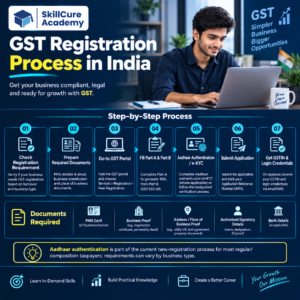
GST Registration Process in India
The GST registration process online is completed through the official GST portal. The overall process involves submitting business details, verifying the applicant’s information, uploading required documents, and completing authentication.
Step 1: Visit the GST Portal
Start by visiting the official GST portal and selecting the option for new registration.
You will generally need to provide basic information such as:
- State or Union Territory
- Legal name of the business
- PAN
- Email address
- Mobile number
- Business constitution
After entering the details, complete the required verification.
Step 2: Generate Temporary Reference Number
After submitting the initial information and completing verification, a Temporary Reference Number (TRN) may be generated.
Keep this number safe because it can be used to continue the GST registration application.
Step 3: Complete the GST Application
Use the TRN to access the registration application and provide the required business information.
Depending on the business structure, information may include:
- Business details
- Promoter or partner details
- Principal place of business
- Additional places of business
- Goods and services supplied
- Bank account details
- Authorized signatory details
Step 4: Upload Required Documents
The applicant needs to upload applicable documents supporting the information provided in the application.
Common documents may include:
| Document | Purpose |
|---|---|
| PAN Card | Identity/tax identification |
| Aadhaar | Authentication and identity verification |
| Photograph | Applicant/promoter identification |
| Address proof | Business location verification |
| Bank account details | Business banking information |
| Business constitution proof | Partnership/company/LLP etc. |
| Authorization documents | Authorized signatory verification |
The exact documents can differ depending on the type and structure of the business.
Step 5: Complete Verification
The applicant needs to complete the applicable verification process.
Depending on the case, this may involve Aadhaar authentication and other verification procedures.
Make sure that the information provided in the application matches the supporting documents.
Step 6: Application Verification
After submission, the application may be reviewed by the GST authorities.
If additional information or clarification is required, the applicant may receive a notice requesting a response.
Responding within the prescribed time is important to avoid delays or rejection.
Step 7: Receive GSTIN
Once the application is approved, the applicant receives the GSTIN.
The business can then download the GST registration certificate from the GST portal and use the GSTIN for applicable business and tax-related activities.
Documents Required for GST Registration
The documents required depend on the business structure.
For example:
Proprietorship
- PAN card
- Aadhaar
- Photograph
- Business address proof
- Bank account details
Partnership Firm
- PAN of the firm
- Partnership deed
- PAN/Aadhaar of partners
- Business address proof
- Bank account details
- Authorization documents
Company
- PAN of company
- Certificate of Incorporation
- Memorandum/Articles where applicable
- PAN/Aadhaar of authorized signatory
- Board authorization
- Registered office proof
- Bank account details
How Long Does GST Registration Take?
The time required for GST registration can vary depending on the application, verification requirements, authentication, and whether the GST department asks for additional information.
Applications with complete and accurate information generally have a smoother process.
Tip: Make sure your business name, PAN, address, contact details, and supporting documents are consistent before submitting the application.
Is GST Registration Free?
The government GST registration application itself does not generally require a government registration fee when submitted through the official GST portal.
However, if you hire a tax professional, consultant, or other service provider to complete the registration on your behalf, professional service charges may apply.
Benefits of GST Registration
GST registration can provide several benefits to eligible businesses.
1. Legal Recognition
GST registration provides formal recognition under the GST framework.
2. Issue GST Invoices
Registered businesses can issue applicable GST-compliant tax invoices to customers.
3. Input Tax Credit
Eligible registered businesses can claim Input Tax Credit subject to applicable GST rules and conditions.
4. Business Expansion
GST registration can make it easier for businesses to work with larger organizations and expand their operations.
5. Online Compliance
GST registration and many related compliance activities can be managed through the online GST system.
Common Mistakes to Avoid During GST Registration
Many applicants face delays because of simple mistakes in their applications.
Avoid these common errors:
- Entering incorrect PAN details
- Providing an incorrect business address
- Uploading unclear documents
- Using inconsistent business information
- Selecting the wrong business constitution
- Missing authentication requirements
- Ignoring GST notices
- Not responding within the prescribed timeline
GST Registration vs GSTIN
These two terms are often confused.
| GST Registration | GSTIN |
|---|---|
| Process of registering under GST | Identification number issued after registration |
| Involves application and verification | 15-digit unique number |
| Completed through the GST system | Used for GST-related transactions |
| Comes before GSTIN | Received after successful registration |
What to Do After GST Registration?
Getting a GSTIN is not the end of the process. A registered business may also have ongoing GST compliance responsibilities.
These can include:
- Issuing proper tax invoices
- Maintaining records
- Filing applicable GST returns
- Paying GST within applicable deadlines
- Reconciling purchase and sales information
- Maintaining documentation for Input Tax Credit
- Updating registration details when required
Businesses should understand their applicable GST return and compliance requirements based on their registration and type of activities.
Why Understanding GST is Important for Business Professionals
GST knowledge is useful not only for business owners but also for professionals working in:
- Accounting
- Finance
- Taxation
- Business operations
- Commerce
- Accounts payable and receivable
- Small business management
Understanding GST registration, invoicing, returns, and compliance can help professionals handle day-to-day business activities more effectively.
Frequently Asked Questions
1. What is GST registration?
GST registration is the process of registering a business or eligible person under India’s Goods and Services Tax system and obtaining a GSTIN.
2. Can GST registration be done online?
Yes. GST registration can be applied for online through the official GST portal.
3. Is GST registration free?
The government registration application does not generally carry a registration fee when submitted through the official portal. Professional or consultant charges may apply if you use outside assistance.
4. What is GSTIN?
GSTIN stands for Goods and Services Tax Identification Number. It is a unique 15-digit number issued to a registered taxpayer.
5. What documents are required for GST registration?
Documents can vary by business type, but commonly include PAN, Aadhaar, photographs, business address proof, bank details, and business constitution/authorization documents where applicable.
Conclusion
The GST Registration Process in India is an important step for businesses that are required to register under GST. From submitting basic business information and uploading documents to completing verification and receiving a GSTIN, understanding each stage can make the process easier.
Businesses should always check the latest GST rules, applicable thresholds, and compliance requirements before applying. Keeping accurate documents and providing consistent information can also help reduce delays during registration.