

GST (Goods and Services Tax) is one of the most important topics for students preparing for accounting, taxation, and finance jobs in India. Whether you are applying for an Accountant, GST Executive, Accounts Executive, or Finance Executive position, interviewers often test your knowledge of GST.
Understanding GST is not just about knowing tax definitions. You should also understand GST calculations, input tax credit, return filing, GST invoices, and practical accounting entries.
In this blog, we have covered the most important GST interview questions and answers for freshers and experienced professionals to help you prepare for accounting interviews in 2026.
Basic GST Interview Questions and Answers
1. What is GST?
GST stands for Goods and Services Tax. It is an indirect tax charged on the supply of goods and services in India. It was introduced on 1 July 2017 to replace several indirect taxes with a unified taxation system.
2. What are the four types of GST?
There are four types of GST in India:
| GST Type | Meaning |
|---|---|
| CGST | Central Goods and Services Tax |
| SGST | State Goods and Services Tax |
| IGST | Integrated Goods and Services Tax |
| UTGST | Union Territory Goods and Services Tax |
3. What is the difference between CGST, SGST, and IGST?
CGST and SGST generally apply to transactions within the same state, whereas IGST generally applies to transactions between different states.
Example:
- Delhi to Delhi: CGST + SGST
- Delhi to Maharashtra: IGST
4. What is GSTIN?
GSTIN stands for Goods and Services Tax Identification Number. It is a unique 15-digit identification number assigned to registered taxpayers.
5. What is Input Tax Credit (ITC)?
Input Tax Credit allows businesses to claim eligible GST paid on purchases and adjust it against GST payable on sales.
Example:
| Particulars | Amount |
|---|---|
| GST paid on purchases | ₹5,000 |
| GST collected on sales | ₹12,000 |
| Net GST payable | ₹7,000 |
Important GST Interview Questions for Accountants
6. What is a GST invoice?
A GST invoice is a document issued by a registered supplier for taxable goods or services. It contains supplier details, GSTIN, invoice number, taxable value, GST rate, and tax amount.
7. What is GSTR-1?
GSTR-1 is a return containing details of outward supplies (sales) made by a registered taxpayer.
8. What is GSTR-3B?
GSTR-3B is a summary GST return used to report tax liabilities, eligible ITC, and tax payments.
9. What is GSTR-2B?
GSTR-2B is an auto-drafted ITC statement that helps businesses identify and reconcile potentially eligible input tax credit.
10. What is Reverse Charge Mechanism (RCM)?
Under Reverse Charge Mechanism, the recipient becomes responsible for paying GST instead of the supplier in specified situations.
11. What is an E-Way Bill?
An E-Way Bill is an electronic document required for the movement of goods under specified GST conditions. It contains details about goods, suppliers, recipients, and transportation.
12. What is an E-Invoice?
An E-Invoice is an electronically authenticated invoice registered through the Invoice Registration Portal (IRP). It generates an Invoice Reference Number (IRN) and QR code.
13. What is the GST composition scheme?
The composition scheme is a simplified taxation scheme for eligible small taxpayers. It offers simpler compliance requirements but restricts regular ITC claims.
14. What is GST reconciliation?
GST reconciliation is the process of matching accounting records with GST returns and statements to identify differences.
For example:
- Sales register vs GSTR-1
- Purchase register vs GSTR-2B
- Tax liability vs GSTR-3B
15. What is the difference between exempt and zero-rated supplies?
Exempt supplies are exempt from GST under applicable provisions. Zero-rated supplies generally include exports and supplies to SEZ developers or units for authorised operations, subject to applicable conditions.
Practical GST Interview Questions and Answers
Interviewers may also ask practical questions to test your knowledge of GST calculations and accounting.
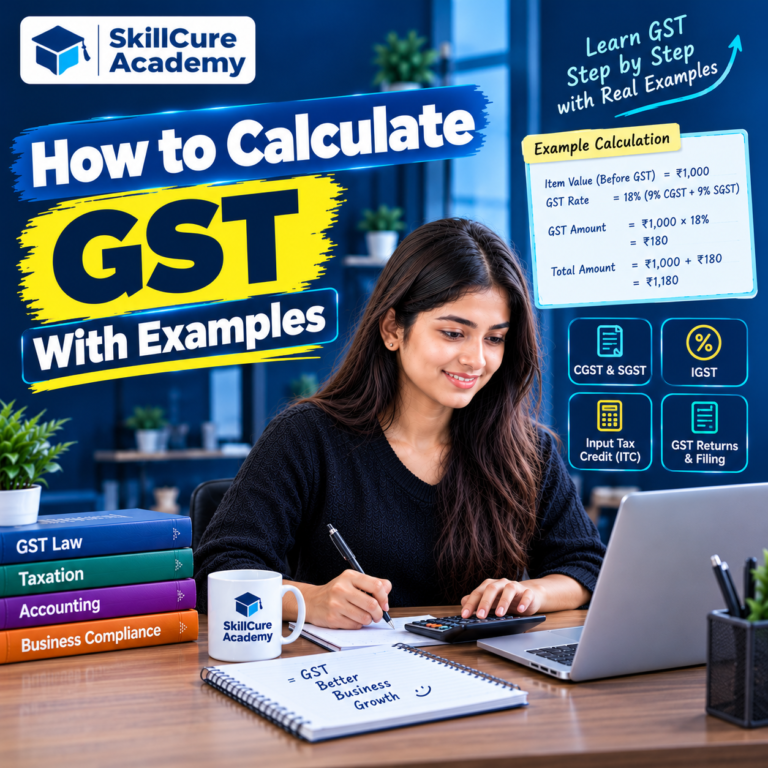
16. How do you calculate GST?
GST is calculated by multiplying the taxable value by the applicable GST rate.
Example:
Product value = ₹10,000
GST rate = 18%
GST amount = ₹10,000 × 18% = ₹1,800
Total invoice value = ₹11,800.
17. What is the difference between intra-state and inter-state supply?
| Intra-State Supply | Inter-State Supply |
|---|---|
| Supply within the same state | Supply between different states |
| CGST + SGST generally applies | IGST generally applies |
18. What is a debit note?
A debit note is issued when the taxable value or GST charged in an earlier invoice needs to be increased.
19. What is a credit note?
A credit note is issued when the taxable value or GST charged in an earlier invoice needs to be reduced, subject to GST provisions.
20. Can a business claim ITC on personal expenses?
No. GST paid on personal consumption is generally not eligible for input tax credit.
How to Prepare for a GST Interview?
Follow these tips to improve your interview preparation:
- Understand basic GST concepts and terminology.
- Practise GST calculations using different tax rates.
- Learn GSTR-1, GSTR-3B, and GSTR-2B.
- Understand purchase and sales entries in Tally Prime.
- Practise GST reconciliation.
- Prepare practical accounting examples.
- Improve your communication and interview skills.
Conclusion
GST knowledge is essential for building a career in accounting, taxation, and finance. Preparing these GST interview questions and answers can help freshers understand important concepts and experienced professionals revise their knowledge.
Along with theoretical knowledge, focus on practical accounting, GST calculations, return filing, and Tally Prime. These skills can help you become more confident and job-ready.
At Skillcure Academy, practical learning and industry-oriented training help students develop the skills required to prepare for professional opportunities in accounting and finance.
Frequently Asked Questions (FAQs)
1. What are the most important GST interview questions for freshers?
Freshers should prepare questions about GST types, GSTIN, ITC, GST returns, RCM, E-Way Bills, and GST calculations.
2. Is GST important for an accountant?
Yes. GST knowledge helps accountants manage invoices, tax calculations, return filing, and input tax credit.
3. What are the main GST returns an accountant should know?
Accountants should understand GSTR-1, GSTR-3B, and GSTR-2B, along with other applicable GST compliance requirements.
4. Can I get an accounting job after learning GST and Tally Prime?
Yes. GST and Tally Prime knowledge can help you apply for roles such as Junior Accountant, Accounts Executive, and GST Executive.
5. How can freshers prepare for GST interviews?
Freshers should learn GST fundamentals, practise calculations, understand return filing, and work on practical accounting examples.