
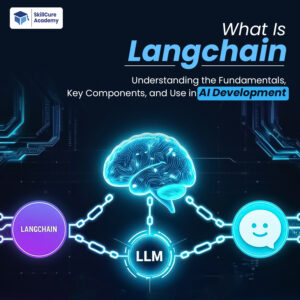

Artificial Intelligence has evolved rapidly, but building real-world AI applications—especially those powered by large language models (LLMs)—still requires structure, orchestration, and integration. This is where LangChain comes in.
In this blog, we’ll break down what LangChain is, its core components, and how it’s used in modern AI development.
What is LangChain?
LangChain is an open-source framework designed to help developers build applications powered by large language models (LLMs) like GPT. It provides tools and abstractions that make it easier to connect LLMs with external data sources, APIs, and workflows.
Instead of just sending prompts to an AI model and getting responses, LangChain allows you to build intelligent, context-aware, and multi-step AI systems.
Why LangChain Matters?
LLMs on their own are powerful—but limited:
- They don’t have real-time data access.
- They forget previous interactions (without memory systems).
- They struggle with multi-step reasoning workflows.
LangChain solves these problems by enabling:
- Context retention (memory).
- Integration with external tools.
- Structured workflows (chains and agents).
Key Components of LangChain!
1. Models (LLMs and Chat Models).
These are the core engines of LangChain applications. You can integrate models like GPT, Claude, or open-source LLMs.
2. Prompts.
Prompts define how you interact with the model. LangChain provides prompt templates to dynamically structure inputs.
3. Chains.
Chains combine multiple steps into a single workflow, enabling multi-step reasoning pipelines.
4. Memory.
Memory enables applications to retain context across interactions, making chatbots smarter and more human-like.
5. Agents.
Agents allow the AI to decide actions dynamically, such as calling APIs or querying databases.
6. Tools & Integrations.
LangChain connects LLMs to APIs, databases, file systems, and more.
7. Retrievers & Vector Stores.
These help fetch relevant data for tasks like semantic search and document Q&A.
Use Cases of LangChain in AI Development?
- Chatbots with memory.
- AI-powered search engines.
- Document question answering systems.
- Autonomous AI agents.
- Code assistants.
Advantages of Using LangChain?
- Modular and flexible architecture
- Easy integration with multiple LLMs
- Supports real-time data access
- Enables complex workflows
Limitations to Consider?
- Adds complexity for simple use cases.
- Requires learning multiple components.
- Performance depends on integrations.
Future of LangChain?
LangChain will play a key role in building autonomous AI systems, improving human-AI collaboration, and scaling enterprise AI applications.
FAQs.
1. What is LangChain used for?
LangChain is used to build AI applications that combine language models with external data, tools, and workflows.
2. Is LangChain only for developers?
Primarily yes, but no-code and low-code tools are emerging to make it accessible to non-developers.
3. Which programming languages support LangChain?
LangChain is mainly used with Python and JavaScript.
4. Is LangChain free to use?
LangChain itself is open-source and free, but using LLM APIs may involve costs.
5. What are LangChain agents?
Agents are components that allow AI to make decisions and use tools dynamically based on the task.
6. Can LangChain be used in production?
Yes, many companies use LangChain to build production-grade AI applications.