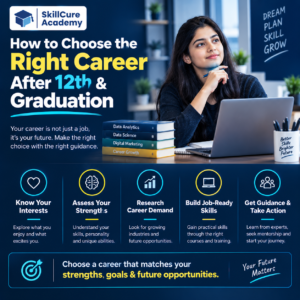

Choosing the right career after 12th or graduation is one of the most important decisions in a student’s life. With hundreds of career options available today, students often feel confused about which course, skill or profession is right for them.
Earlier, career choices were mostly limited to traditional options such as engineering, medicine, teaching, banking and government jobs. Today, the career landscape has changed significantly. Technology, digital businesses, analytics, design and other skill-based industries have created many new opportunities.
The right career should not be selected only by looking at salary. Your interest, skills, career opportunities, future demand and learning ability should also be considered.
Why Choosing the Right Career Matters
A career is not just about getting your first job. It is a long-term journey that can affect your professional growth, income and job satisfaction.
A suitable career can help you:
- Build skills that are valuable in the job market
- Find better employment opportunities
- Grow professionally over time
- Improve your earning potential
- Work in an industry that matches your interests
- Build a stable and future-ready career
On the other hand, choosing a course without understanding your interests or career goals can lead to frustration and wasted time.
How to Choose the Right Career After 12th
After 12th, students usually have many questions:
Which course should I choose? Which career has better scope? Should I choose a degree or a skill-based course?
There is no single answer for everyone. Start by understanding yourself.
1. Understand Your Interests
Think about the subjects and activities you naturally enjoy.
For example:
| If You Enjoy | Possible Career Areas |
|---|---|
| Mathematics and numbers | Data Analytics, Finance, Statistics |
| Computers and technology | Data Science, IT, Software |
| Creativity and visuals | Graphic Designing, Video Editing |
| Communication and promotion | Digital Marketing |
| Business and management | Business Analytics, Management |
| Accounting and finance | Tally, GST, Finance, SAP FICO |
| Supply chain and business operations | SAP MM, Operations |
Your interests do not have to determine your entire career, but they can help you identify suitable directions.
2. Identify Your Strengths
Your strengths are equally important.
Ask yourself:
- Am I good with numbers?
- Do I enjoy working with computers?
- Am I creative?
- Do I enjoy communicating with people?
- Do I like solving problems?
- Do I prefer analytical work?
- Do I enjoy business-related subjects?
For example, someone who enjoys numbers and problem-solving may explore Data Analytics or Business Analytics, while someone with a strong creative side may consider Graphic Designing or Video Editing.
3. Research Career Demand
Do not choose a career only because your friends are choosing it.
Research:
- Job opportunities
- Required skills
- Industry growth
- Entry-level roles
- Career progression
- Skills employers expect
- Learning requirements
A career with strong industry demand can provide more opportunities, but you should still make sure that the work matches your interests and abilities.
How to Choose the Right Career After Graduation
Graduation does not mean your career options are over. In fact, many graduates use this stage to develop practical skills and move into specialized careers.
For example, graduates from B.Com, BBA, BA, B.Sc., BCA and other backgrounds can develop industry-relevant skills and explore different career paths.
1. Evaluate Your Degree
Start by asking:
What skills have I gained from my graduation?
For example, a commerce graduate may have knowledge of accounting and business, while a science graduate may have analytical and mathematical knowledge.
You can then add practical skills that complement your degree.
2. Choose Skills Along With Qualifications
A degree can provide academic knowledge, but many modern jobs also require practical skills.
For example, someone interested in analytics may learn:
- Advanced Excel
- SQL
- Power BI
- Statistics
- Python
- Data visualization
- Real-world project skills
Similarly, someone interested in digital marketing may develop skills in:
- SEO
- Social media marketing
- Google Ads
- Meta Ads
- Content marketing
- Analytics
Combining your graduation with practical skills can make your profile more relevant to employers.
Skill-Based Careers to Consider
Students and graduates today can explore several skill-oriented career paths.
| Career Field | Important Skills | Possible Entry-Level Roles |
|---|---|---|
| Data Analytics | Excel, SQL, Power BI, Python | Data Analyst, MIS Analyst |
| Data Science | Python, Statistics, ML, SQL | Junior Data Scientist, Data Analyst |
| Business Analytics | Excel, SQL, Power BI, Business Knowledge | Business Analyst |
| Digital Marketing | SEO, Ads, Social Media, Analytics | Digital Marketing Executive |
| Graphic Designing | Photoshop, Illustrator, Design Principles | Graphic Designer |
| Video Editing | Premiere Pro, After Effects, Editing | Video Editor |
| SAP FICO | Finance, Accounting, SAP | SAP FICO Consultant/Support Roles |
| SAP MM | Procurement, Inventory, SAP MM | SAP MM Consultant/Support Roles |
| Tally & GST | Tally, GST, Accounting | Accounts Executive |
The right option depends on your educational background, interests and career goals.
Data Analytics as a Career Option
Data Analytics has become an important career area because organizations use data to understand customers, improve operations and make business decisions.
A student or graduate interested in numbers, technology and problem-solving can consider learning Data Analytics.
A practical Data Analytics learning path can include:
Excel → SQL → Power BI → Statistics → Python → Projects → Interview Preparation
Practical projects are especially useful because they help learners understand how analytical tools are used to solve real business problems.
Data Science as a Career Option
Students interested in programming, statistics, mathematics and artificial intelligence can explore Data Science.
A typical learning journey may include:
- Python
- Statistics
- SQL
- Data Analysis
- Machine Learning
- Data Visualization
- Projects
Data Science can be a strong option for learners who are comfortable with technical and analytical concepts.
Business Analytics as a Career Option
If you are interested in both business and data, Business Analytics can be worth exploring.
Business analysts use data and business knowledge to help organizations make better decisions.
Important skills include:
- Excel
- SQL
- Power BI
- Data visualization
- Business understanding
- Analytical thinking
This can be particularly useful for graduates who want to combine business knowledge with data skills.
Digital Marketing as a Career Option
Digital Marketing is another skill-based career option for students who enjoy marketing, communication, creativity and technology.
Students can learn:
- Search Engine Optimization
- Social Media Marketing
- Google Ads
- Meta Ads
- Content Marketing
- Email Marketing
- Web Analytics
Graduates can explore roles such as Digital Marketing Executive, SEO Executive, Social Media Executive and Performance Marketing Executive.
Creative Career Options
Not every student wants a technical or analytical career.
If you are creative, you can explore fields such as:
- Graphic Designing
- Video Editing
- UI/UX Design
- Content Creation
- Branding
- Motion Graphics
These careers require practical portfolios, so creating real projects while learning is important.
Should You Choose a Degree or a Skill-Based Course?
This is one of the most common questions students ask.
The answer does not have to be degree vs skill course. In many cases, they can complement each other.
| Degree | Skill-Based Learning |
|---|---|
| Provides academic foundation | Provides practical knowledge |
| Usually takes several years | Can be completed in a shorter period |
| Gives formal qualification | Builds job-oriented skills |
| Covers broader concepts | Focuses on specific industry skills |
| Useful for long-term academic progression | Useful for practical career preparation |
For students after 12th, a degree can provide a strong educational foundation while additional practical skills can help them become more industry-ready.
For graduates, skill-based learning can help bridge the gap between academic education and workplace requirements.
How Skillcure Academy Can Help
If you are looking for career-oriented skill development after 12th or graduation, Skillcure Academy offers training options across several career-focused domains.
Depending on your interests and career goals, you can explore courses such as:
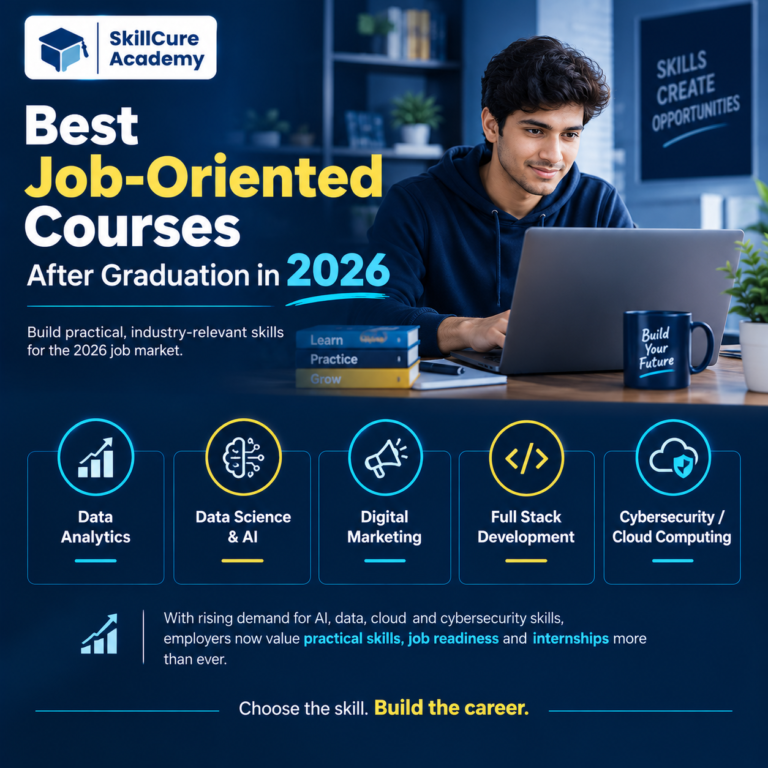
- Data Analytics
- Data Science
- Business Analytics
- Digital Marketing
- Graphic Designing
- Video Editing
- SAP FICO
- SAP MM
- Tally & GST
The goal of choosing any course should not simply be to collect another certificate. Focus on developing practical skills, working on projects and understanding how those skills are used in real professional environments.
Skillcure Academy provides online and offline learning options, allowing students and graduates to choose a learning mode according to their requirements.
A Simple Career Selection Formula
If you are confused about what to choose, use this simple approach:
Interest + Strengths + Career Demand + Skills + Long-Term Goals = Better Career Decision
For example:
Interested in numbers + enjoy technology + like problem-solving → Data Analytics
Interested in AI + programming + statistics → Data Science
Interested in business + data + decision-making → Business Analytics
Interested in marketing + communication + creativity → Digital Marketing
Interested in creativity + visual design → Graphic Designing
This approach can help you narrow down your choices instead of randomly selecting a course.
Common Mistakes Students Should Avoid
Choosing a Career Because Friends Are Doing It
Your friend’s interests and strengths may be completely different from yours. Make decisions based on your own career goals.
Choosing Only Based on Salary
Salary is important, but it should not be the only factor. Consider job responsibilities, growth, interest and required skills.
Collecting Certificates Without Learning Skills
Multiple certificates do not automatically guarantee a job. Employers also look for practical knowledge and the ability to apply skills.
Ignoring Practical Projects
Projects help you demonstrate what you can actually do. Build projects related to the career you want to enter.
Not Researching the Career
Before enrolling in any course, understand what the job involves, which skills are required and what entry-level opportunities look like.
Career Selection Checklist
Before choosing a career, ask yourself these five questions:
- Do I actually enjoy this field?
- Does this career match my strengths?
- What skills do employers require?
- Are there opportunities for growth?
- Am I willing to continuously learn?
If you can answer these questions clearly, you are more likely to make a well-informed career decision.
Frequently Asked Questions
1. How do I choose the right career after 12th?
Start by understanding your interests, strengths and preferred subjects. Then research career opportunities, required skills and future growth before selecting a course.
2. Can graduates change their career field?
Yes. Graduates can learn new industry-relevant skills and transition into different career fields. For example, graduates from different backgrounds can explore areas such as Data Analytics, Digital Marketing, Business Analytics and other skill-based careers.
3. Is a degree enough to get a job?
A degree provides an important academic foundation, but many employers also expect practical and technical skills. Adding industry-relevant skills and projects can strengthen your profile.
4. Which skill-based courses can students consider after graduation?
Depending on their interests, students can explore Data Analytics, Data Science, Business Analytics, Digital Marketing, Graphic Designing, Video Editing, SAP FICO, SAP MM, Tally and GST.
5. Should I choose a career based only on salary?
No. Salary should be one factor, but interest, skills, job responsibilities, career growth and long-term opportunities should also be considered.