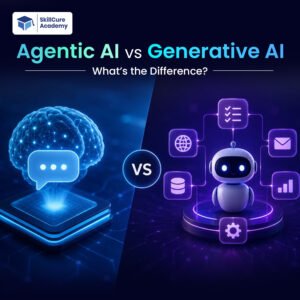

Artificial Intelligence is evolving rapidly, and two terms that are becoming increasingly important are Generative AI and Agentic AI. While both technologies are powered by advanced AI models, they are designed to solve problems in different ways.
Generative AI focuses mainly on creating content, while Agentic AI focuses on achieving goals by planning, making decisions, using tools, and taking actions. In simple words, Generative AI can help you create an answer, while Agentic AI can potentially take that answer and use it as part of a larger workflow.
Understanding the difference between Agentic AI vs Generative AI is important for students, professionals, businesses, and anyone planning a career in AI.
What is Generative AI?
Generative AI is a type of artificial intelligence designed to create new content based on the instructions and context provided by a user.
It can generate:
- Text and articles
- Images and graphics
- Videos
- Audio
- Software code
- Summaries and reports
- Ideas and explanations
Tools based on large language models can understand a user’s prompt and generate a relevant response. For example, a user can ask an AI tool to write a blog about digital marketing, generate Python code, summarize a document, or create an image prompt.
Generative AI is therefore particularly useful when the primary requirement is content creation or transformation.
Common Uses of Generative AI
Generative AI is being used across many industries for:
- Content writing
- Marketing copy
- Software development
- Customer support
- Data summarization
- Image generation
- Research assistance
- Document creation
- Education and training
For example, a digital marketing professional can use Generative AI to create a first draft of a social media post. The professional can then review, edit, and publish the content.
What is Agentic AI?
Agentic AI takes artificial intelligence a step further by allowing systems to work toward a defined goal with varying levels of autonomy.
Instead of simply responding to a prompt, an Agentic AI system can potentially:
- Understand a goal
- Break the goal into smaller tasks
- Create a plan
- Select appropriate tools
- Gather information
- Perform actions
- Evaluate results
- Adjust its approach
- Continue until the objective is completed
AWS describes AI agents as systems capable of perceiving context, planning actions, executing tasks, and adapting their behavior toward a defined goal.
For example, instead of asking an AI to write an email manually, an agentic system could potentially identify the relevant information, draft the email, check supporting data, and send it through an approved system after applying the required rules and permissions.
This makes Agentic AI particularly useful for multi-step workflows and task automation.
Agentic AI vs Generative AI: Key Difference
The simplest way to understand the difference is:
Generative AI creates. Agentic AI acts toward a goal.
Generative AI generally follows a prompt-and-response model. You provide an instruction, and the system generates an output.
Agentic AI works more like a goal-oriented digital worker. You provide an objective, and the system can determine a sequence of actions required to achieve that objective, depending on how the system has been designed.
IBM explains that Generative AI primarily focuses on creating content, while Agentic AI adds planning, decision-making, tool use, and goal-oriented action.
Agentic AI vs Generative AI Comparison
| Feature | Generative AI | Agentic AI |
|---|---|---|
| Primary purpose | Creates content | Achieves goals |
| Working style | Prompt and response | Goal, planning and execution |
| Autonomy | Usually lower | Usually higher |
| Planning | Limited or user-directed | Can plan multiple steps |
| Tool usage | Depends on integration | Core capability in many systems |
| Decision-making | Mainly provides suggestions | Can make decisions within defined boundaries |
| External systems | Limited depending on application | Designed to interact with tools and systems |
| Human involvement | Often reviews output | Can supervise or approve actions |
| Memory | Primarily conversation/context based | Can include task or persistent memory |
| Best suited for | Content generation and assistance | Complex workflows and automation |
How Does Generative AI Work?
A Generative AI system receives a prompt or input and processes it using an underlying AI model.
For example:
User: “Write a LinkedIn post about data analytics.”
The AI understands the request and generates a suitable piece of content.
The process can be simplified as:
Prompt → AI Model → Generated Output → Human Review
The user generally remains responsible for deciding what to do with the generated result.
This makes Generative AI highly useful for productivity and creative tasks.
How Does Agentic AI Work?
Agentic AI involves a broader workflow.
Suppose a company wants to automate a customer-support process.
An agentic system could potentially:
- Receive a customer request.
- Understand the objective.
- Retrieve relevant customer information.
- Check company policies.
- Decide what action is appropriate.
- Use approved business tools or APIs.
- Update the relevant system.
- Generate a response.
- Evaluate whether the task has been completed.
- Ask for human intervention when necessary.
The exact level of autonomy depends on the system’s architecture, permissions, tools, and safeguards.
AWS notes that agentic systems can combine capabilities such as LLMs, retrieval, tools, memory, and interaction with external environments.
How Generative AI and Agentic AI Work Together
Agentic AI and Generative AI are not necessarily competitors.
In many applications, they can work together.
Generative AI can provide the intelligence for understanding and generating content, while an agentic layer can use that capability as part of a larger workflow.
For example, consider software development.
Generative AI can:
- Generate code
- Explain code
- Create documentation
- Suggest solutions
An agentic system can potentially take the process further by:
- Understanding the development objective
- Breaking the project into tasks
- Generating code
- Running tests
- Identifying errors
- Revising the implementation
- Repeating the process
- Reporting the final result
This combination can make AI systems much more useful for complex tasks.
Real-World Examples of Generative AI
Generative AI is useful when the main objective is producing or transforming information.
Marketing
A marketer can use Generative AI to create:
- Blog drafts
- Ad copy
- Social media captions
- Email drafts
- Content ideas
Education
Students and educators can use it for:
- Explanations
- Study notes
- Question generation
- Summaries
- Learning assistance
Software Development
Developers can use Generative AI to:
- Generate code
- Explain programming concepts
- Debug code
- Create documentation
Real-World Examples of Agentic AI
Agentic AI is particularly useful when a task involves multiple steps and interactions with external systems.
Customer Service
An AI agent could potentially understand a customer request, retrieve account information, check policies, update a support ticket, and communicate the result.
Business Operations
An agent can be designed to coordinate repetitive workflows across different business applications.
Software Development
An agentic system can potentially plan development tasks, write code, run tests, identify problems, and make revisions.
Data Analysis
Agentic AI could potentially retrieve data, perform analysis, identify trends, generate a report, and recommend next steps based on predefined objectives and permissions.
The key difference is that the system is not limited to generating information. It can be designed to take actions within an approved environment.
Advantages of Generative AI
Generative AI offers several benefits:
- Faster content creation
- Increased productivity
- Assistance with brainstorming
- Faster coding and documentation
- Improved access to information
- Support for creative tasks
- Reduced time spent on repetitive writing
It is especially valuable when humans want AI assistance but still want to review and control the final output.
Advantages of Agentic AI
Agentic AI can offer additional benefits for complex workflows:
- Automation of multi-step processes
- Reduced manual intervention
- Faster task completion
- Continuous workflow execution
- Tool and API integration
- Goal-oriented decision-making
- Ability to adapt to changing information
However, greater autonomy also requires stronger controls. Agentic systems can interact with real systems and perform actions, so organizations need appropriate permissions, monitoring, security, and human oversight.
Which One is Better: Agentic AI or Generative AI?
There is no universal winner between Agentic AI and Generative AI.
The right technology depends on the task.
Choose Generative AI when you need:
- Content generation
- Summaries
- Brainstorming
- Writing assistance
- Image or video generation
- Code generation
- Question answering
Choose Agentic AI when you need:
- Multi-step automation
- Goal-oriented workflows
- Tool interaction
- Decision-making
- Continuous task execution
- Integration with multiple business systems
For many organizations, the best approach may be to use both.
Career Opportunities in Generative and Agentic AI
The growth of AI is creating opportunities for professionals with technical and business skills.
Students interested in this field can develop knowledge in:
- Python
- Machine Learning
- Deep Learning
- Large Language Models
- Natural Language Processing
- Prompt Engineering
- APIs
- AI Automation
- Data Analytics
- AI Agents
- Cloud Technologies
- AI Governance and Security
Learning only how to use an AI chatbot may not be enough for advanced AI careers. Professionals who understand how AI models, data, APIs, automation, and business workflows work together can build more valuable skills.
For students and working professionals, learning both Generative AI and Agentic AI concepts can provide a stronger foundation for understanding the future of AI-powered applications.
The Future of Agentic AI and Generative AI
Generative AI has already changed how people create and consume digital content. Agentic AI is extending this concept toward systems that can perform more complex tasks.
The future is likely to involve AI systems that combine:
Generative AI + Reasoning + Tools + Memory + Automation + Human Oversight
Rather than completely replacing Generative AI, Agentic AI can build upon it.
The important shift is from AI that simply provides an answer to AI systems that can increasingly work toward an outcome.
At the same time, organizations need to consider security, permissions, monitoring, accuracy, and human oversight as AI systems become more autonomous. Current industry guidance highlights that increased agency introduces additional risks because agents can interact directly with tools, data, and other systems.
For anyone planning a career in technology, understanding this transition can be valuable. The future of AI will not only be about generating content—it will increasingly involve building systems that can understand goals, coordinate tasks, use tools, and assist businesses in completing real-world workflows.
Frequently Asked Questions
1. What is the main difference between Agentic AI and Generative AI?
Generative AI primarily creates content such as text, images, code, audio, and summaries. Agentic AI focuses on achieving goals by planning tasks, making decisions, using tools, and taking actions with varying levels of autonomy.
2. Is Agentic AI better than Generative AI?
Not necessarily. Generative AI is better suited for content creation and AI-assisted tasks, while Agentic AI is more suitable for complex, multi-step workflows. Many applications can benefit from using both technologies together.
3. Does Agentic AI use Generative AI?
Yes, many agentic systems use Generative AI models, particularly large language models, as part of their reasoning, communication, and content-generation capabilities. Agentic AI adds capabilities such as planning, tool use, memory, and action execution.
4. What skills are required to learn Agentic AI?
Useful skills include Python, APIs, machine learning fundamentals, LLMs, prompt engineering, AI frameworks, databases, automation, cloud platforms, and an understanding of AI agents and tool integration.
5. Is Agentic AI the future of artificial intelligence?
Agentic AI is an important direction in AI development because it extends AI from generating responses toward completing multi-step tasks. However, its adoption will depend on factors such as reliability, security, cost, governance, and the complexity of individual business use cases.